
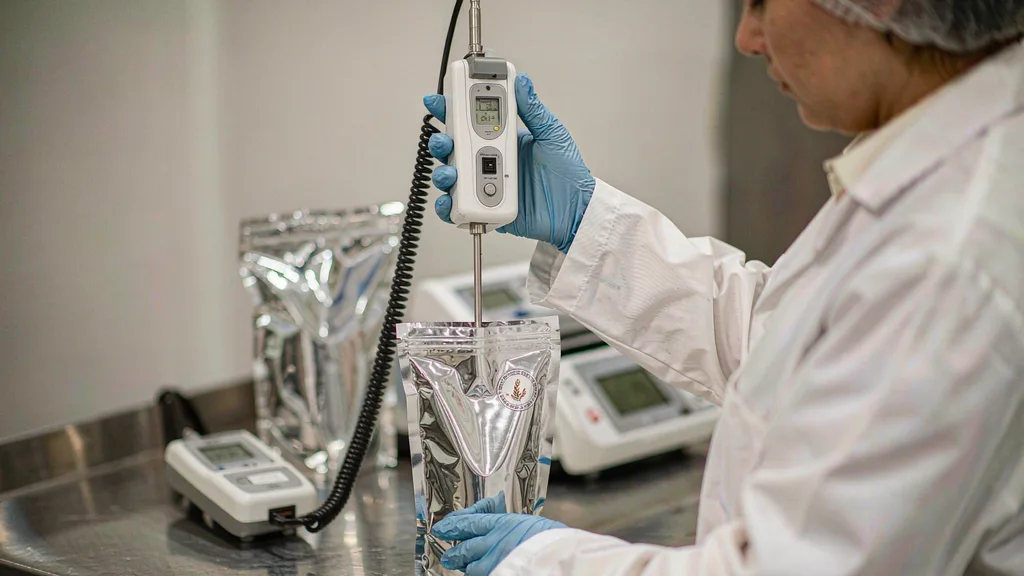
Headspace oxygen is the percentage of oxygen trapped in the gas space of a sealed pouch. Measuring it tells a food factory within minutes whether the nitrogen flush, the film and the sealing operation did their job. For modified-atmosphere products, the target is product-specific but typically sits between 0.5% and 3% — and most bad readings are caused by sampling technique, not by the packaging.
What Headspace Oxygen Tells You — and What It Does Not
The gas left inside a pouch after sealing is the residue of two processes: the gas flush or vacuum at filling, and the exchange that happens in the seconds between fill and seal. Headspace oxygen is the number that summarizes both. If it is high, one of three things went wrong — insufficient flush volume or dwell, a fill-and-seal gap that let air re-enter, or a map between product geometry and headspace that the flush never reached.
What the number does not tell you is future ingress. That is governed by the film’s oxygen transmission rate and by seal quality, both of which are separate tests. A pouch can measure 1% O₂ on day zero and still leak badly on day twenty; a low day-zero reading is a process verification, not a shelf-life guarantee. Treat the two test families as complementary: headspace confirms the fill operation, OTR and seal integrity confirm the package.
This distinction matters when defending shelf-life claims. A QA file built only on day-zero headspace data will not survive a customer audit or a complaint investigation; a file that pairs headspace trending with OTR certificates and periodic seal testing will.
Which Analyzer Should a Factory Use?
Three measurement technologies dominate. They differ in cost, speed and whether the sample survives the test.
| Method | Principle | Destructive? | Typical use |
|---|---|---|---|
| Extraction, electrochemical or paramagnetic cell | Pump headspace gas through a sensor; ambient air reads 20.9% | Yes | General QA, lowest cost per point |
| Optical fluorescence spot | Sensor patch glued inside; read through film with an optode | No | R&D, transparent or translucent packs |
| Laser (TDLAS) headspace analyzer | Tunable diode laser absorption through the headspace | No | High-speed 100% checking on MAP lines |
For most food factories, an extraction analyzer is the workhorse: rugged, portable, calibration is a two-point check against ambient air at 20.9% and ideally a certified zero gas. Optical spots earn their cost in development work where the same package must be tracked over time. Laser analyzers are the standard on high-speed MAP lines running thousands of packs per hour with automated sampling.
Whichever technology is chosen, verify the instrument against ambient air before each session and log the check. An analyzer that drifted overnight has produced more false packaging alarms than any actual film defect.
How to Sample Without Corrupting the Reading
Most bad data comes from technique. The rules that matter:
- Sample within a defined window after sealing — commonly within 15–30 minutes — and record the actual time. Residual oxygen can shift as product absorbs or releases gas; comparing a 2-minute reading against a 40-minute reading is meaningless.
- Puncture through the seal area, not the film body, and only after confirming the needle path does not pass through product. A needle wick or blockage produces a low-biased reading that looks like a great flush.
- Purge the sampling line per the instrument’s specified volume before trusting the display. Long tubing on a small headspace dilutes the sample with ambient air.
- Compress nothing. Squeezing a pillow pouch during measurement forces headspace gas through the needle path and drags in replacements.
- Reject and re-test in pairs. If a reading is far off trend, re-puncture adjacent to the first hole. Single outlier points without confirmation generate endless wasted investigations.
Set the sampling plan like any other process check: a defined number of packs per head per shift, plus a mandatory check after every film splice, gas supply change or format changeover. Trend the numbers on a control chart rather than storing them as isolated pass/fail values.
What Target Should Each Product Carry?
Targets come from the product’s degradation chemistry, not from the analyzer’s resolution. Commonly used starting points:
| Product | Typical headspace O₂ target | Reason |
|---|---|---|
| Whole bean and ground coffee | < 2%, best practice < 1% | Aroma oxidation; beans also degas CO₂ |
| Fried snacks and nuts | < 1% | Oil rancidity is oxygen-driven |
| Cured and fresh meat (MAP) | Per recipe, often 0.5–2% | Color and microbiological stability |
| Fine powders (matcha, milk powder) | < 2% | Oxidation plus caking risk |
| High-moisture ambient meals | Recipe-specific | Often paired with CO₂ for microbiology |
Two cautions. First, a target copied from a competitor’s artwork is not a specification; validate it against your own accelerated storage data. Second, some products consume or release gas after sealing — coffee degassing raises pressure, fresh produce respiration changes composition — so the day-zero number and the day-thirty number measure different things and both belong in the file.
For the film side of the equation, our guide to MAP packaging film specification covers how OTR targets translate into structure choices, and the packaging film qualification protocol shows how to verify a new film before committing a production run.
How Headspace Data Connects to Seal Quality and Complaints
When a retailer complaint reports stale or rancid product, headspace history is often the fastest discriminator. A batch with in-control day-zero readings and a sound OTR certificate points the investigation toward the distribution chain — temperature abuse, puncture, or seal damage in transit. A batch with drifting or elevated readings points in-house, toward flush volume, line speed or seal parameters.
Seals and headspace interact directly at start-up. After a film change or a temperature adjustment, seals can look acceptable while trapping a slow micro-leak that bleeds air into the headspace over days. That is why the start-up sequence should always pair the first-piece seal check with a headspace reading taken after a defined dwell, not immediately after sealing. Our seal integrity testing comparison covers the destructive methods that confirm what the headspace trend only hints at.
The practical loop is simple: headspace trend flags a shift, seal testing confirms or clears the seals, OTR documentation clears the film. Factories that run all three as routine close complaint investigations in days instead of weeks.
FAQ
What is headspace oxygen in food packaging?
It is the concentration of oxygen in the gas volume trapped inside a sealed package above the product. On modified-atmosphere lines it is measured with an analyzer, expressed as a percentage, and used to verify that the gas flush worked. Ambient air is about 20.9%, so a sealed pouch reading near that value effectively received no flush at all.
How quickly after sealing should headspace oxygen be measured?
Within a defined window, commonly 15–30 minutes, and the elapsed time should be recorded with the result. Some products absorb or release gas after sealing, so readings taken at different times are not comparable and a drifting trend may reflect product behavior rather than packaging failure.
Does a low headspace oxygen reading guarantee shelf life?
No. It confirms the filling operation on the day of measurement. Long-term protection depends on the film’s oxygen transmission rate and on seal integrity, which are separate tests. A complete shelf-life defense pairs day-zero headspace data with OTR documentation and periodic seal testing.
How many pouches should be tested per shift?
Enough to catch process drift, commonly a fixed sample per sealing head per shift, plus mandatory checks after every gas supply change, film splice or format changeover. Results should be plotted on a control chart; isolated pass/fail points hide slow trends that predict complaints.
Why do two analyzers give different readings on the same pouch?
Calibration drift and sampling technique account for most discrepancies. Both instruments should pass an ambient-air check at 20.9% before use, the sampling lines should be purged, and the puncture locations should be comparable. If differences persist after those checks, one instrument needs zero-gas calibration or service.
At 至纯包装 (PURESTPACK), we supply headspace and OTR data alongside film lots so that food factories can connect day-zero measurements to the material that produced them, making trend investigations faster and audit files complete.
More reading on this site: heat seal parameters and troubleshooting, packaging film roll defects and coffee stick packaging film. For the brand-side view of gas flushing and oxygen control, see nitrogen flush packaging for coffee and active packaging with oxygen scavengers.