
The fitment weld fails first on most BIB filling lines, not the film. Film defects usually announce themselves at the first fill, while a weak weld passes the line, passes the pallet check and opens a slow leak three days into a chilled store room. That is why BIB filling trials are judged on the collar rather than on the flat of the bag. This article walks through the failure sequence seen on sauce and paste lines in food service, and the trial data that separates a real weld from a good-looking one.
Which Point Fails First in a Food Service BIB Line
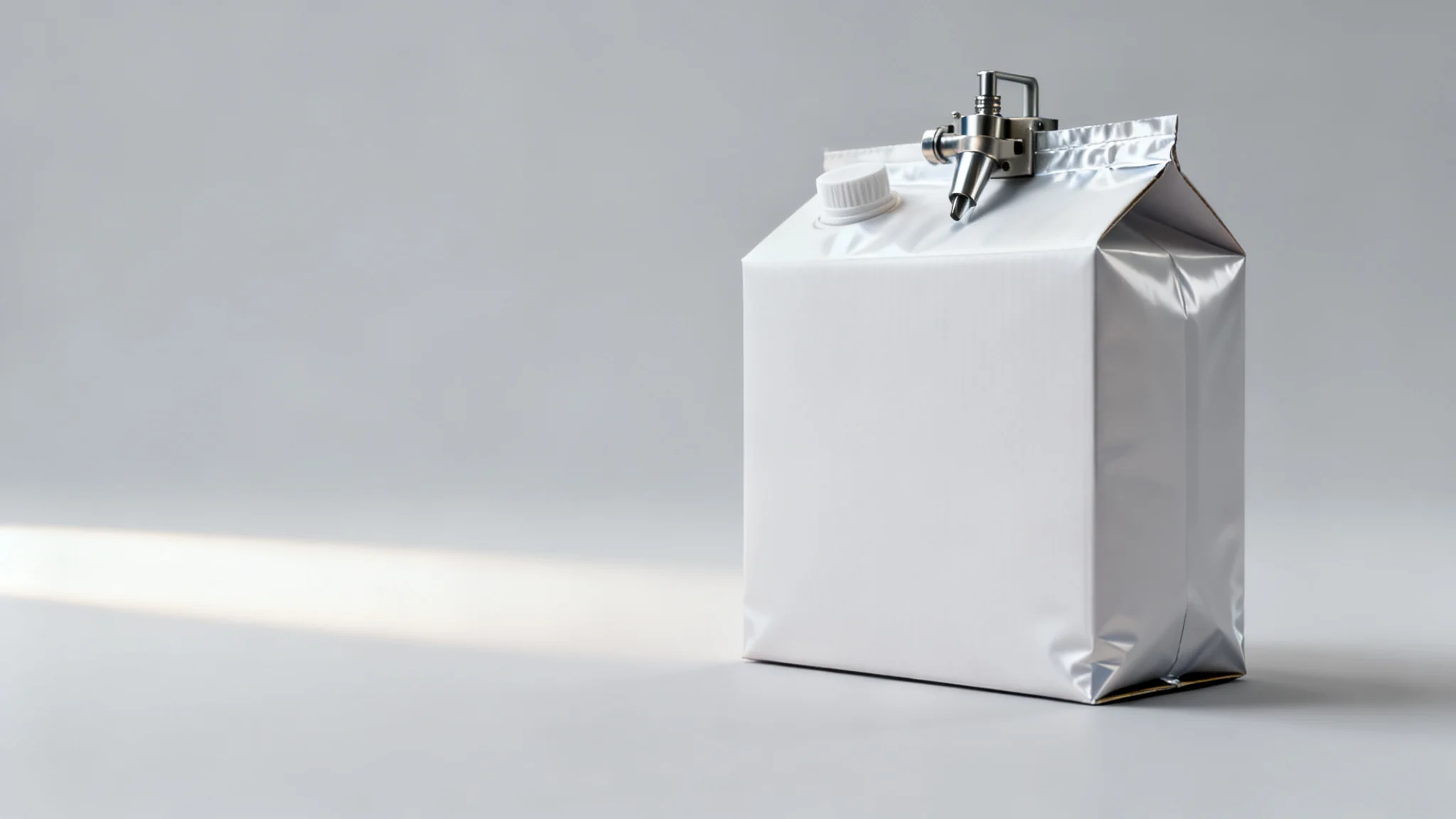
In order of frequency, the failures that reach the customer are: a channel at the fitment collar, sauce contamination trapped under the weld, a cap that no longer seals after the first opening, and finally a film puncture or flex crack. Operators watch the fin seal, which is easy to see, while the collar sits under the fill head. This applies to gravity-filled lines running pumpable sauces; a pail line is a different case.
A line audit that starts at the collar finds most problems before the first pallet ships. Check it after welding, after filling, after capping and after the first opening in the kitchen.
Why Fill Port Hygiene Decides the First Failure
Sauce splashes. A fill nozzle that pulls away with a drop hanging from it leaves product on the collar face, and the cap or the plug then closes onto that film of sauce instead of onto clean PE. The result is a seal that holds pressure at the factory and weeps in the chiller, because cooling changes the viscosity of the trapped residue and the closure relaxes.
The fix is mechanical before it is procedural. Set the fill level so the nozzle tip stays clear of the collar, use a drip tray or a blow-off at the head, and give the operator a light and a mirror at the collar station. A line that relies on an operator noticing a smear on a moving bag will ship contamination.
Where Fitment Welding Goes Wrong on the Line
Three process variables account for most weak welds. The first is jaw alignment: a fitment that sits a fraction off centre loads one side of the collar more than the other, and the weak side opens under vacuum. The second is dwell against temperature: a short, hot weld can pass a pull test and still leave a brittle ring that cracks on the drop. The third is film tension at the weld station, where a bag that is slightly slack folds a wrinkle into the collar and creates a path along the fold.
Weld appearance is a useful screen but a poor proof. A collar that looks smooth and glossy has melted; it has not necessarily bonded to the same depth on both flanges. Coupon testing off the line, pulled to the method in ASTM F88, shows if the break is adhesive at the interface or cohesive inside the sealant.
Does Cap Torque Change Re-Seal Behaviour?
Yes, and the effect shows up after the first opening rather than at the factory. A cap applied too tight deforms the sealing lip, so the second closure no longer meets the same surface. A cap applied too loose leaves the tamper band intact but the plug short of its seat, and the pack leaks in transit. Both faults look identical on a filled, unopened bag.
Torque is also a moving target across a shift, because the applicator head warms up and the cap material relaxes. Sample the torque at the start, middle and end of a run and after a chiller hold, and treat the spread as the real specification rather than a single reading.
How to Run a Fill Trial That Proves the Seal
- Fill with the production sauce at the production temperature, not with water or a simulant.
- Pull five bags per head per shift and record collar appearance before and after cooling.
- Hold the filled bags at the storage temperature the customer uses for the same period the pallet will wait.
- Open and re-close the tap ten times on two bags, then stand them on their side overnight.
- Cut the collars open and look for product tracks between the weld flanges.
Step four is the one most trials skip, and it is the step that predicts what a kitchen will report. A pack that fails a re-closure test has only passed the factory’s test.
Causes, Symptoms and Fixes at a Glance
| Symptom | Likely cause | First check |
|---|---|---|
| Damp carton corner after two days | Channel at the collar | Jaw alignment and film wrinkle at the weld |
| Leak only after the tap is re-closed | Cap torque out of range | Torque spread across the shift |
| Brown staining around the fitment | Product trapped under the weld | Fill level and nozzle drip |
| Leak at the fin, not the collar | Seal bar contamination or pressure | Seal bar condition and product splash |
Line Data Worth Recording During the Trial
Record the fill temperature, the sauce batch, the head used, the jaw set temperature, the dwell, the cap torque, and the storage temperature during the hold. Six numbers and a product reference turn a failed trial into a diagnosis; without them, the second trial repeats the first. Keep a filled reference bag from each head, labelled with the same data.
Conclusion
BIB filling problems concentrate at the fitment collar, and they are predictable once the line is watched in the right order. Set the fill level so the collar stays clean, hold jaw alignment and film tension steady at the weld, and treat cap torque as a range that drifts across a shift. Prove the format with a trial that includes a chiller hold and repeated re-closure, and record the six line values with the sample. A supplier who cannot describe that sequence is quoting a bag, not a filling process. For the pouch side of the same format, the custom seasoning packaging range and soybean paste packaging pouches show the structures usually compared with a BIB line.
Frequently Asked Questions
Why does a BIB bag leak at the fitment only after a few days in the chiller?
A thin channel at the weld is the usual cause, and it only opens once the pack is cold. Cooling thickens the sauce trapped between the flanges and relaxes the closure as the materials contract, so a collar that holds at the factory weeps in the chiller. The useful check is a chiller hold before the pallet ships, followed by cutting the collar open to look for product tracks. If a track is present, correct the weld before adjusting anything else on the line.
Should the bag be filled before or after the fitment is welded?
Weld first, then fill, in almost every food service layout. Welding after filling puts heat next to the product and makes the collar impossible to inspect, and it also distorts a bag that is already carrying weight. The exception is a format built around a large drum spout, where the fitment is inserted into a pre-made neck. In that case the neck tolerance becomes the critical dimension, so measure it on incoming bags rather than on the finished pack.
What fill temperature should the line run at?
Run at the temperature the sauce requires for its own preservation, not at the highest temperature the film tolerates. Overheating a BIB filling line stiffens the sealant at the collar and can pre-shrink the film around the fitment, which shows up later as a wrinkled weld. Confirm the temperature with the sauce maker’s process sheet, then check the collar appearance and the pull result at that temperature rather than at a convenient one.
How many re-closures should a tap survive before replacement?
Match the figure to the kitchen’s real opening count rather than to a fixed cycle rating. Build it from the service routine: count how often a kitchen opens the box in a working day, multiply by the days the box stays in use, and add a margin for shared kitchens. Then test that count on your own filled bags. A tap that passes the customer’s real closure count is the only one worth specifying.