

2025 Food Packaging Regulations: Understanding the Industry Change from the Start
The 2025 food packaging regulations are now on the horizon, and for China’s packaging industry they represent one of the most sweeping compliance overhauls in recent memory. The updated framework touches everything from film chemistry and label design to environmental requirements. For any company buying food pouches, getting familiar with the 2025 rules early is not merely a matter of staying within the law — it is a strategic move that lets you ride the shift instead of reacting to it. Below we look at four angles — materials, labeling, printing and action plans — to give you the full picture at a glance.
According to the State Administration for Market Regulation, the guiding principle behind the 2025 food packaging regulations can be summed up in three words: safer, clearer and greener. The practical effect is that food producers, brand owners and packaging converters must all revisit the solutions they have relied on until now.
1. Impact of the 2025 food packaging regulations on material selection
Materials face the strictest scrutiny under the 2025 food packaging regulations. Safety thresholds for food-contact substances have been raised across the board, with far tighter caps on plasticizers, heavy metals and other contaminants. In day-to-day terms, films made from PET, PE and PP will increasingly have to be backed by detailed migration test reports — a development that mirrors what is already happening internationally, including the migration-testing requirements found in the EU’s Framework Regulation (EC) No 1935/2004 on food contact materials.
In addition, the revised rules push hard for recyclable and biodegradable materials, a signal with major implications for the whole supply chain. Choosing a film now means balancing environmental compliance against cost and performance rather than optimizing for one factor alone. If you are evaluating different substrates side by side, our Pros and cons comparison of 6 common packaging materials offers a handy starting point.
Finally, the regulations put concrete numbers on physical properties such as interlayer peel strength and heat seal strength for composite films, which pushes factory quality control to a higher standard.
2. New labeling requirements under the 2025 food packaging regulations
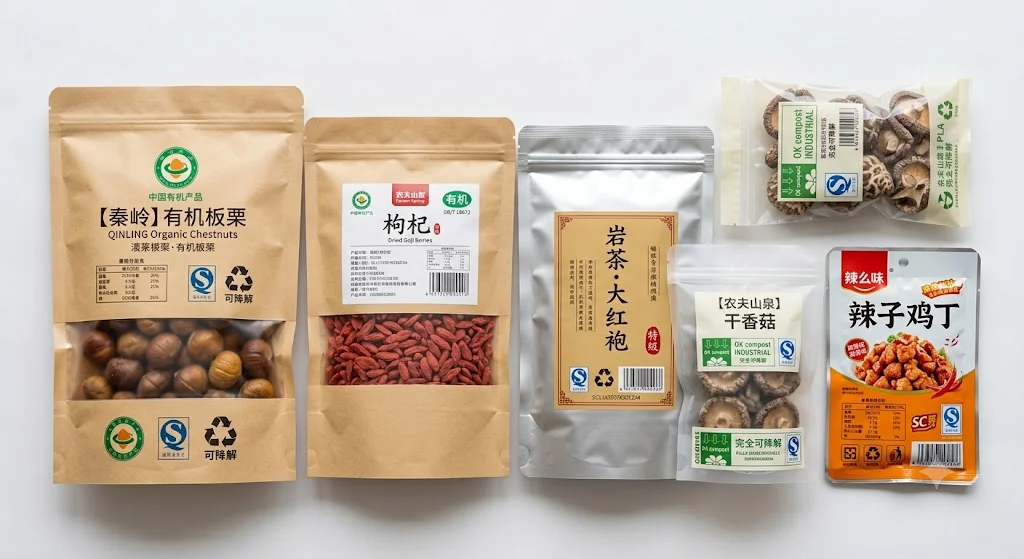
Labeling is the second front where the 2025 food packaging regulations make themselves felt. Mandatory on-pack information now includes material details, recycling symbols, production dates and batch numbers, and the rules spell out minimum font sizes and where these elements must sit. Packs made with recycled or biodegradable inputs additionally need to show the relevant certification marks and the intended scope of use. Because pouch formats differ, label placement does too; you can find a useful breakdown in our Food Pouch Types and Label Layout Guide.
The nutrition facts panel has also been redesigned for a cleaner information hierarchy. That means brand teams and packaging designers will need to cooperate closely to fit every compliance element into a constrained space without sacrificing readability. For the fundamentals of pouch selection behind all of this, our 5 Key Factors in Choosing Food Packaging Pouches is well worth revisiting.
3. How the 2025 food packaging regulations affect printing processes
Printing is another area caught up in the 2025 food packaging regulations. Ink safety is now a headline requirement: food packaging must be produced with benzene-free and ketone-free inks that meet food-safety standards. Residual solvent levels are part of routine testing as well, which puts gravure and flexographic operations under closer supervision.
For brands that order small batches, the case for digital printing grows stronger under the new regime. With no plates, no solvent residue to worry about and full variable-data capability, digital offers a head start on compliance almost by design. Once the rules are in force, more buyers are likely to turn to digital for sampling and short-run procurement.
4. How companies should respond to the 2025 food packaging regulations
Confronted with the 2025 food packaging regulations, there are four practical moves that put you ahead of the curve:
1. Comprehensively audit existing packaging: go through every current specification one by one — material compliance, label completeness, validity of test reports — and build a replacement timeline for anything that falls short.
2. Validate with samples in advance: any material switch needs thorough sampling, so set aside at least 15–20 days to confirm the new packaging behaves well on your line. For the governing standards, check the State Administration for Market Regulation food-contact material standards.
3. Choose compliant suppliers: partner with converters that have real in-house testing capability and insist on complete third-party documentation covering migration, solvent residue and other critical indicators.
4. Build compliance archives: keep a full compliance file for every pack you buy — material certificates, lab reports, approved label artwork — so everything is ready to show an inspector at a moment’s notice.
Summary: the 2025 food packaging regulations are both a challenge and an opportunity
Rolling out the 2025 food packaging regulations will carry short-term costs and add management pressure, yet over time it acts as a filter that separates the prepared from the unprepared. Businesses that move early on compliant packaging will gain stronger brand trust and more room to grow. Treating compliance as an endpoint would be a mistake — the real value lies in using it as a springboard for brand renewal.
Looking for 2025 food packaging regulations-compliant packaging solutions? Welcome to Contact PurestPack. We provide one-stop service from material selection and compliance testing through mass production, helping your products transition smoothly into the new regulatory era.