

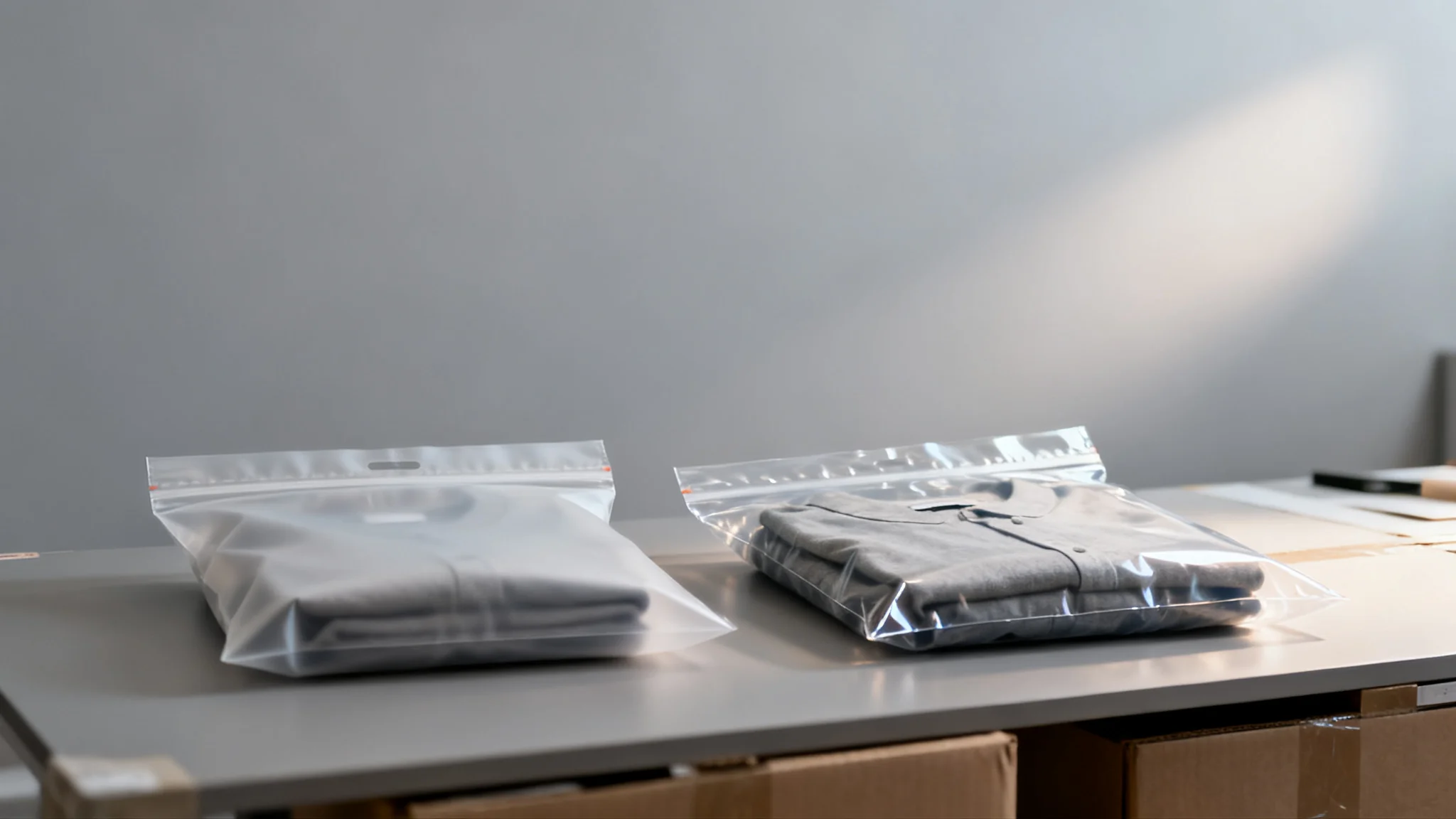
A frosted apparel bag is not a clear bag with a cosmetic finish. The matte surface that gives the pack its soft look is produced either by a mineral filler or an embossed texture in the film, or by laminating a matte skin layer on top. Each route changes how much light scatters, how well ink bonds, and what the seal looks like after the jaws close. Buyers who compare only the sample swatch usually discover the difference at the sealing station, not on the shelf.
Key Takeaways
- Haze and clarity are different measurements. Frosted film raises haze; a matte surface can also lower clarity, which is what makes print look softer.
- Ink bonds differently to a rough surface than to a glossy one. Tape adhesion testing on the actual substrate is the only reliable check.
- Seals on frosted film read as a white band. That band is a design element, not a defect, and it has to be planned into the artwork.
- Match the film to the shelf and the pack line together. A film that prints beautifully can still seal badly on an existing bar profile.
What Does Haze Actually Measure?
Haze is the share of transmitted light that scatters more than a defined angle instead of passing straight through, and it is measured under ASTM D1003 together with total luminous transmittance. Two films can transmit the same amount of light and still look different, because one scatters more of it. Film grades behind both options are compared in this pouch material guide. That is the whole reason a frosted bag looks milky while a clear bag looks transparent, even when both sit at a similar light transmission.
Clarity is the companion measurement. It describes how sharply an image is seen through the film, and it drops when surface texture scatters light at small angles. A heavy matte finish can keep transmittance high and still make a printed logo look soft at reading distance. When a brand says the print lost definition after switching to matte, haze and clarity explain the change better than a claim about film quality.
Does Print Adhesion Change on Frosted Film?
Yes, and the change runs both ways depending on how the matte surface was made. A mineral-filled matte layer presents a micro-rough surface with lower effective contact area for the ink, so the ink needs a formulation that wets into the texture. An embossed or matte-lacquered surface behaves differently again, because the ink sits on a coated skin rather than on the base polymer. Neither is worse by default; both need the ink and the treatment matched to them.
Surface treatment decays. A film treated for print adhesion loses some of that treatment in storage, especially in warm warehouses, so a roll that printed well last quarter may not hold ink the same way six months later. ASTM D3359 tape adhesion testing gives a repeatable rating that can be run on incoming rolls and on the finished print. If the tape pulls ink from a matte panel and leaves a glossy panel clean, the problem is the ink and surface pair, not the press operator.
Why Do Seals Turn White on Frosted Film?
Because the heat and pressure of the seal bar flatten the matte texture in that band, and flattened matte film scatters light differently from the surrounding area. The effect is optical. On a heavily textured film the change is obvious; on a light matte it reads as a faint line. Air trapped in the texture during sealing can add a milky look on top of the optical change, which is why a worn or crowned seal bar makes the band look worse.
Plan for it in the artwork. If the seal band falls inside a printed panel, the white line crosses the graphic and reads as a mistake. Design the print so the seal sits on an unprinted margin or on a colour that tolerates a lighter band. Where the seal must cross print, ask for a seal-through-print trial on the actual film, because ink chemistry changes how the band behaves.
Which Film Reads Better on the Shelf?
It depends on what the pack has to show. Clear film wins when the garment itself is the selling point and the fold is clean: shirts, knitwear and anything with visible texture or colour detail. Frosted film wins when the garment is creased, when the pack holds accessories or hardware, or when the brand wants a soft, premium surface with a large printed area. Frosted also photographs better under mixed store lighting, because it spreads glare instead of returning a hot spot.
| Property | Clear film | Frosted film |
|---|---|---|
| Product visibility | High, wrinkles visible | Diffused, wrinkles softened |
| Print contrast | Sharp edges on gloss | Softer edges, lower peak contrast |
| Glare under store light | Visible hot spot | Spread, less glare |
| Seal appearance | Transparent band | White or milky band |
| Ink bond risk | Treatment-dependent | Texture and coating-dependent |
Where Each Film Choice Fits
Frosted suits programmes where the pack carries a large printed area and the garment is secondary: accessories, socks, folded basics, gift sets and anything sold as a coordinated range. Clear suits programmes where the customer is buying the fabric and needs to see it. Mixed programmes are common, and they are where the specification gets sloppy: the same artwork is applied to both films and one of them loses its type weight in print. Split the artwork by substrate rather than scaling one file, and ask the converter to quote the two films as separate specifications; the custom apparel bags range is a useful reference for how far a printed panel, zip and header can be combined.
Recycling and material disclosure also enter the decision. A laminated matte skin makes the structure harder to describe in a single-material claim, and EU-facing brands increasingly have to document packaging material under the European packaging waste rules. If a mono-material story matters for the market, a matte finish produced inside the same polymer family is easier to defend than an added skin layer.
Trial Order Checklist
- Two film samples at the same gauge, one clear and one frosted, from the same converter.
- The same artwork printed on both, so print contrast can be judged side by side.
- Seal trials at the production bar profile, not a lab sealer.
- A tape adhesion pull on both substrates, rated the same way.
- Filled packs hung for a week at the store fixture to check the seal band and the header.
- A note of which film the artwork file was adjusted for.
Sample swatches are not enough. A frosted swatch tells you what the film looks like; it does not tell you how your ink sits on it or how your bar closes it. The trial has to carry print and seal together, and it is worth running through the bag converting services you will actually use, since plate count and bar profile differ between suppliers.
Conclusion
Choose the film from the shelf requirement first, then verify it on the press and the sealer. Clear film keeps the garment legible and exposes wrinkles; a frosted apparel bag softens both, hides handling marks and turns the seal into a visible design element. Judge ink adhesion and seal appearance on the real substrate, adjust the artwork per film, and keep the trial short but complete. Where a programme needs both looks, treat them as two specifications rather than one file printed twice.
Frequently Asked Questions
Does a frosted apparel bag hide the garment too much?
It hides creases more than it hides the product. Frosted film still transmits most of the light, so colour and silhouette read through it, while sharp folds and handling marks soften. That suits accessories, folded basics and gift sets. It does not suit a garment where the customer is judging fabric weave or a specific shade, because the diffused surface shifts how the colour reads under store lighting. Test it the way a customer will: fill the bag, hang it on the fixture, and look at it from a metre away under the store’s own lamps rather than on a desk.
Can we print the same artwork on clear and frosted film?
You can, but expect the frosted version to look softer. The matte texture scatters light at the edges of every element, so fine type and thin rules lose definition first, and photographs lose contrast before solid colour does. Adjust type weight and contrast for the frosted file, then proof both. Printing one file on both substrates is the most common reason a matte pack looks washed out next to its glossy sibling.
Why does the ink peel only on the matte panels?
Because the matte surface presents a different bonding surface, and the ink was matched to the glossy one. A micro-rough or coated surface needs an ink that wets into it, and the treatment level on that side may differ from the reverse. Run a tape pull on both panels of the same print. If only the matte panel fails, change the ink or the treatment rather than the press settings. Pull the tape slowly and at a consistent angle, and rate the removed ink against the same reference chart each time, so the result is comparable between rolls and between suppliers.
Is the white seal band on frosted film avoidable?
Not completely, and it should be designed around instead. Heat and pressure flatten the texture inside the seal, so that band always scatters light differently from the surrounding film. A lighter matte finish, a narrower seal, or keeping print off the seal zone all reduce the visible contrast. Approve the artwork only after a seal trial on the real film at the production bar profile, so the band width on the proof matches what the line will produce.