
A heavy duty pet bag fails at two joints before it fails anywhere else: the handle weld and the bottom seal. Handle failures show up as a tear at the weld edge or a handle that peels away on the first lift; bottom seal failures show up as a split corner after a week on a pallet. Both are process problems as much as material problems, and both can be caught on the line if the checks are run in the right order. This is the verification sequence we would run on a 10 kg format before it goes to market.
What a Handle Weld Has to Hold
A welded handle is a small bonded joint that carries the whole filled mass. On a 10 kg bag the weld sees 10 kg in tension every time the pack is lifted, plus a dynamic factor when the bag is swung or set down hard. Three things decide the result: polymer compatibility between the handle strip and the bag’s outer layer, weld geometry, and the amount of film left intact under the weld.
Compatibility is the part that cannot be fixed at the sealing jaw. A polyethylene handle strip welds readily to a polyethylene outer layer; the same strip on a PET or metallised outer surface needs an adhesive layer or a different handle material, and a joint that looks continuous can be a tack weld with almost no peel strength. Where the handle is welded through the print, the ink film sits inside the joint and acts as a contaminant, so welds over heavy ink coverage deserve their own check.
Geometry matters as much as strength. A narrow bead concentrates load on a thin line; a wider bead with rounded ends spreads it. Over-welding thins the film under the bead until the joint is strong but the bag around it is not, which produces the confusing result where the handle stays attached and the bag wall tears beside it.
Where the Bottom Seal Fails First
The bottom of a flat-bottom bag is not one seal. It is a set of folds where the body, the gusset and the bottom panel converge, and at each corner four layers of film meet. At a four-layer corner the same jaw pressure and dwell that produced a good seal on the two-layer panel may not be enough to fuse all four plies, so the corner bonds partly and holds only until load is applied.
Side-gusset bags have the same problem in a different place: the bottom seal crosses the gusset fold, and the fold has to be sealed through four layers along a line that is not flat. A wrinkle trapped in that line becomes a channel. On both formats, contamination is the second failure route — a dust or litter particle inside the seal area keeps the sealant surfaces apart, and the resulting bond is weaker than the numbers from a clean lab strip suggest.
Why Stacking, Not Lifting, Breaks Weak Seals
Lifting and stacking load the bag in opposite ways, which is why one passing test says little about the other. Lifting is a short tensile event applied at the handle. Stacking is a sustained compressive load applied to the bottom bag’s face and corners, and it lasts for weeks at whatever temperature the warehouse reaches.
Sealant polymers creep under sustained load, and creep accelerates with heat. A corner that passed a peel test on the day of filling can thin and open by the time the pallet is unwrapped at the retailer, with no damage visible from the outside until the bag is lifted and the contents run out. Any verification plan that only pulls handles is measuring half the duty cycle.
Verification Sequence Before a Format Goes to Market
Run the checks in this order, because each one depends on the previous result being sound:
- Incoming check on the handle strip and the bag film: gauge, and a weld trial on scrap to confirm that the two materials actually bond under production settings.
- First-off handle pull on a filled bag, pulled to failure rather than to a pass mark, recording where it fails — weld peel, handle break, or bag wall tear.
- Bottom seal strips cut from the four-layer corners of a filled bag and pulled per a method such as ASTM F88, noting failure mode as well as peak force.
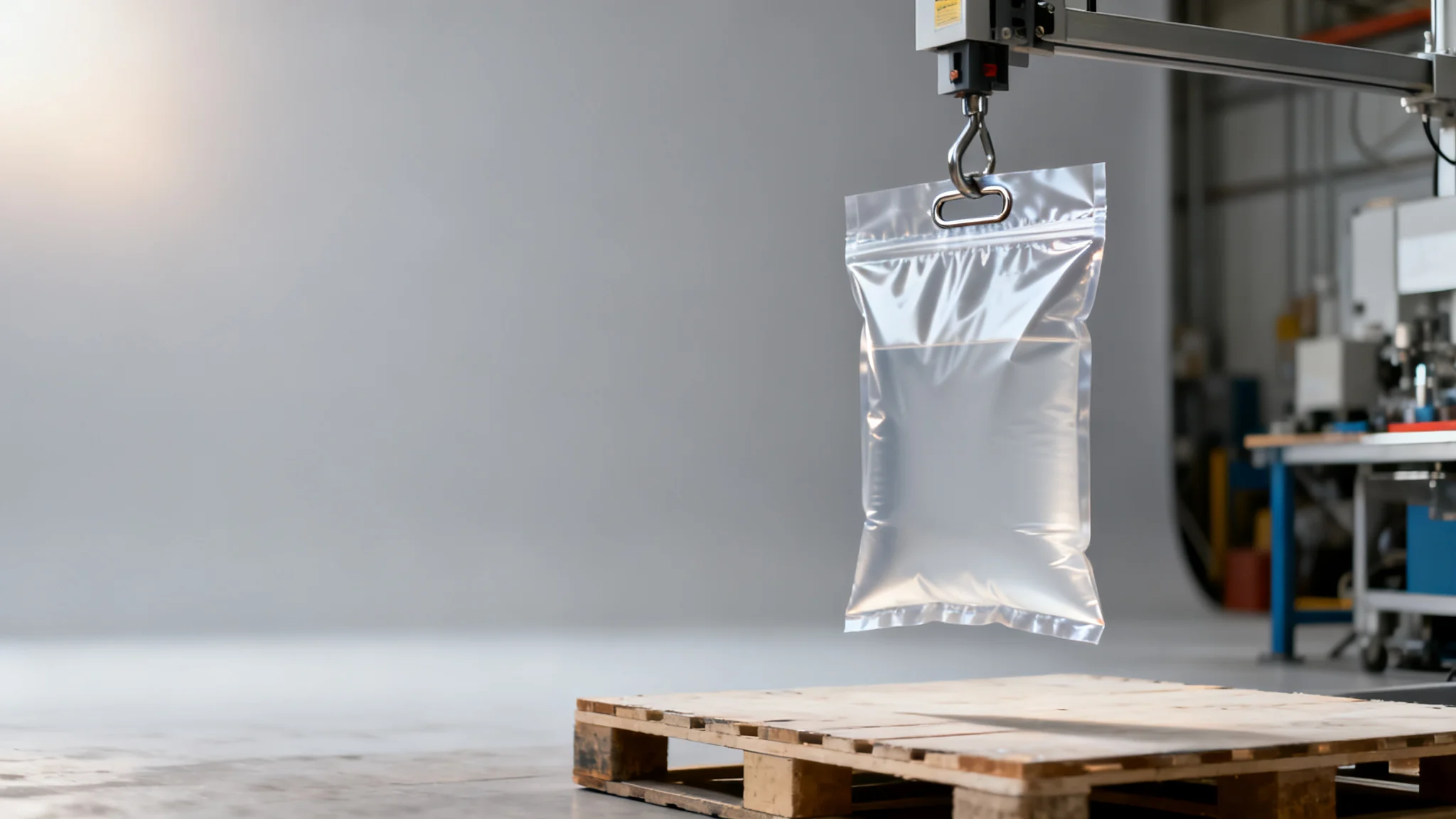
- Sustained hang of a filled bag by its handle at elevated temperature, long enough for creep to express itself rather than for a quick break to appear.
- Drop test on the bottom seam and on a corner, following a method such as ASTM D5276, then cut the dropped bags open at the impact point.
- Vibration and compression as a pair, since distribution damages seals through repeated small loads before a single large one. A vibration method such as ASTM D999 followed by compression reproduces that sequence.
How Many Bags Should a Run Be Tested On
There is no universal sample size, and quoting one would be misleading. The number follows lot size, the criticality of the failure — a split 10 kg litter bag is a cleanup, not a reseal — and how stable the process has been. What can be standardised is the pattern: first-off, mid-run and last-off on every shift, with the pulled strips retained and labelled so a later complaint can be compared against the run that produced it.
Where the format is new, or where a film or handle supplier has changed, treat the first production run as a trial and test at a higher rate than steady state. Reducing the rate afterwards is a decision that should be recorded, not a habit that drifts.
When a Weld Passes at the Plant and Fails in the Field
Most field failures that cannot be reproduced at the plant share three causes. The plant test is run on a fresh bag at room temperature, while the field load arrives hot, after days under compression. The plant pulls the handle vertically, while a customer lifts at an angle and swings. And the plant tests a bag that has just left the jaw, while the field tests a bag whose sealant has had weeks to relax.
Reproducing any one of those conditions usually turns an unexplainable complaint into a measurable result. If a complaint cannot be reproduced even then, the next thing to examine is the joint itself — cut a failed handle open and look at the bond line, since a smooth peeled surface and a torn cohesive surface point at completely different process settings.
Scope of This Method
This applies to pre-made heavy-duty pet bags in the 5 to 15 kg class, filled with dry litter, kibble or other free-flowing solids, with either a welded handle or a die-cut reinforced handle. It covers bags run on pre-made pouch lines and on form-fill-seal machines where the handle is applied offline. Both formats that carry this weight class in practice — the handled flat bottom pouch and the smaller three-side-seal litter bag — run through the same checks. It does not cover woven polypropylene sacks, valve bags or formats above 15 kg, where the load path is carried by a different construction and the test set changes accordingly.
Key Takeaways
- Handle welds fail through incompatibility or geometry, and both show up in a pull-to-failure test, not a pass mark.
- Four-layer corners and gusset crossings are the weakest points of any bottom seal.
- Stacking and lifting must be tested separately because they load the pack in opposite directions.
- Sampling pattern matters more than sample size: first-off, mid-run and last-off, with retainers kept.
Conclusion
Handling verification on a heavy-duty pet bag is a sequence, not a single test. Confirm the materials bond, pull the handle to failure and read the failure mode, then test the bottom seal at the corner where four layers meet. Only after those pass does stacking and distribution testing mean anything, because compression will simply widen a defect that already exists.
Run the sequence on the actual filled mass and at the temperature the pack will meet in storage. A format that survives sustained hang, corner drop, vibration and compression is ready to scale; one that fails tells you which joint to change, and it is almost never the film as a whole. Format and seal construction for this weight class are grouped on the pet food packaging solutions page, and the shoulder and gusset choices behind them are covered in the guide to large pet food bags.
Frequently Asked Questions
What pull value should a handle weld reach?
There is no universal figure, and any supplier quoting one without knowing the filled mass is guessing. Set the requirement from the filled mass with a defined safety margin, then confirm it by pulling to failure and recording where the joint breaks. A weld that peels cleanly off the bag wall and one that tears the surrounding film can show the same peak force while behaving very differently in the field.
Should the bottom seal be checked before or after filling?
After filling, always, because filling changes the seal. The jaw closes over a flat panel at the top of the bag but over folded, four-layer geometry at the bottom corners, and product dust can reach the seal area during the fill. A strip pulled from an empty bag tells you what the jaw does to flat film; it says nothing about the corner that actually fails.
Do drop and stacking tests both need to be run?
Yes, because they damage different joints. A drop concentrates energy at a corner or a bottom seam over milliseconds, which is where a partial bond opens. Stacking applies a slow compressive load for days, which is where creep thins a seal that was sound. A heavy duty pet bag that passes only one of the two has been verified for half of its journey.
Why do handles peel at the weld edge instead of tearing?
Because the bond is weaker than the film at that point, usually from low weld temperature, short dwell or an incompatible handle strip. A peel failure leaves a smooth surface on both sides; a cohesive failure leaves film torn from one side. The first points at the sealing jaw and the material pair, the second at the film or the weld being too hot. Reading which one occurred is the fastest route to the right setting.