

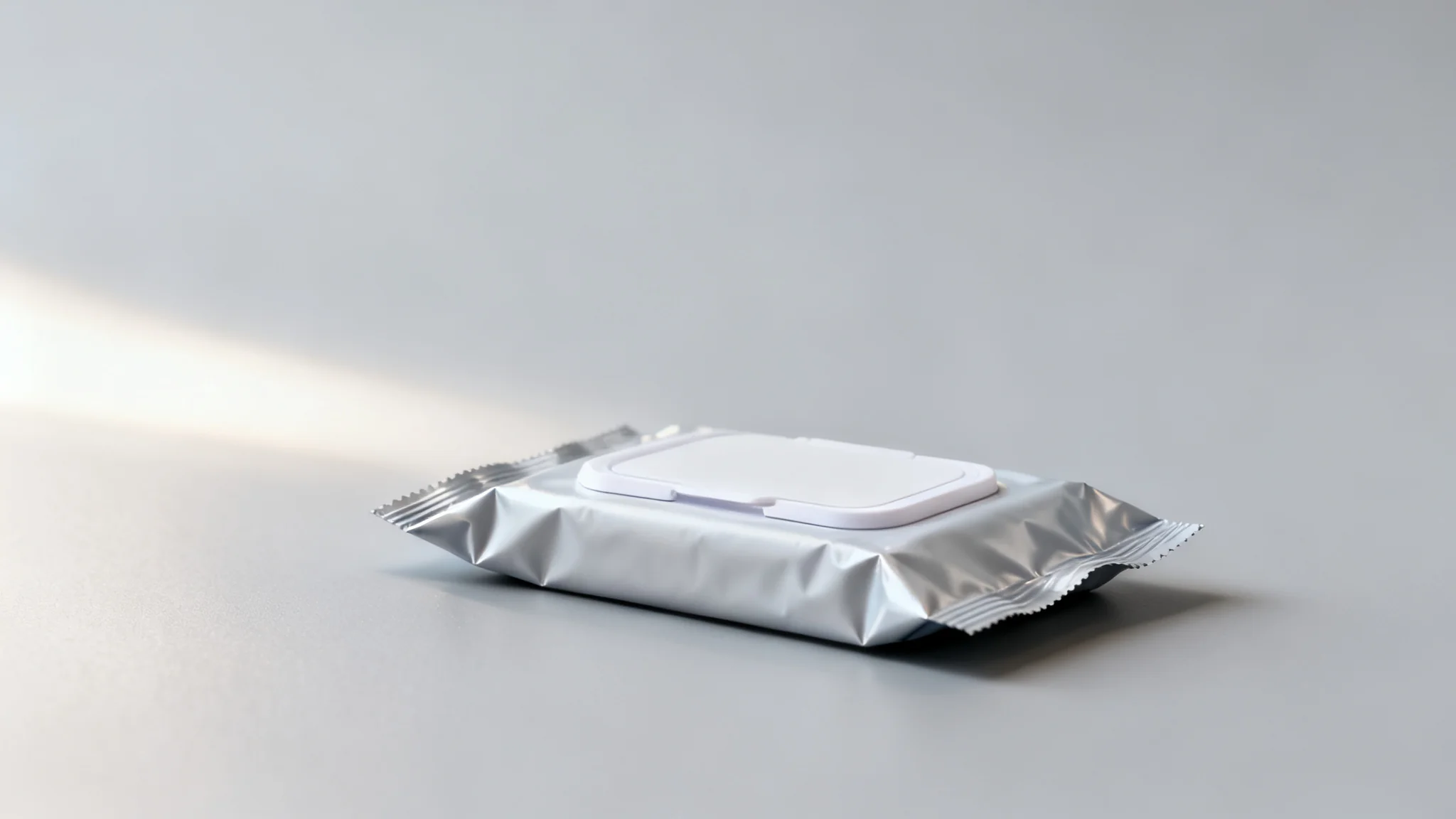
A wet wipe pack that leaks usually passed inspection when it left the sealing station. The failures surface days or weeks later, after transport vibration, solvent softening and a few hundred lid cycles. That gap is why wet wipe pack seal verification has to run as a small test program beside the line — peel checks on the edge seals, a gross leak pass, a lid open-close counter and a simple moisture-loss trend — instead of a single spot check at the end of the shift.
Why Do Wet Wipe Pack Leaks Show Up Late?
Three mechanisms push seal failures past the inspection point. First, the solution itself attacks the seal: alcohol migrates into the inner layer and lowers the effective seal strength over weeks, so a hot-tack reading taken at the machine overstates what the pack can do in the warehouse — the same solvent-aging logic that affects other personal-care formats such as compression-packed hygiene products. Second, transport adds flexing at the fold lines, and a marginal edge seal opens along the crease after a few hundred vibration cycles. Third, the lid is a moving part; every consumer open-close cycle works the adhesive ring under the lid frame, which no end-of-line test sees.
For that reason, the pass criteria written at the sealing station should be set above the strength the pack needs after aging, not just at t=0. The four checks below are ordered so each one answers a different question about the same pack.
Reading Edge Seals Under Peel Testing
Peel testing the edge seal tells you how the seal will age. ASTM F88 measures seal strength on a flat specimen, and the value matters less than the failure mode: a cohesive peel that leaves film residue on both sides tends to hold up after solvent exposure, while a brittle interfacial peel at low strength often drops further once the solution migrates into the seal area. Pull specimens from three positions — near the lid, mid-panel and the bottom crease — because crease-position seals age worst and rarely match the mid-panel reading. The peel parameters themselves follow the same logic as the general heat seal parameters workflow on this site, narrowed here to aged, solvent-exposed specimens.
Record peel strength alongside seal width and jaw temperature. A pack that passes at a wide seal but fails when the jaw drifts narrower is telling you the process window is too tight for the line speed you are running.
Setting Up the Lid Cycle Test
The lid is where consumer complaints concentrate, and the test costs almost nothing to run:
- Fill packs with production solution, mount the lid normally, and log the initial gross weight.
- Run an agreed number of full open-close cycles with a wipe pulled through on a fixed share of them, so fibers cross the aperture the way real use does.
- Store the cycled packs alongside unopened controls for the same interval.
- Re-weigh, inspect the lid rim for staining, and close each pack to confirm the clip or sticker still seats flush.
The pass rule should combine a dry function check (no visible gap, lid seats flush) with a retention check (no rim staining, weight trend in line with the unopened control). A lid that still closes but leaves a wet ring on the shelf has failed, even if the cycle counter says otherwise. Similar aperture-and-resupply logic shows up in other dispensing formats, from custom cotton swab packaging to canister wipes.
How Much Moisture Loss Is Acceptable?
There is no universal number, and quotes that promise one should be treated with suspicion. What the line can do is measure its own baseline: weigh filled packs, cycle the lids, store them under the channel’s real conditions, and plot the trend. Acceptance then becomes a comparison against that baseline over the agreed interval, plus the two hard visual checks — no leakage and no rim staining. ASTM F2096 gives the gross-leak half of this picture for larger defects, using pressurized air under water to find channel leaks that a weight trend would miss.
This acceptance framework applies to hard-lid canisters and flow-wrap refill packs alike; only the cycle count and storage interval need to change with the pack format.
When Should a Seal Result Stop the Line?
Two results justify stopping. One is a peel failure mode shift: if specimens that peeled cohesively this morning now peel interfacially at the same settings, the film surface or the solution concentration has drifted, and continuing to seal puts marginal packs into the warehouse. The other is a leak that repeats at the same jaw position, which points to a mechanical cause — worn jaw teeth, misaligned film, or a lid frame sitting proud of the film path — that no recipe change will fix.
Everything else, including a low average peel strength with a consistent mode, belongs in the adjustment log rather than in a line stop.
Which Cause Moved: Material, Machine or Operator?
Sorting the three causes takes one habit: change one variable at a time and keep the specimens labeled by jaw station. Material causes move with the film roll or the solution batch — swap the roll and the failure moves with it. Machine causes stay pinned to a station or a jaw pair — the same position fails across rolls. Operator causes appear after shift changes or after a new reel splicing routine — the same settings produce different seals in different hands. Most chronic wipe pack seal problems trace to a material change that nobody logged, which is why the reel number belongs in the same record as the peel value.
Key Takeaways
- Set the sealing-station pass criteria above the aged strength the pack needs, not the as-sealed reading.
- Peel failure mode predicts aging better than the strength number alone.
- The lid cycle test belongs on filled packs, with fibers crossing the aperture like real use.
- Moisture-loss acceptance should be your own baseline plus hard visual checks, never a borrowed number.
Conclusion
A wet wipe pack is verified by a short program, not a moment: peel the edge seals at three positions, run a gross leak pass, cycle the lid on filled packs, and trend the weight loss under real storage conditions. Write the acceptance rules so each check answers one question — seal integrity, leak path, lid function, retention — and record the reel and jaw station with every result. Lines that keep this discipline catch the leaks that would otherwise surface in the warehouse, and they stop the line only when the evidence says the cause is mechanical or the material has moved.
Frequently Asked Questions
How many open-close cycles should a lid survive before it is rejected?
The cycle count should come from your own usage assumption, not from a supplier datasheet. A canister that a clinic opens several times per shift ages differently from a household pack opened weekly. Run the cycle test at the count your use case implies, then add margin, and judge the result on the two visible checks — flush seating and no rim staining — together with the weight trend next to the unopened control.
What is the simplest way to measure moisture loss from a wipe pack?
Weight. Record the gross weight of filled packs, cycle the lids, store them under the channel’s real conditions, and re-weigh at set intervals. Keep opened and unopened packs on separate lines of the same log, because the difference between the two curves tells you how much loss comes from the lid path as opposed to the film body. It is low-cost, repeatable and sensitive enough to rank film or lid options.
Can edge seal problems be fixed by raising the sealing temperature?
Rarely. Higher temperature can mask a weak seal at t=0 while speeding up solvent attack on the same seal, so the pack ages worse, not better. Before touching the temperature, check the failure mode under peel and the seal width; if the peel is interfacial and the width has drifted, the cause is more likely the film surface, the jaw condition or the reel change than the setpoint. Adjust the setpoint only after the failure mode confirms a thermal cause.
When should the lid supplier be asked to match a new film, and what changes in wet wipe pack seal verification?
Ask whenever the film structure or the solution recipe changes. The lid adhesive bonds to the film surface and swells or dissolves by contact with the solution, so the pairing must be re-proven. The verification adds one step: cycle the lid on packs filled with the new solution, then check rim staining and flush seating before any retention number is quoted. Treat the lid and film as one bonded pair — a wet wipe pack seal is only as good as the interface the two of them share.