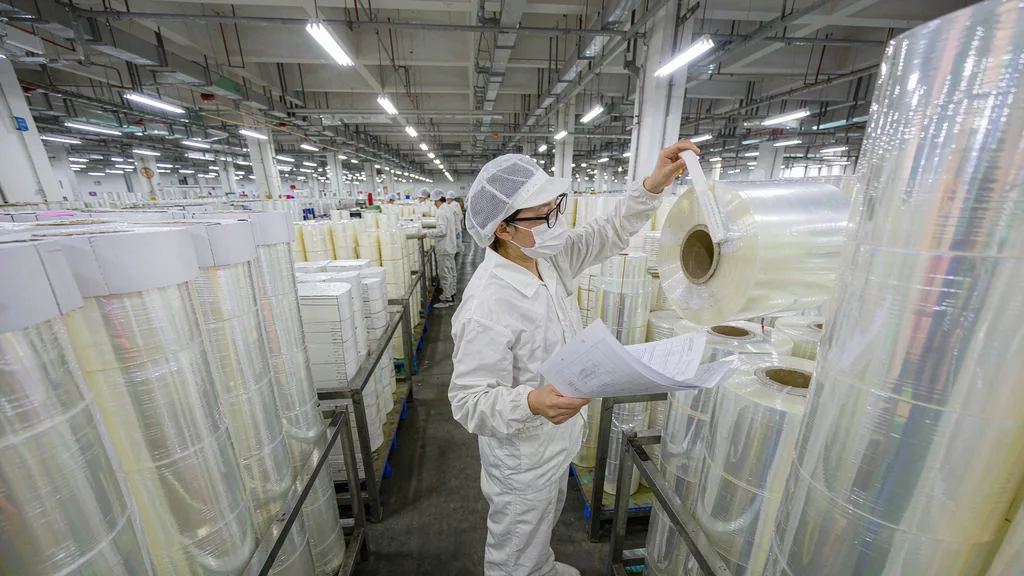

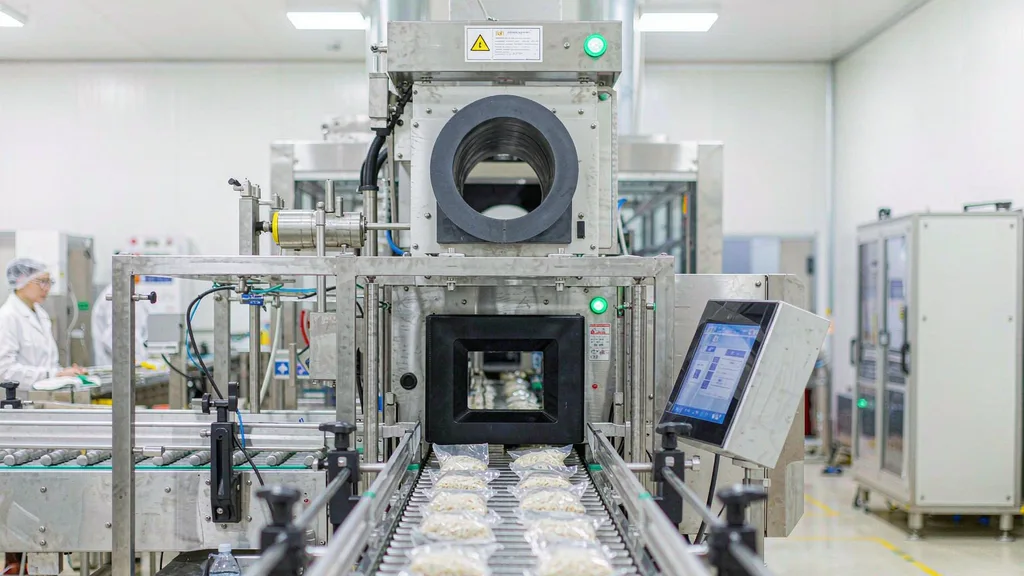
Metal-detectable packaging is film or pouch stock that contains a food-safe metallic additive, so that if the packaging itself tears and fragments fall into the product, the metal detector or X-ray machine downstream can detect and reject the affected batch. It is worth specifying whenever film fragmentation is a realistic failure mode: hard or sharp products, high-speed lines, and any audit scheme that treats packaging as part of the foreign-body hazard analysis.
Why Packaging Film Is Itself a Foreign-Body Risk
Most foreign-body programs focus on what comes into the plant: glass, metal, hard plastic from equipment. Packaging is easy to overlook because it arrives as the “clean” material. Yet under HACCP, packaging materials belong in the hazard analysis like any other input. A torn corner of pouch film, a sliver of lamination or a shed piece of spout fitment is physically indistinguishable from a food product to the consumer, and a thin transparent PE fragment is almost invisible on a cutting board or in a filled tray.
Incident databases and retailer complaint data consistently list plastic fragments among the most frequent reasons for product recalls in Europe and North America. Auditing schemes such as BRCGS Packaging Materials therefore expect converters and their customers to consider packaging debris as a hazard, and many retail specifications now explicitly ask whether the packaging is detectable or rejectable by the inspection equipment on the filling line. Treating the film as a potential contaminant, not just a container, is the shift that makes metal detectable packaging a rational purchase rather than an exotic one — a mindset shift similar to the design-stage review in 10 packaging pitfalls before production.
How Metal Detectors and X-Ray Machines Actually See Things
A metal detector works by disturbing an electromagnetic balance; an X-ray machine works by measuring density. Their strengths differ, and the choice of detectable film depends on which one sits on your line.
Typical free-fall or conveyor metal detector sensitivity for a test sphere, at a 100 mm aperture, is roughly 2.0–2.5 mm for ferrous metal, 2.5–3.0 mm for non-ferrous, and 3.0–3.5 mm for stainless steel 316. X-ray inspection, which reads density rather than conductivity, commonly finds stainless steel around 0.8–1.5 mm in most foods and also sees glass, stone, bone and dense rubber that a metal detector cannot.
Two interactions matter when packaging enters the picture. First, aluminum metallized film and foil laminates create a “product effect” that can blind a metal detector, so products packed in foil structures are usually inspected by X-ray instead — where foil packaging is effectively invisible. Second, plain transparent film fragments are too low in density and too irregular in shape for either machine to reliably reject. Metal-detectable additives exist precisely to close this gap.
What Makes Film “Metal Detectable”?
Manufacturers make film detectable by compounding in a small percentage of a metallic additive — commonly an iron oxide–based pigment — into the film layer. The additive is dosed at roughly 1–3%, remains food-contact compliant, and gives the film a faint gray or blue tint that also makes fragments visually easier to spot. The same concept is already standard in adjacent industries: detectable pens, cable ties and earplugs have been mandatory in many food plants for years. Film simply brings the packaging into the same discipline.
The specification should state three things explicitly. First, which layer carries the additive (usually the inner sealant layer, so it survives lamination). Second, the target detectability, expressed as the smallest sphere-equivalent signal the film must produce on your actual detector. Third, visual color, because a detectable film that looks wrong on the shelf will be rejected by marketing before it ever reaches QC.
Before committing to a full production run, run a qualification trial on the real line: seed film fragments of defined sizes into product at line speed and confirm stable rejection. PURESTPACK’s factory trial protocol for new packaging film sets out this sequence step by step, and the same discipline applies to any claim on the label, from shelf life data as covered in Shelf Life and Best-Before Dates.
How Should a Factory Build the Verification Routine?
Detection capability is a claim; verification is what auditors believe. The routine that most certification schemes expect looks like this:
- Test the detector with certified test wands at start-up, at fixed intervals of 30–60 minutes during the run, and at shutdown, logging every result.
- Pass known film fragments and foreign-body test cards through the system alongside metal wands, so the pack-in risk specific to packaging is actually verified.
- Confirm reject function with a fail test, not only a detection test: a detector that finds contamination but fails to divert it is a hazard, not a control.
- Review logs at defined intervals and re-validate after any film supplier change, detector repair or product changeover.
Note that the film change itself is a packaging change: switching from standard to detectable film alters slip, seal behavior and opacity slightly, so seal strength and seal integrity should be re-verified. Practical test methods are compared in seal integrity testing: bubble, dye penetration and vacuum decay, and the film’s food-contact documentation should be re-checked exactly as when qualifying any new material, following the four practical identification methods in how to identify food-grade plastic.
Where X-Ray Beats Metal Detection — and Where It Does Not
X-ray is the right primary control in three situations: foil or metallized structures that defeat metal detection, dense products where glass-in-glass detection is required, and lines that need one machine to also check fill level and seal closure. Metal detection remains cheaper, faster and more sensitive to small ferrous and non-ferrous particles in “wet” conductive products when packaging does not interfere. Many factories run both: metal detection at filling, X-ray at case level or as a second checkpoint. The packaging decision then follows the machine: detectable additives for metal detector lines, and for X-ray lines, focus on film that stays invisible rather than creating false rejects.
Frequently Asked Questions (FAQ)
Is metal detectable packaging safe for food contact?
Yes, when the additive is part of a food-contact compliant film construction. The metallic pigment is embedded in the polymer and migrates no more than the base resin; the film should still come with a declaration of compliance under the applicable regulations, such as EU 1935/2004 or FDA 21 CFR.
Does metal detectable film cost much more than standard film?
Typical uplift is in the range of 10–20% over the equivalent standard laminate, driven by the additive and smaller batch sizes. Against the cost of one recall or one retailer line-stop, most food factories consider it inexpensive insurance.
Can a metal detector see transparent PE film fragments?
No. Plain transparent polyethylene is too low in density and produces no measurable signal in either metal detection or X-ray. That is precisely why detectable additives are compounded into the film for lines that treat packaging debris as a hazard.
Does metallized or foil packaging pass through a metal detector?
Usually not cleanly. Metallized laminates create enough product effect to trigger or mask the detector, so foil-packed products are normally inspected by X-ray, where foil is effectively transparent to the density reading.
How often should the metal detector be tested on a packaging line?
A common audit-aligned routine is testing at start-up, every 30 to 60 minutes during production, and at shutdown, with each test logged. Intervals should follow your HACCP plan and customer specifications, and re-validation is required after film or product changes.
What should we ask a film supplier before switching to detectable film?
Ask for the additive type and dosage, the food-contact declaration, the smallest detectable sphere equivalent on your aperture and product, seal-latitude data versus the standard film, and reference customers running the same combination. Then confirm all four with your own line trial before rollout.