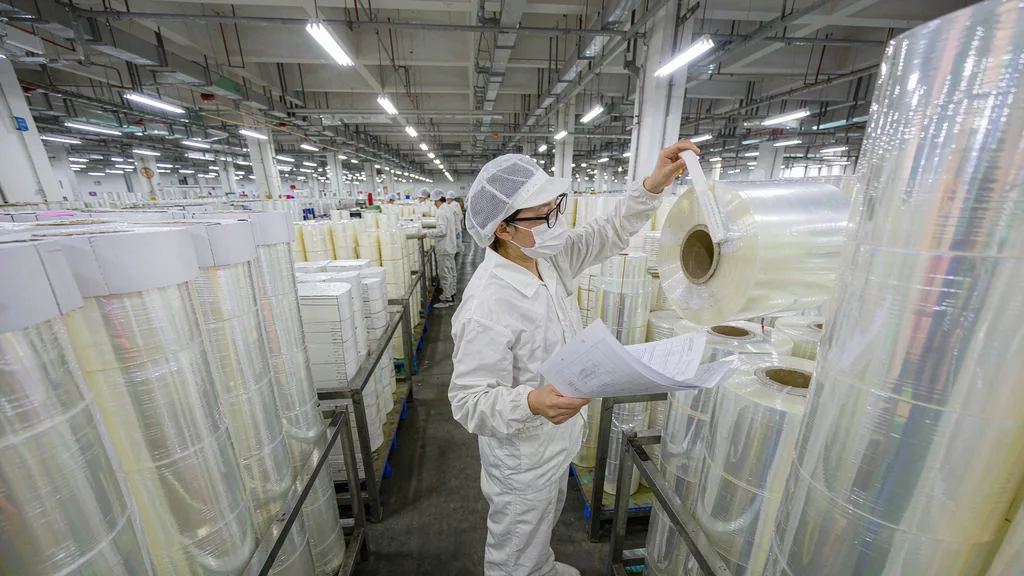

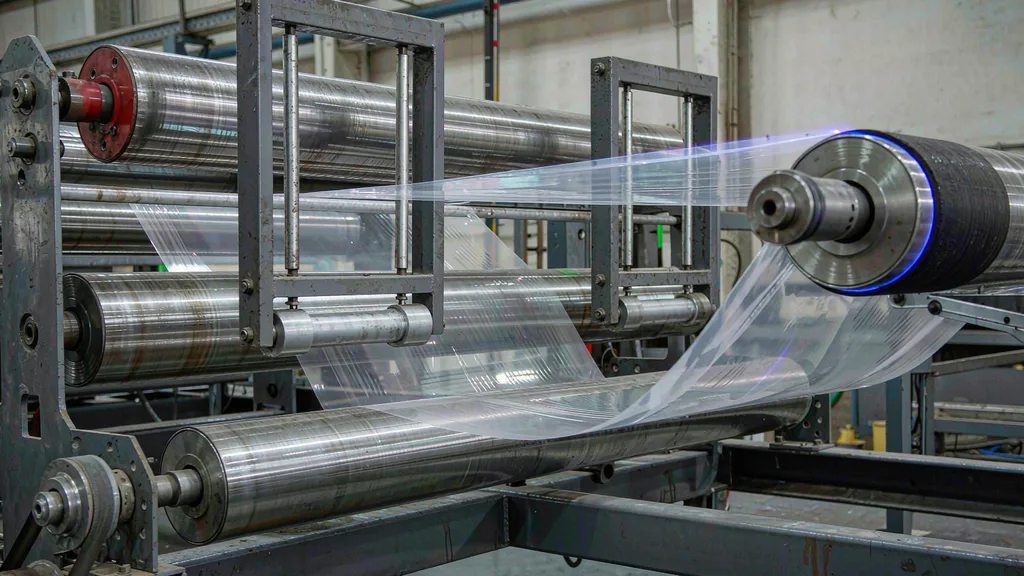
Corona treatment is the electrical discharge that raises a polyolefin film’s surface energy so ink, adhesive and coatings can wet it. The number that tells you whether it worked is the dyne level. In practice, most adhesion complaints trace back to one thing: the film was treated correctly at the converter and had decayed below the process requirement by the time it reached the press.
What Corona Treatment Does to a Film Surface
Polyethylene and polypropylene are non-polar. Their surfaces present no chemical sites for ink or adhesive to bond to, so a drop of water or ink beads up instead of spreading. Corona treatment passes the film through a high-voltage discharge between an electrode and a grounded roll. The discharge oxidises the surface and introduces polar groups, which raises surface energy.
Three points matter for a factory:
- It changes only the surface. Bulk properties such as tensile strength, barrier and seal behaviour are untouched, which is why treatment is cheap and universal.
- It is not permanent. The polar groups reorient and migrate below the surface over time, and the measured dyne level falls.
- It can be done twice. Most converting lines treat in-line immediately before printing or laminating, which is the most reliable way to guarantee a known surface at the moment it matters.
How to Read a Dyne Level
A dyne level is a measure of surface tension, reported in dynes per centimetre (mN/m). The standard shop-floor method uses a series of test liquids or pens of known surface tension: the film wets at every value up to its actual surface energy and beads above it. The relevant standards are ASTM D2578 and ISO 8296; contact angle measurement gives a more precise number in a laboratory.
| Film | Typical untreated | Typical treated | Common minimum for the process |
|---|---|---|---|
| LDPE / LLDPE | 29–31 dynes/cm | 38–44 dynes/cm | 38 for printing, 42 for solvent lamination |
| BOPP | 29–31 dynes/cm | 38–42 dynes/cm | 38 for printing, 40 for cold seal |
| BOPET | 40–44 dynes/cm as supplied | Often treated again before use | 48 for demanding ink systems |
| BOPA (nylon) | 36–40 dynes/cm | 44–52 dynes/cm | 44 for lamination |
Two rules make these numbers useful. First, the requirement belongs to the process, not the film: water-based inks and solventless adhesives are less forgiving than solvent-based systems. Second, the number only means anything with the test method and the date attached.
Why Treated Film Loses Surface Energy
Treatment decay is the single most common cause of adhesion complaints, and it is predictable.
- Time. Measured dyne level drops over days to weeks after treatment, with most of the loss in the first days.
- Temperature. Storage above roughly 30–35°C accelerates decay significantly. A container that sat on a hot dock is a common root cause.
- Additives. Slip agents such as erucamide and oleamide migrate to the surface and form a weak low-energy layer that suppresses wettability even when the film was well treated.
- Blocking and dust. Tightly wound rolls and dusty storage both degrade the surface that the press sees.
This is exactly the mechanism behind the situation described in Packaging Film Storage: How Good Film Loses Performance in the Warehouse: the roll was fine when it left the plant and different when it was unwrapped.
Where the Failure Shows Up
Printing. Ink crawls back from the edge of a solid, leaves pinholes in the print, or wipes off in a tape test. The process background is covered in Gravure Printing Guide for High-Volume Packaging.
Lamination. Bond strength comes in low and, worse, unevenly across the web. Delamination often shows up only after the pouch is sealed and filled, because the stress of sealing and the chemistry of the product finish what poor wetting started. The bonding mechanism is explained in Dry Lamination: How Flexible Packaging Bonding Works.
Cold seal and coatings. Cold seal release coatings and heat-seal coatings are the most sensitive of all, because they are applied as thin layers with little margin for error.
| Symptom | Likely cause | First check |
|---|---|---|
| Ink retracts at the edges of solids | Surface energy below ink requirement | Dyne test on the roll as received |
| Bond strength low, but only on one side | Only one side treated, or wrong side treated | Test both sides separately |
| Failure appears only on old stock | Treatment decay or slip blooming | Compare dyne on new versus aged roll |
| Failure appears only in summer | Storage temperature accelerating decay | Check warehouse temperature log |
| Tape test passes but pouch fails later | Marginal wetting plus product stress | Run bond strength after fill and seal |
How to Specify Corona Treatment in a Purchase Order
Most specifications do not mention surface treatment at all, which is why disputes end with no agreed reference point. Five lines fix that:
- Minimum dyne level at the time of use, not at the time of manufacture. This is the single most important wording change.
- Test method. Name ASTM D2578 or ISO 8296 so results are comparable between supplier and buyer.
- Maximum age and storage condition. State a retest obligation if the roll is used after a defined number of days, and cap storage temperature.
- Which side is treated. For lamination, both webs may need treatment; for printing, only the print side. Write it down.
- Slip and additive limits. If the film carries a high slip package, agree the type and level with the converter, because slip will fight the treatment.
Over-treatment is also a real risk. Excessive corona can make film block on the roll, cause back-side treatment that creates unwanted heat sealing, and in thin films produce pinholes. The target is the lowest level that reliably meets the process requirement, with margin.
What Corona Cannot Fix
Treatment raises surface energy. It does not clean the film, and it does not compensate for a process that is otherwise out of control. If adhesion fails, rule out these causes before blaming the film:
- Wrong ink or adhesive for the substrate. No dyne level rescues an incompatible chemistry.
- Contamination. Dust, oil mist from the line, and fingerprints defeat treatment.
- Insufficient drying or curing. Solvent trapped in the bond line lowers measured strength regardless of wetting.
- Low coat weight. An adhesive applied below its designed coverage will not reach specified bond strength.
The trial protocol in How to Qualify a New Packaging Film places surface checks early for exactly this reason: they are cheap, fast, and they remove a variable before the expensive part of the trial.
Corona Treatment FAQ
What dyne level do I need for printing on PE film?
Most converters work to a minimum of 38 dynes/cm for solvent-based and water-based flexo and gravure inks on treated PE, and many specify 40 to 42 dynes/cm for water-based systems. UV inks are often specified higher. The correct number is the one your ink supplier states for your specific ink and substrate, measured at the press immediately before printing.
How quickly does corona treatment decay?
It starts immediately and slows over time, with most of the loss in the first days; the rest depends on storage temperature, film formulation and slip package. In warm storage a roll that measured 42 dynes/cm at the converter can arrive below 38, which is why the spec should state the level at the time of use.
Can I re-treat film that has decayed?
Yes, if you have in-line corona at the press or laminator. This is the standard solution and it removes most decay risk. Film that has already been printed or coated generally cannot be re-treated without damaging the existing layer, so re-treatment belongs upstream of printing, not after it.
Does a high slip additive cause adhesion failure?
It can. Slip agents migrate to the surface after extrusion and form a low-energy layer that lowers the measured dyne reading and blocks wetting. If your process is adhesion-critical, agree the slip type and level with the film supplier, or use a non-migrating slip system.
Why does my laminate pass bond strength at the machine and fail later?
Because bond strength is measured before the stresses that expose a weak interface: heat sealing, product contact, and thermal cycling. Marginal wetting produces a bond that looks acceptable on a strip test and fails in a filled pouch. Test bond strength after sealing and after a storage cycle, not only off the laminator.
Is a higher dyne level always better?
No. Over-treatment can cause blocking on the roll, unwanted treatment of the reverse side, and in thin films can damage the surface. The goal is the lowest level that meets the process requirement with margin, verified by a bond or tape test rather than by chasing the highest reading.