

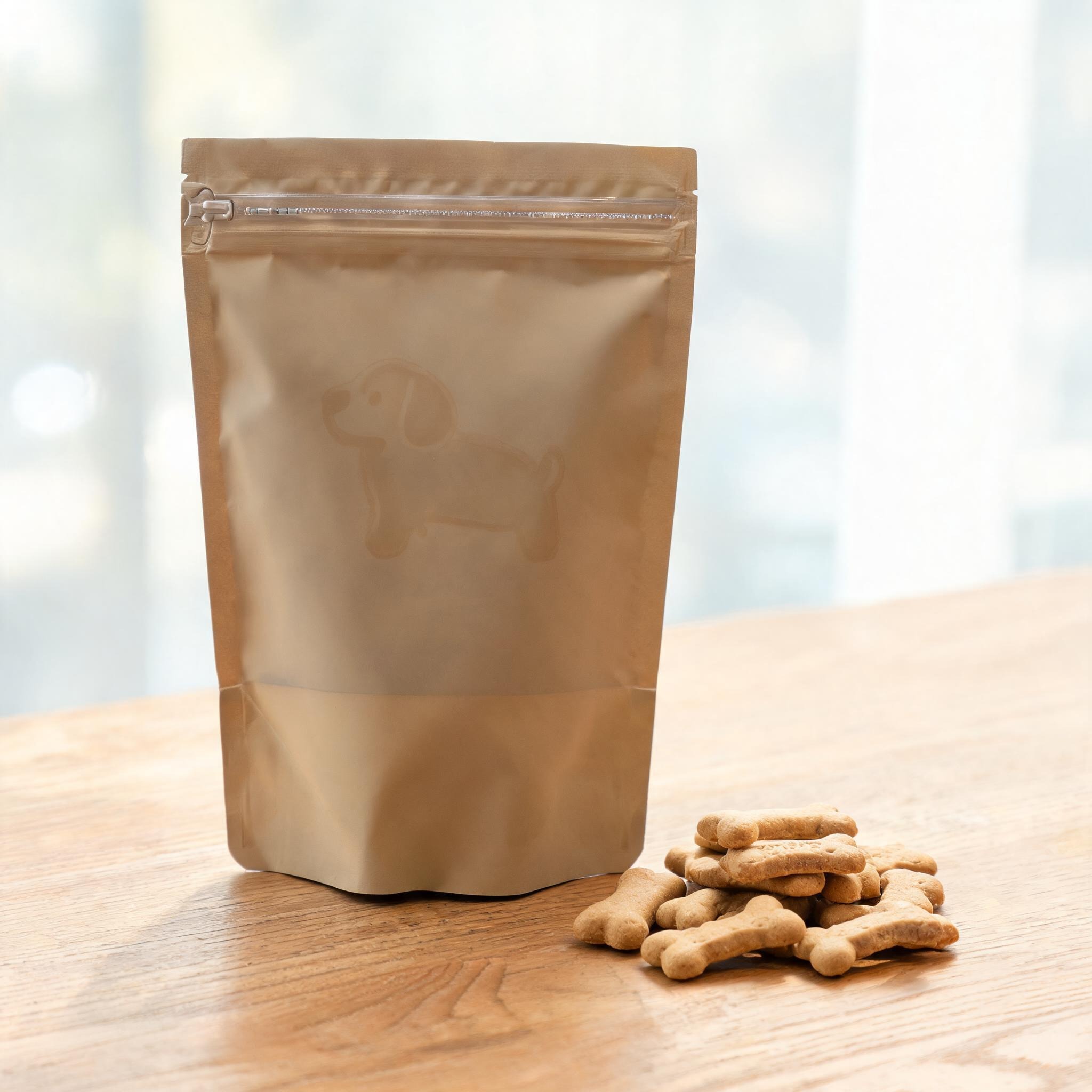
Pet treat packaging has a problem that human snack packaging does not: the buyer and the eater are different customers. The shopper decides on shelf presence, resealability and a clean ingredient story, while the dog or cat only cares that the treat still smells fresh three weeks after opening. Getting pet treat packaging bags right means balancing a small format, a tight barrier and a closure that survives daily use. This guide covers the structure, film and format choices that matter for treat pouches in the 50 g to 250 g range.
Why Small Formats Are Harder Than They Look
A 100 g treat pouch has a high surface-area-to-volume ratio, so oxygen and moisture ingress per gram of product is much higher than in a 1 kg bag. Soft chews and semi-moist treats are the most demanding: they lose moisture and firm up, or pick up humidity and turn sticky, long before the printed best-before date. The same geometry leaves little room for the seal, the zipper and the regulatory panel, which is why treat pouches are usually designed as a system rather than a single film choice.
Fill weight also drives economics. Treat pouches are often sold in multi-packs of two or three flavours, so the converter runs several short jobs instead of one long one, and set-up cost per unit climbs.
Choosing the Film Structure
For dry kibble-style treats, a two-layer PET/PE or MOPP/PE structure is usually sufficient: the outer layer carries print and stiffness, the sealant layer provides a hermetic seal and tear resistance. For soft chews, jerky and freeze-dried treats, add a metallised or aluminium layer, or move to a high-barrier clear coating if the brand wants product visibility. For raw or frozen treats, consider PA-based structures for puncture resistance at low temperature.
Whatever the build, the sealant layer must match the filling line. Too low a sealing temperature gives channels that leak in transit; too high a temperature cuts through the zipper and creates a hard, brittle seal line that cracks when the pouch is opened repeatedly.
Zippers, Tear Notches and Daily Abuse
The closure is where most treat pouches fail in real use. A press-to-close zipper must survive dozens of open and close cycles with crumbs and grease in the track, and it must be positioned far enough below the top seal that the customer can tear the pouch open without cutting into the zipper itself. Tear notches should sit above the zipper and be laser-scored or die-cut consistently; inconsistent notches are the single most common complaint in small-format pet packaging.
Zipper selection is a design decision, not a stock item. Our guide to choosing zippers for seal performance explains how track profile, slider type and placement interact with fill weight and opening force.
Stand-Up, Flat or Flat-Bottom?
Stand-up pouches dominate pet treats because they present well on shelf and stand stable after opening. Flat-bottom pouches offer a stronger box-like presence and better stacking for e-commerce, but cost more per unit because of the additional forming and sealing steps. Flat or three-side-seal sachets remain the cheapest option for sample sizes and single-serve training treats.
The trade-off is usually shelf space against unit cost. A 100 g stand-up pouch may occupy the same facing as a 250 g flat-bottom pack, so the decision often comes down to how the brand wants the price ladder to read. Cost drivers for flat-bottom formats are covered in our flat-bottom pouch cost analysis.
Printing, Claims and Compliance
Pet treats sit in an awkward regulatory space: they are not food for humans, but they are eaten, so several markets apply feed or pet-food labelling rules rather than food-contact rules. Guaranteed analysis, feeding instructions, batch coding and country of origin usually need dedicated panel space, which is tight on a small pouch. Plan the artwork grid before choosing the format, not after.
On the sustainability side, “recyclable” claims require a mono-material structure and a collection pathway that actually exists in the target market. Where that pathway is missing, a downgauged structure with an honest disposal instruction is a more defensible position than a label the local waste stream cannot process.
Frequently Asked Questions
What film is best for soft chews?
A high-barrier laminate with a metallised or foil layer and a PE sealant. Moisture and oxygen are both critical for soft, semi-moist products, and a clear two-layer structure usually falls short over a 9 to 12 month shelf life.
Can one pouch size cover a full range?
Usually not. Training treats, daily treats and large-breed portions differ enough in fill weight that two or three formats reduce overfill and keep the price ladder sensible. Standardising on one zipper and one film family across those formats keeps tooling cost down.
How do I stop the zipper from failing?
Specify the zipper position relative to the tear notch, validate seal temperature against the zipper material, and run an open-close abuse test rather than only a leak test. Most failures are a placement or sealing-parameter issue, not a defective zipper.
If you are developing a treat pouch range, send us your fill weights, product moisture and target shelf life. PURESTPACK will propose a film structure, zipper and format combination with samples for fill trials. Contact PURESTPACK about pet treat packaging, or review our flexible packaging programmes at PURESTPACK.com.