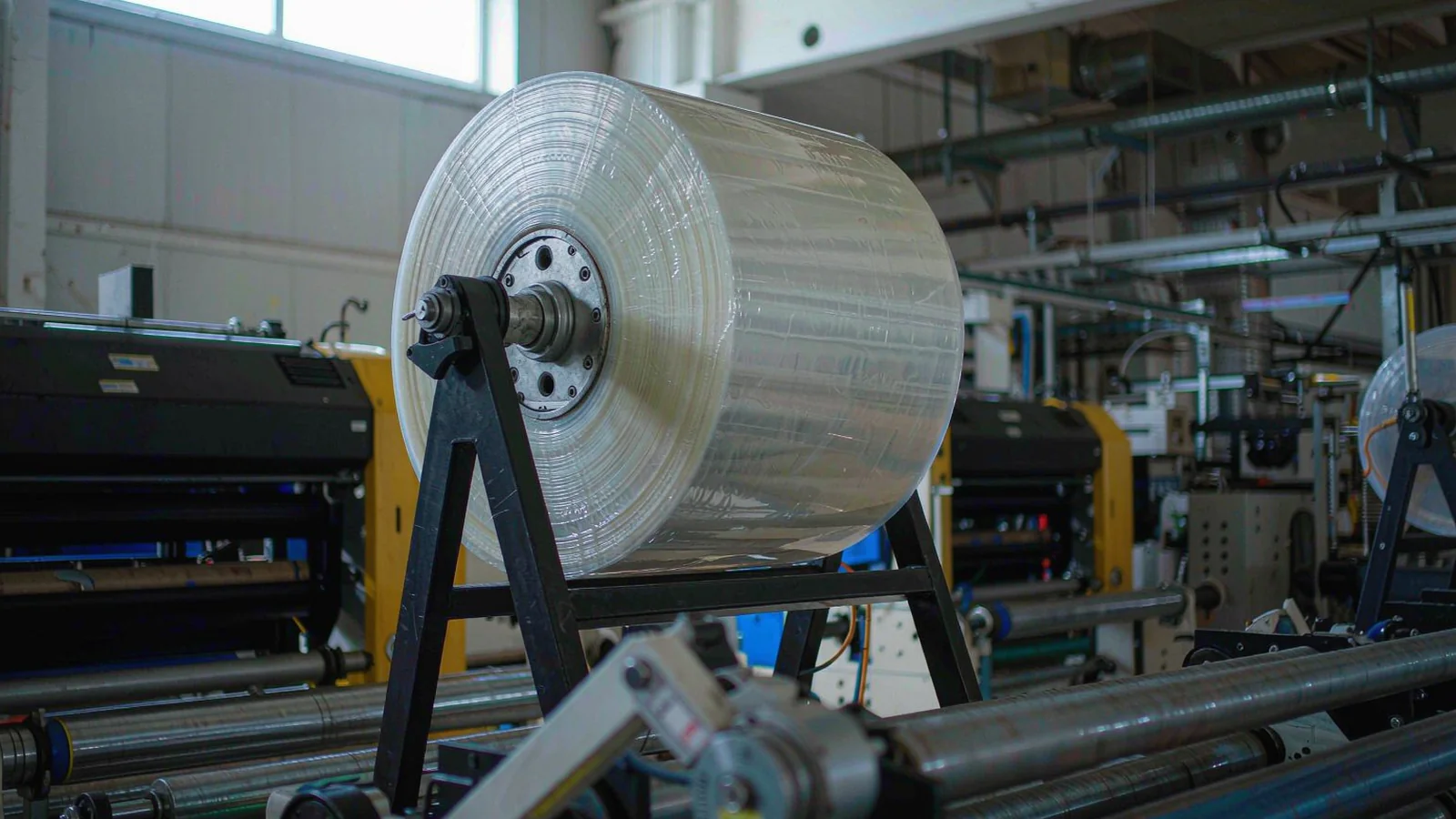

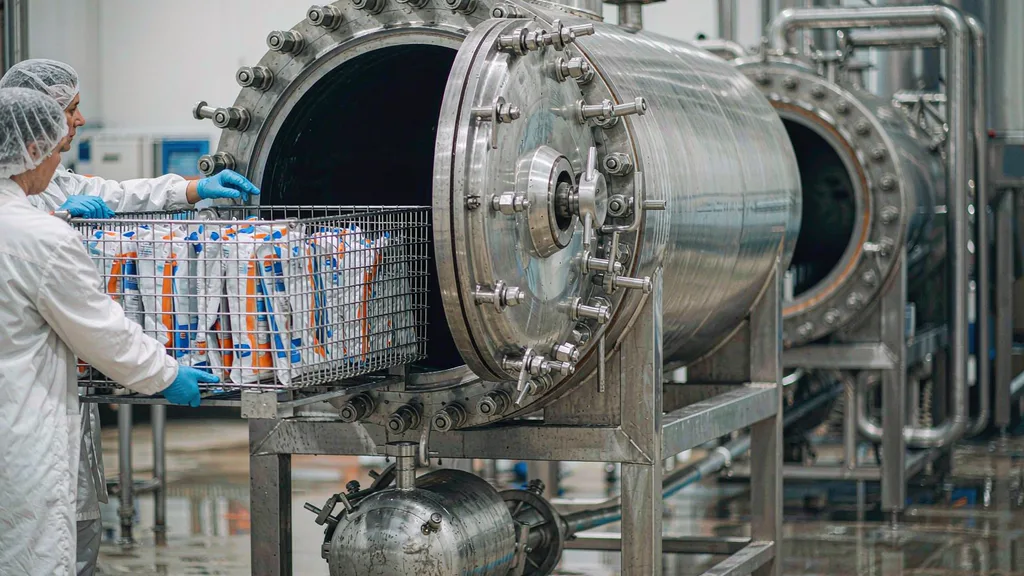
HPP packaging must survive a pressure of 400–600 MPa applied for one to six minutes while the product stays chilled. The pouch is squeezed by roughly 15% in volume, then released. Film structure, seal strength and headspace all have to be designed for that cycle, not for a normal filling line.
What Is HPP and Why Does It Change the Package?
High pressure processing puts sealed, already-packed food into a vessel filled with water and raises the pressure to 400–600 MPa, which is 4,000 to 6,000 bar. The pressure is held for one to six minutes at 4–10°C, then released. Pressure transmits through water in every direction at once, so the treatment is uniform regardless of pack size.
What it does: it inactivates vegetative bacteria, yeasts and moulds, usually by five log cycles. What it does not do: it does not kill bacterial spores. That single limitation explains the whole packaging brief. HPP products stay refrigerated, and the pack must protect a chilled, high-moisture food for 30 to 90 days, not a year on ambient shelf.
The FDA’s review of alternative processing technologies treats HPP as pasteurisation-equivalent for vegetative cells, not as sterilisation. A factory that specs HPP packaging like retort packaging fails at the first shelf-life trial.
Why Does the Pouch Collapse Inside the Vessel?
Water compresses. At 600 MPa, the volume of water falls by roughly 15%, and everything inside the vessel — product, headspace gas, packaging — is compressed with it.
A flexible pouch simply follows the volume change. It flattens, the headspace gas is compressed to a fraction of its original volume, and the film is pushed hard against the product. When the pressure releases, the pouch returns to shape, sometimes with visible creasing at the panel edges and the gusset corners.
Three consequences follow:
- Headspace is not optional. A pouch filled to the seal with no gas will have the product forced into the seal area during compression. Target 5–10% headspace by volume.
- Rigid packs need compensation. A rigid tray or bottle with trapped air will deform or crack unless it has a pressure-compensation device. Most HPP lines run flexible pouches for this reason.
- The film must be able to move. A very stiff laminate resists the compression and loads the seals instead. The best-performing HPP structures are flexible coextrusions, not heavy foil laminates.
Which Film Structures Survive HPP?
The workhorse is a coextruded PA/PE or PA/EVOH/PE structure, 80–120 µm total. Nylon gives puncture resistance and thermoformability, EVOH gives the oxygen barrier, and PE gives the seal.
| Structure | HPP fit | Comment |
|---|---|---|
| PA/PE coextrusion, 90–110 µm | Good | Standard choice for chilled HPP packs |
| PA/EVOH/PE coextrusion | Good | Higher barrier, watch EVOH moisture sensitivity |
| PET/ALU/PA/CPP laminate | Poor to fair | Foil flex-cracks at the gusset after repeated compression |
| Mono-PE with EVOH | Fair | Recyclable, but stiffness and puncture resistance are lower |
Two failure modes dominate. The first is delamination between layers, usually where a solvent-based adhesive was used and the film was not fully cured before packing. The second is flex cracking at the gusset radius and at the seal shoulder, which shows up as pinholes after 20 to 50 cycles of compression and release.
Solvent-free and solvent-based polyurethane adhesives both work if fully cured; an adhesive still releasing solvent when the roll is packed will delaminate under pressure. Ask the converter for the curing record, not only the certificate of analysis.
What Happens to the Seal Under Pressure?
A seal that passes a dye test before HPP can fail after it. Pressure drives product into any weak point in the seal, and a chilled, high-moisture product with oil or particulates is very good at finding one.
Practical targets for an HPP pouch:
- Fin seal strength of 35–45 N/15 mm before processing, and no more than a 15% loss after
- No channel leaks by dye penetration to ASTM F1929, tested after the pressure cycle
- Burst pressure to ASTM F2054 of at least 0.5 bar above the highest pressure the pouch sees in the vessel wall contact zone
- Seal width of at least 8 mm on the top and bottom seals; 6 mm is too narrow for HPP
Cold seal coatings are not suitable. The cohesive bond is pressure-sensitive and releases under the compression cycle, which is exactly the opposite of what HPP needs.
How Does HPP Affect Barrier and Migration?
Oxygen transmission through the film rises after HPP, typically by 10–30% for EVOH-containing structures, because the compression and release cycle creates micro-voids at the layer interfaces. For a 60-day chilled product this is usually tolerable. For a product with a 90-day target, it needs to be measured rather than assumed.
Migration is the other issue. Pressure increases the mobility of small molecules in the polymer, and food-contact testing carried out on untreated film does not represent the treated pack. EU Regulation 10/2011 compliance should be demonstrated on the finished pack after processing, at the worst-case time and temperature of use. In practice this means a migration test on HPP-treated samples, not on flat film.
Which Products Actually Use HPP?
HPP is economic where the product is high value, heat-sensitive and sold chilled:
- Guacamole, dips and avocado products, where heat would destroy colour
- Fresh juices and smoothies with a short chilled shelf life
- Wet salads, grain bowls and ready-to-eat meals
- Sliced cooked meat, cured meat and seafood
- Infant puree in spouted pouches
For a factory, the decision is usually about distribution radius, not about packaging cost. A three-day chilled product can be packed in a simple barrier pouch. A 60-day product that ships across a country needs HPP, and then the packaging specification becomes a process document.
What Should a Factory Test Before Release?
Run the trial on the real filler and the real product, and test after the pressure cycle, not before:
- Seal strength, tensile peel, five samples per lane, before and after HPP
- Dye penetration on ten pouches per batch
- Burst test on five pouches
- Visual check for creasing, gusset distortion and valve or spout damage
- Headspace oxygen on three pouches
- OTR on one sample per structure, before and after
- Storage trial at 4°C and at 8°C for the declared shelf life
Keep untreated control samples: after a failure, only a paired before-and-after record settles whether the pouch or the process caused it. Our guide to seal integrity test methods covers the test sequence, and the film qualification protocol sets out how to run the trial without stopping production. For the film side, the nylon film guide explains why PA is the usual puncture layer. Factories moving from ambient to chilled formats often start with the filling temperature question, and the filling and sealing equipment guide is useful when the line has to handle both pack types.
Frequently Asked Questions (FAQ)
Does HPP sterilise the food?
No. HPP inactivates vegetative bacteria, yeasts and moulds, usually by five log cycles, but bacterial spores survive pressures up to 600 MPa. HPP products are therefore chilled products with a limited shelf life, not ambient stable products.
Can you HPP a pouch with a zipper or spout?
Yes, if the fitment is welded correctly and rated for the pressure. Spout welds and zipper tracks are the weakest points because they are rigid inserts in a flexible film. Test them after the cycle, and expect a small number of spout leaks in the first production runs.
Why do HPP pouches come out creased?
The pouch is compressed by about 15% in volume and then released. Creasing at the panel edge and the gusset is normal and does not by itself indicate a leak. Deep creases that turn white, or creases crossing the seal, are a warning sign and should be dye tested.
Does HPP damage the oxygen barrier?
It can reduce it. OTR typically rises 10–30% after processing because the compression cycle creates micro-voids at the layer interfaces. Measure OTR on treated pouches, not on flat film, if the shelf life target is longer than 60 days.
What headspace should an HPP pouch have?
Five to ten percent by volume. Too little headspace forces product into the seal during compression; too much leaves a large gas volume that collapses and creases the pack, and increases the oxygen load at sealing.
How much does HPP packaging cost compared with retort?
The pack itself is usually cheaper, because a coextruded PA/PE film costs less than a retort-grade foil laminate. The cost moves to the process: HPP tolling is charged per cycle, and the chilled distribution chain is more expensive than ambient. The packaging decision is therefore a distribution decision.