
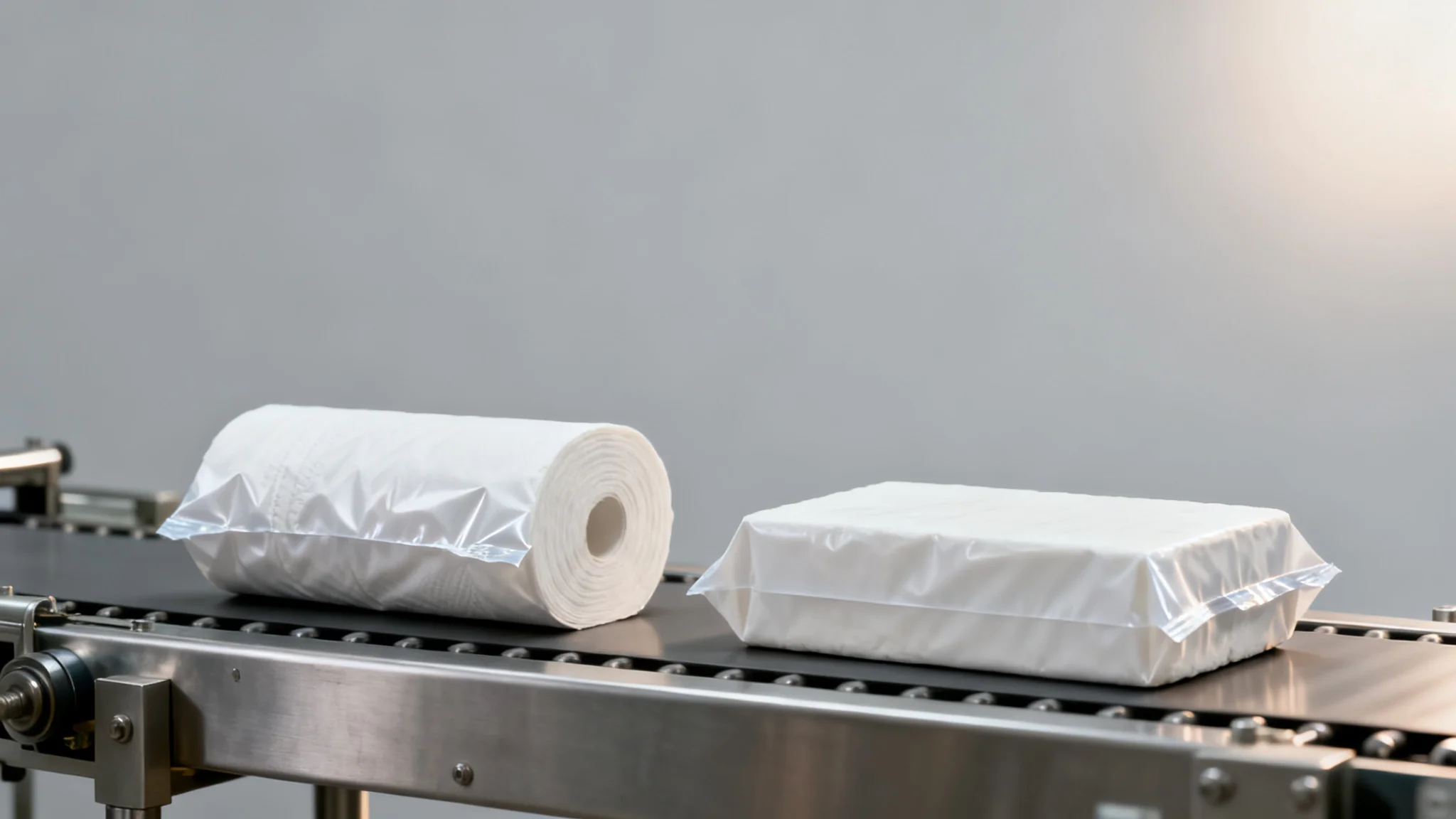
For compression packing hygiene products, the choice comes down to two routes: wind the pack, or press it. Roll packing suits products that can be wound — wipes, cotton pads, rolled sheets — and it turns a soft stack into a firm cylinder that feeds a tube or sleeve former. Flat compression suits stacked squares such as pet pads, where the pack has to stay rectangular for a carton and a shelf tray. The choice is made on the filler, the pack shape and the carton, not on which machine looks faster.
Key Takeaways
- Roll compression is a winding process; flat compression is a pressing process. The equipment, the film tension and the failure modes differ from the first metre of film.
- Rebound shows up as diameter growth in a roll pack and as thickness growth in a flat pack, so it is measured and tolerated differently.
- Cylinders leave void space in a carton; bricks do not. Carton cube usually decides the format before film cost does.
- Both formats put the film under continuous load, so seal and puncture checks belong in the line trial as well as the sample room.
Two Ways to Compress a Hygiene Pack
In a roll pack the product is wound under tension around a core or into a tight spiral, and the film follows the spiral as the outer wrap. Air leaves through the open edges as the roll tightens. In a flat pack the product is a stack, the stack is pressed between platens to a set thickness, and the film is sealed around it while the platens still hold the shape. Both remove air; only the flat process fixes the pack’s final thickness with a hard stop. This comparison applies to hygiene products packed in flexible film on a compression line — pads, wipes, cotton rounds. It does not cover rigid cartons, shrink-wrapped multipacks or vacuum packs of textiles, where the load path and the failure modes are different.
How Roll Compression Runs on a Line
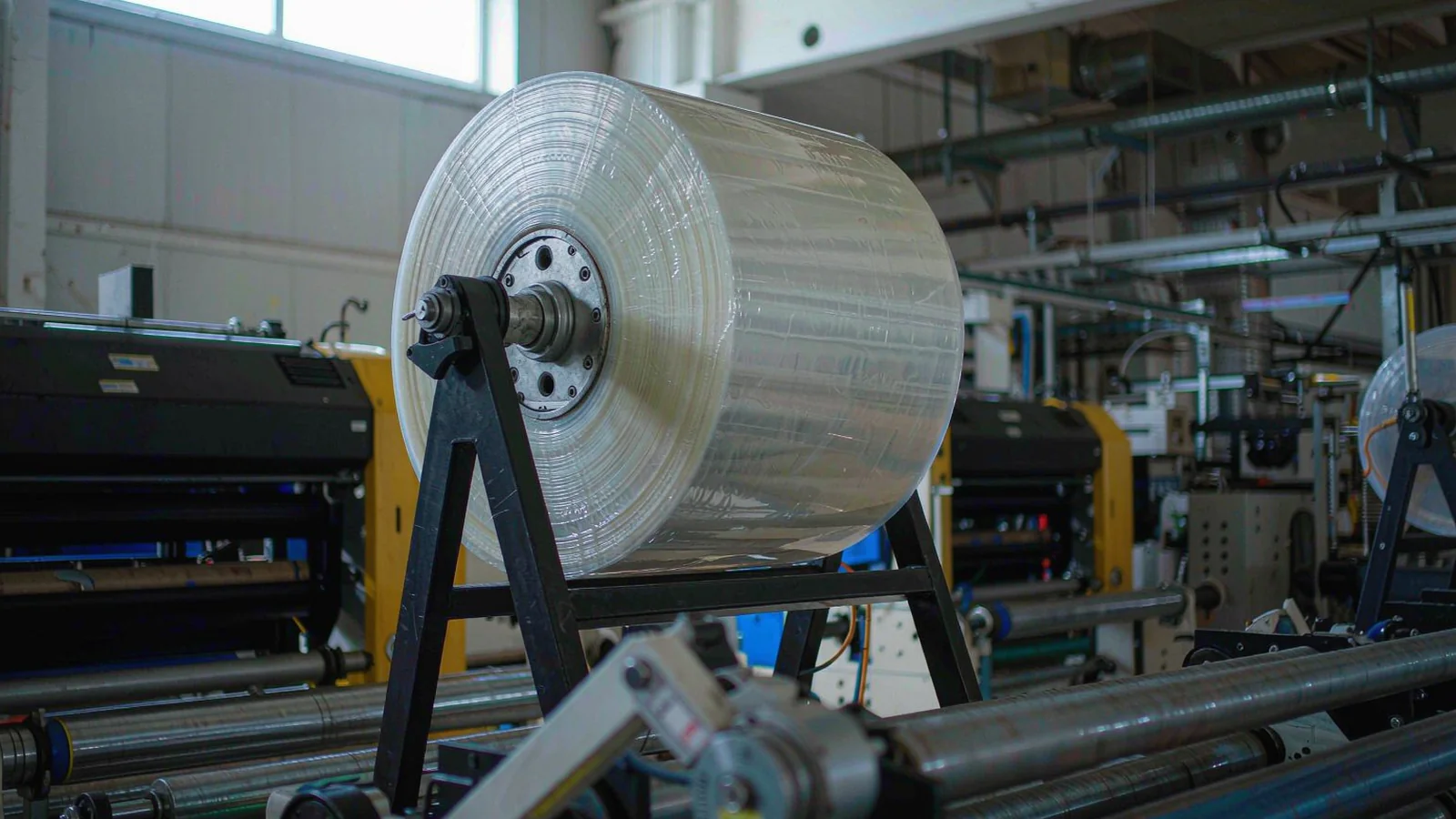
A roll line needs a winder with controllable tension, a roll diameter target and a film path that keeps the web flat as the diameter grows. Tension is the setting that decides the pack: too little and the roll relaxes in the carton, too much and the film is pre-stretched before it ever reaches the shelf. The roll then goes into a tube, a sleeve or a wrap, and the end seals close the pack. Cycle time is short and continuous, which is why roll lines dominate high-volume wipes production. The web itself is the other half of the decision: a printed roll film supplied to a consistent width and gauge keeps tension stable as the roll diameter grows, while a web with gauge bands forces the winder to compensate all shift.
How Flat Compression Runs on a Line
A flat line needs a platen at least as large as the pack face, a dwell long enough for air to escape the stack, and a seal bar positioned so the seal closes before the platens release. Where the press and the sealer are separate stations, the transfer between them is the weak point: any release of pressure before sealing lets air back in and the pack arrives oversized. Flat compression runs in batches on a platen press or in line with an automatic bagger, and the platen shape is what leaves marks on the product. The flat pouch formats used for hygiene items such as cotton swab packaging show the same geometry at a smaller scale: a counted stack, a flat face for print and a seal that closes while the stack is still held.
Which Format Fits Your Filler?
Match the format to how the product leaves the filler, not to how it looks in a photograph. A stacker that delivers counted stacks face-up feeds a flat press with almost no handling; the same stacker feeding a roll winder needs a turning station that often damages the top pad. Conversely, a web-fed wipes line that already winds product is halfway to a roll pack. If the filler output is a continuous web or a rolled sheet, roll compression is the natural extension; if it is a counted stack, flat compression keeps the handling to one transfer.
Does Roll Compression Hold Rebound Better?
No — it holds rebound differently. A roll pack stores energy in the spiral, so when the wrap is opened the roll grows in diameter rather than in thickness. That growth is easy to accommodate in a round shelf well and awkward in a rectangular tray, where a few millimetres of diameter change can stop the pack from dropping into place. A flat pack grows in thickness, which pushes against the carton lid and the pallet above. Neither format removes rebound; both need the pack dimension specified with a tolerance measured after release.
What Does Carton Efficiency Look Like in Each Format?
Cylinders leave void space. A carton filled with round packs has gaps at the corners and between rows unless the packs are nested in a matched insert, and those gaps are paid for on every pallet. Flat bricks fill a carton almost completely, which is why pad and diaper formats converge on rectangular packs even when the product itself is soft. Vibrating a loaded carton, as described in ASTM D999, settles the packs and exposes the formats that will not stay in place. The trade is presentation: a brick reads as a value pack, a roll reads as a display unit that can hang or stand in a well.
Where the Seal Carries the Load
The flat pack loads its end seal across the full pack width, with the rebound of the whole stack pushing outward for the life of the pack. The roll pack loads its end seal in peel, because the spiral tries to unwind and the tension sits along the wrap direction. That is why a roll pack can pass a peel test and still fail in a warm carton: heat relaxes the film, tension redistributes, and the seal that was adequate at 20 °C starts to creep. Seal strength tests on either format should be run at the temperature the pack will actually see. The compression and drop behaviour of a stand-up pouch for pods is a useful side-by-side, because a pod pack carries a similar steady load on a much smaller seal.
E-commerce and Shelf Fixtures Pull in Different Directions
E-commerce favors the flat brick. It stacks, it survives a parcel chute without rolling away, and its corners can be protected with a simple wrap. The shelf favors whichever format the retailer’s fixture accepts: a euro slot needs a flat header, a display well needs a roll. Where the same product sells in both channels, the usual compromise is a flat pack for the parcel channel and a roll or a flat pack with a hanging header for retail, sharing one film specification to keep the print run economic. Parcel carriers apply their own impact and stacking sequence, and ASTM D4169 is the usual reference for building a distribution cycle that matches the lane. Pad programmes that already ship in both channels are collected under pet food packaging formats, which makes the format comparison easier to run against real pack sizes.
What to Ask a Converter Before Choosing?
Ask four things and the format usually decides itself: the pack dimension with a tolerance measured 24 hours after packing, the film structure proposed for the load path, the seal test method and temperature, and the carton count the format delivers. Then ask for a line trial rather than a hand sample, because both formats behave differently at production speed than at a bench. A trial that includes one hour of running, a carton drop and a week in a warm room tells you more than any specification sheet.
Conclusion
Choose roll compression when the product can be wound and the channel wants a round, hangable unit. Choose flat compression when the product is a counted stack and the carton cube matters. Then specify the dimension tolerance after release, test the seal at storage temperature, and confirm the carton count on a real pallet. Compression packing hygiene products is a line decision first; the film follows the format, and the format follows the filler.
Frequently Asked Questions
Can one line run both roll and flat compression?
Technically yes, commercially seldom. The two formats need different infeed handling — a stacker for the press, a winder for the roll — and the film path and tension control are not shared. A line that switches between them spends more time on changeover than on packing unless both products run in long campaigns. Where a factory needs both, two dedicated lines with a shared film specification are usually cheaper to run than one convertible line.
Why does a compressed hygiene pack bulge a week after packing?
Because the pack was sealed before the air had finished leaving the stack, or the seal crept under load. Air trapped between layers keeps pushing outward and finds the weakest point, which is usually the end seal or a fold. Warm storage accelerates the effect by relaxing the film. To separate the two causes, measure the pack on day one and day seven at the same temperature: growth that stops after a day points to trapped air, growth that continues points to seal creep or film relaxation.
Which format gives better shelf presence for pads?
Flat packs, in most pet aisles. A brick stands square on a shelf, prints a full front panel and stacks into a facing without a fixture. Roll packs read better in a wire basket or a display well, which is rare for pads and common for wipes. If the retailer’s fixture is a shelf with a fixed depth, a flat pack with a controlled thickness tolerance will face up more consistently than a roll whose diameter varies with rebound.
Does a heavier film stop a compression pack from rebounding?
Not by itself. Rebound is driven by the product, and a thicker film only resists it for longer before the same load is carried. What a heavier film does change is puncture resistance and stiffness, so it helps where pad corners or roll edges press into the film. In compression packing hygiene products the effective levers are the pack dimension, the amount of air left inside, the seal quality and the storage temperature. Adding gauge without fixing those four usually raises cost and leaves the bulge in place.