

The Complete Guide to Custom Coffee Pouch Packaging: A Full-Dimension Analysis of Pouch Types, Materials, Printing and Functions
Custom coffee pouch packaging is a topic every roasting brand has to confront as it scales up. Whether you are a small specialty coffee studio just finding its feet or an established roaster producing several tons of beans every month, the right custom pouch directly shapes product freshness, brand image and the experience buyers have when they open the bag. This guide breaks the subject down into four practical dimensions: pouch type selection, material structure, printing process and functional configuration.
1. Why is custom coffee pouch packaging so important?
Roasted coffee beans continue to release carbon dioxide while they also pick up oxygen and moisture from the surrounding air, and both effects gradually rob the beans of their flavor. Custom coffee pouch packaging is therefore far more than “a bag for holding things” – it is a functional container designed to protect that flavor. A well-designed pouch can stretch the beans’ peak flavor window from roughly 2 weeks to 6-12 months.
Second, the specialty coffee market has grown increasingly crowded, and packaging has become a key tool for brand differentiation. When shoppers pick up your pouch on a shelf, its texture, design and functional details all speak for the brand. That is why more and more roasters now treat custom coffee pouch packaging as part of their overall brand strategy.
Finally, custom coffee pouch packaging also touches regulatory compliance. Food-grade packaging materials must pass the relevant certifications, and export markets may impose their own environmental rules. For more background on packaging materials, see our earlier article onHow to Choose Among 6 Types of Plastic Packaging.
2. Step one of custom coffee pouch packaging: choose the right pouch type
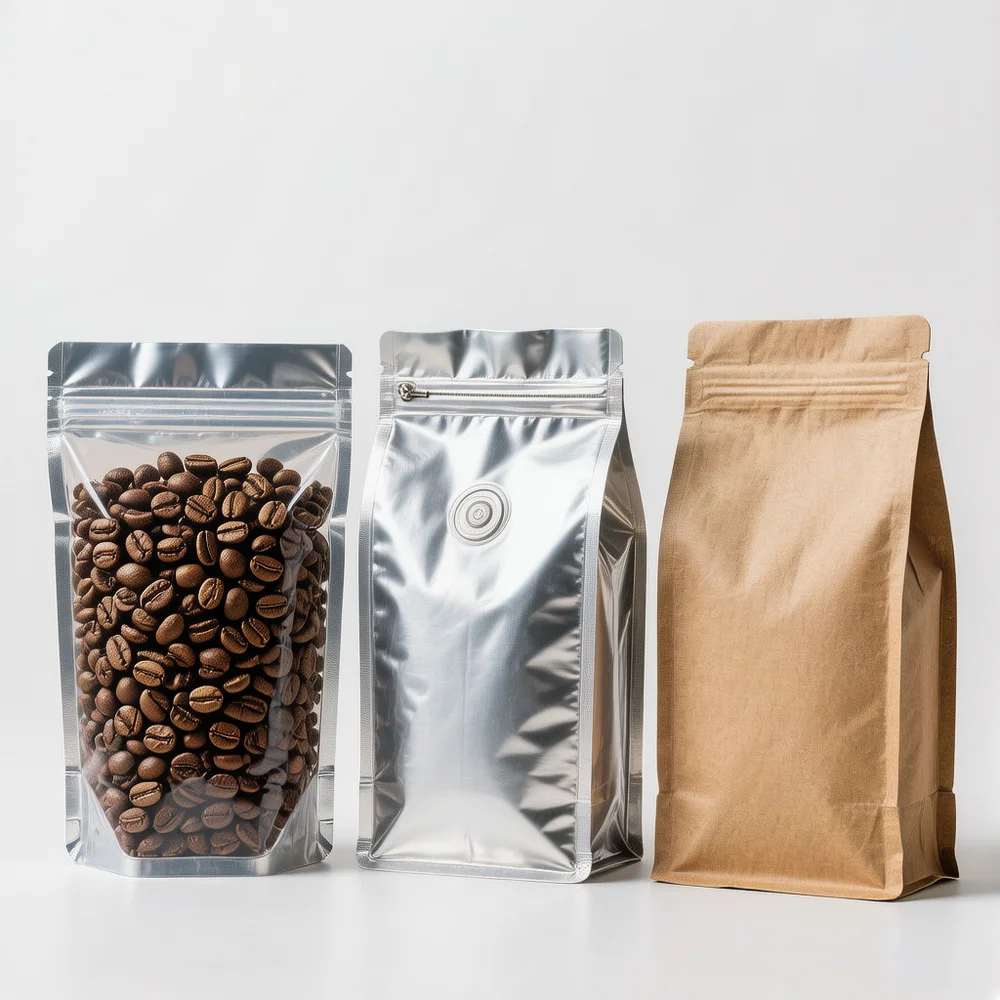
Pouch type is the foundational decision in any custom coffee pouch project, and it has a direct impact on shelf display and the overall consumer experience. Three pouch styles stand out for coffee products:
Eight-side seal pouch: the first choice for specialty coffee
The eight-side seal pouch – also known as a flat-bottom pouch or Box Pouch – has become the fastest-growing format in custom coffee packaging in recent years. Its flat bottom plate lets it stand steadily like a box once filled. Compared with an ordinary stand-up pouch, the eight-side seal design offers a much larger printable surface: the front, both sides, top and bottom can all carry brand artwork.
For specialty coffee brands, the biggest advantage of the eight-side seal pouch is its “shelf presence”. At coffee festivals, specialty supermarkets and similar display environments, the three-dimensional form attracts more attention than flat pouches. The side panels can also carry origin stories, brewing guides and other details, giving brands more room to tell their story.
Stand-up pouch with one-way degassing valve: the balance of functionality and economy
The stand-up pouch is the most classic format in custom coffee packaging. Fitted with a one-way degassing valve, it allows carbon dioxide from the roasted beans to escape while keeping outside oxygen out – the most economical and effective way to preserve coffee freshness.
Stand-up pouches cost less than eight-side seal pouches, though they stand slightly less steadily. If your coffee moves mainly through e-commerce channels, the cost advantage becomes even more obvious. For a detailed comparison of pouch formats, read our in-depth analysis ofpremium coffee packaging pricing strategies.
Kraft paper gusset pouch: a low-cost option with natural texture
The side gussets of a kraft paper gusset pouch expand to create a generous capacity. The kraft exterior delivers a natural feel and look that aligns closely with specialty coffee’s “handcrafted” and “natural” brand story. For coffee brands with limited budgets that still want to project quality, this is a pouch solution well worth considering.
3. Step two of custom coffee pouch packaging: determine the material structure
Material structure is the factor that determines how well custom coffee pouches preserve freshness. Coffee beans are highly sensitive to oxygen, moisture and light, so the film structure needs strong barrier performance:
PET/aluminum foil/PE: the classic high-barrier structure
This is the most common lamination in custom coffee packaging. The PET outer layer offers good printability and mechanical strength, the aluminum foil middle layer blocks nearly all oxygen and light, and the PE inner layer guarantees reliable heat sealing. Together, the three layers can keep coffee fresh for 12 months or longer.
Kraft paper/aluminum foil/PE: combining natural texture and function
Swapping the outer PET for kraft paper gives the pouch a natural, rustic appearance. This structure is especially popular in specialty coffee because the tactile and visual qualities of kraft match brand stories such as “direct sourcing from origin” and “artisan baking”. The aluminum foil middle layer still delivers excellent barrier performance.
Mono-material recyclable structures: a new choice under the eco-friendly trend
With environmental awareness on the rise and regulations tightening, all-PE and all-PP mono-material recyclable structures are emerging as a new trend in custom coffee packaging. This approach gives up some barrier performance – usually compensated by high-barrier coatings – but allows the entire pouch to be recycled. For brands targeting the European market, this option is becoming increasingly important becausethe EU PPWR regulationimposes mandatory recyclability requirements on packaging.
4. Step three of custom coffee pouch packaging: choose the printing process
The printing process determines both the visual result and the minimum order threshold. Two printing methods dominate custom coffee pouch packaging, and each fits a different situation:
Gravure printing: the optimal solution for high-volume, stable products
Gravure printing delivers some of the best color saturation and print precision available. If your coffee brand has stable sales and uses more than 10,000 meters of film per year, gravure is the most cost-effective route. The plate-making cost is a one-time investment, and the per-unit price becomes very low once it is spread across high-volume orders.
Digital printing: the flexible solution for small batches and multiple SKUs
For roasters just getting started, digital printing is the ideal entry point into custom coffee packaging. There are no plates to buy, the minimum order is 1,000 meters, and samples can be ready within 24 hours. That makes it easy to test designs for different origins and roast levels at minimal risk. Once an SKU’s sales stabilize, you can switch to gravure for mass production.
Digital printing also supports versioned marketing. The same coffee can easily launch limited editions such as holiday or co-branded versions, each printed separately with no additional plate-making cost. For specialty brands that need to keep generating buzz, this is an extremely valuable capability.
5. Step four of custom coffee pouch packaging: functional configuration
The functional configuration of custom coffee packaging directly influences both product freshness and the consumer experience:
- One-way degassing valve:the standard feature of custom coffee packaging. A reliable valve keeps out almost all oxygen while letting carbon dioxide escape; we recommend a branded valve with a filter layer.
- Zipper (resealable strip):lets consumers reseal the pouch again and again after opening, protecting the flavor of the coffee that remains. For packs over 250g, a zipper is close to a must.
- Tear notch:laser scoring or a simple notch lets consumers open the pouch without tools, adding convenience.
- Transparent window:some brands add a small window so buyers can see the real beans, which boosts purchase confidence.
That said, functional configuration has to be weighed against product positioning and price range. Not every feature suits every product – over-configuration drives up cost and weakens price competitiveness. We recommend choosing the smallest set of features that fits the product’s core consumption scenarios.
6. Frequently asked questions about custom coffee pouch packaging
Q1: What is the minimum order quantity for custom coffee pouches?
Digital printing starts at 1,000 meters (roughly 2,000-3,000 finished pouches); gravure printing starts at 10,000 meters (roughly 20,000-30,000 finished pouches). The exact figure depends on pouch size and how efficiently the material width is used. We suggest validating market response with a small digital run first, then committing to high-volume gravure production.
Q2: How long does customization usually take?
Digital printing takes about 7-10 working days from design confirmation to delivery; gravure printing takes about 15-25 working days. Peak seasons (before Mid-Autumn Festival and around the end of the year) can extend these timelines, so we recommend starting the procurement process at least 30 days in advance.
Q3: How do you judge degassing valve quality?
Here is what to look for: one-way blocking efficiency above 99%, a working temperature range from -20℃ to 80℃, and a filter layer that prevents powder from clogging the valve. We also recommend testing valve sealing during the sampling stage. For more food packaging material standards, refer toAnalysis of food packaging materials and sanitary certification standards.
7. Summary
Custom coffee pouch packaging is a systematic decision that brings together pouch type selection, material matching, printing process and functional configuration. Each dimension has to be balanced against brand positioning, product characteristics and target market. An excellent custom coffee pouch solution should simultaneously achieve three goals: freshness, brand display and cost control.
PurestPack specializes in custom coffee pouch packaging, providing one-stop solutions that cover pouch type advice, material selection, design sampling and mass production. Whether you need small-batch digital printing to test the market or high-volume gravure production, we can offer a matching custom coffee pouch solution. Visit ourcustom coffee pouch product pagefor more details.
Questions about or need a custom packaging solution? Welcome toContact PurestPack. We offer one-stop service from material selection and structural design to printing sampling and mass production, and our professional team provides free customization advice.