
Dust on a powder pouch filling line is not a housekeeping issue. It is the single largest cause of seal rejects in dry filling, and it usually appears as an intermittent failure that passes a visual check. The fix is rarely one adjustment: it comes from knowing which station makes the dust, how static holds it in place, and how much contamination the seal parameters and the film can absorb before the joint stops being a joint.
Which Fill Stations Generate the Most Dust?
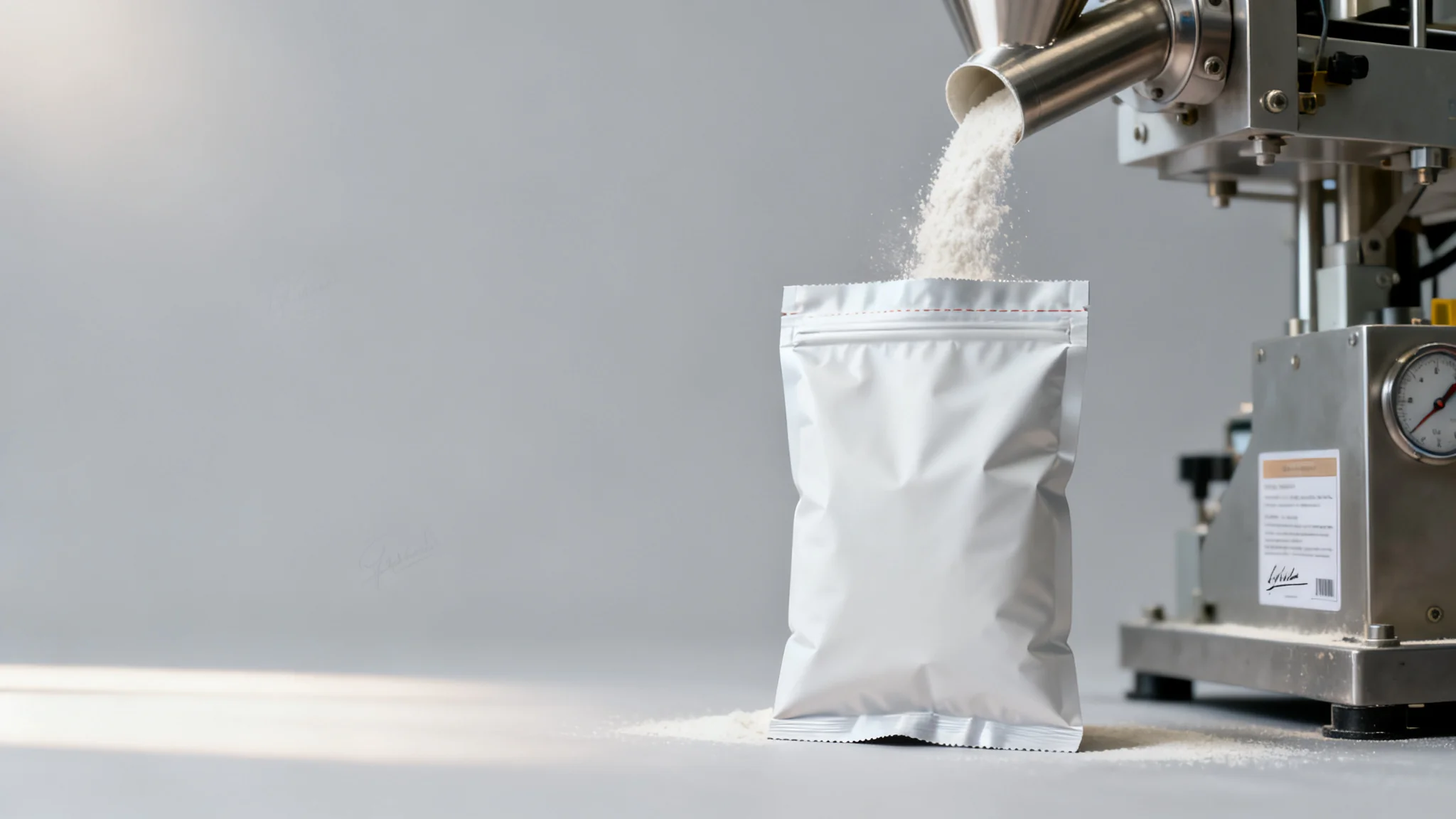
The dosing head makes the obvious cloud, but it is often not the worst offender. Three stations contribute in different ways, and they need different countermeasures. An auger or screw feeder releases a steady stream of fines as the flight tips clear the tube, so the dust is continuous and fine. A volumetric cup or gravity drop releases a larger puff in a fraction of a second when the gate opens, and that puff carries further. The bag transfer and the top-seal station contribute a third source: powder that has already landed on the outside of the bag or on the jaw faces is pushed into the seal zone at the moment of sealing, and that powder has no chance to be extracted.
Mapping the sources first changes the economics of the fix. If the failures cluster on the vertical seal, the dust is arriving early and settling on the film before the bag is formed. If they cluster on the top seal, the problem is usually on the outside of the bag or on the jaws, which is a wiping and jaw-coating question rather than a dosing question.
Why Does Powder Reach the Seal Zone?
Powder arrives at the seal through four paths, and only the first one is obvious. It falls directly from the dosing stream. It bounces off the product surface inside the bag and out through the open top. It is carried on the outside of the formed tube as a thin film after several hundred cycles. And it migrates on air currents created by the extraction system itself, which is why adding suction sometimes makes a dust problem look worse before it looks better.
The film’s own behaviour matters here. A sealant with high surface energy and a slightly tacky feel holds powder better than a slick one; a film with heavy slip additive can actually shed powder more easily but may seal less predictably. These are second-order effects compared with the machine setup, and they should be tested rather than assumed, because the interaction between additive bloom and powder adhesion changes over a production run.
What Static Charge Does to Fine Powder
Fine organic powders charge readily when they slide against a polymer surface, and a charged particle does not fall away from the film. It clings to the seal area, to the inside of the forming tube and to the jaw faces, and it stays there through the air knife that was meant to remove it. This is why a line that runs clean in humid summer weather can fail continuously in a dry heated plant, with no change to the film, the powder or the settings.
Static control is therefore part of dust control, not a separate project. Ionising bars placed immediately before the sealing station neutralise the charge on the film surface so that particles can be extracted instead of held. Grounding the forming tube and the powder contact parts removes the other half of the problem. Our article on static on the packaging line goes further into where the charge comes from and what each remedy actually does.
De-Dusting Options for a Pouch Line
Extraction is the default answer and it works when it is placed correctly. A extraction collar around the dosing head catches the puff at the source; an air knife above the seal zone blows loose particles off the film face before the jaws close; a vacuum shoe at the jaw entry removes what the air knife dislodged. Each element only handles the particle sizes and the locations it was designed for, and a single air knife fitted because a line had dust problems is a common cause of disappointment.
Two mechanical alternatives deserve consideration. A dust flap inside the pouch, above the zipper, gives powder a place to settle that is not the closure or the seal. A jaw coating or a jaw insert that sheds powder reduces build-up on the seal faces, which is the path that no extraction system can reach. Neither replaces extraction; both reduce the amount of powder that extraction has to handle.
How Do You Verify Seal Integrity After Filling?
Verification has to happen on production samples, at line speed, with the real powder in the seal. Offline tests on clean film measure the film, not the process. Three methods cover most needs, and they answer different questions: a visual and tactile inspection finds gross channel defects, a dye penetration test finds the fine channels that visual inspection misses, and a burst or vacuum decay test gives a quantitative result you can trend across a shift.
The comparison of seal integrity testing methods sets out where each one is sensitive and where it gives false confidence. Whichever method is chosen, the sampling plan matters more than the instrument: samples taken at start-up, mid-shift and after a cleaning stop will show the drift that a single sample at the beginning hides. Strength testing on the same samples, following a method such as ASTM F88, gives the number that most customer specifications ask for.
Seal Bar Settings Under Contamination
Temperature, dwell and pressure all interact with contamination, and the trade-offs run in different directions. Raising temperature helps the sealant flow around a particle, but it also narrows the process window and increases the risk of film distortion and seal-through at the jaw edges. Longer dwell gives the polymer more time to diffuse across the contaminated zone, at a cost in line speed. Higher pressure flattens the particle but can also squeeze powder outward into a thin film across the whole seal band, which is worse than a localised lump.
Once the settings are established, record them and stop adjusting them to chase rejects. A line where the operator raises the temperature whenever rejects appear will eventually produce seals that look acceptable and fail in transit, because the same high setting that closes around dust also thins the sealant at the jaw edge. Change the dust level, not the temperature, and use the settings as a stable reference.
Scope Notes: Where This Applies
This applies to vertical form-fill-seal and premade pouch lines running dry powders between roughly 100 g and 5 kg, at speeds where the seal time is measured in a fraction of a second. It fits protein blends, flour and baking mixes, seasoning, milk powder and similar free-flowing products.
It falls short for products that are deliberately sticky at filling temperature, such as warm agglomerated powders, where the deposit on the jaw is a thermal problem before it is a dust problem. It also does not cover the resealable closure on a retail pouch, which fails for different reasons and is a design question rather than a line question.
How Fast Can You Run With Dust on the Seal?
There is no universal ceiling, but the relationship is predictable: as speed rises, seal dwell falls, and the amount of contamination the seal can absorb falls with it. A line that holds a clean seal at high speed may need to slow by a measurable margin once the dust level rises, or accept a higher reject rate, or invest in extraction that brings the dust back down. Choosing between those three is a cost decision that belongs in the specification, and it is much cheaper to make before the line is installed.
Key Takeaways
- Map where the dust lands before buying extraction; vertical seal and top seal failures have different sources.
- Static charge holds fine powder in place and defeats air knives, so ionisation belongs in the dust control plan.
- Verify seals on production samples at line speed with the real powder, and sample across the shift rather than once at start-up.
- Once seal parameters are set, fix the dust rather than raising the temperature, which narrows the window and hides the defect.
Conclusion
Treat dust as a process variable with a measured level, not as an occasional nuisance. Identify which station produces it, neutralise the static that holds it, extract it before the jaws, and verify the result with an integrity method sensitive enough to catch channels. Lines running dairy and nutrition powders in quad seal and stand-up formats can compare structural options in our custom dairy packaging category, or look at a specific build such as milk powder quad seal pouches to see how the seal layout is arranged for a fine powder.
Frequently Asked Questions
Does an air knife alone solve powder contamination on the seal?
Seldom on its own. An air knife only moves particles that are free to move, and fine charged powder clings to the film until the charge is neutralised. It also blows powder in a direction, which can push it towards the jaw rather than away from it. Air knife plus ionisation plus extraction, with the air knife placed immediately upstream of the jaws, is the combination that holds up in production.
Why do seal rejects increase in winter?
Because cold air holds less moisture, and the plant humidity drops when the heating runs. Dry air makes static charge build up faster and makes fine powder cling to film and jaws instead of falling away. The film, the powder and the settings are unchanged, which is why the problem looks mysterious. Measuring relative humidity at the sealing station for a week usually explains a seasonal reject pattern.
Can a thicker sealant layer compensate for a dusty line?
Partly. A thicker sealant layer gives the polymer more material to flow around a particle, so the seal tolerates more contamination before it becomes a channel. It does not remove the particle, and it costs money in every bag. Treat it as a margin rather than a fix, and only choose it after the dust level at the seal has been reduced as far as the extraction system allows.
What sample size shows a stable seal process?
Enough samples to cover the natural variation in a shift: start-up, after each film roll change, after each cleaning stop, and at least once mid-shift. A handful of samples from one moment tells you the machine was working then. Trending the same small sample set across several shifts tells you if it is working now, which is the question that matters for a release decision.