

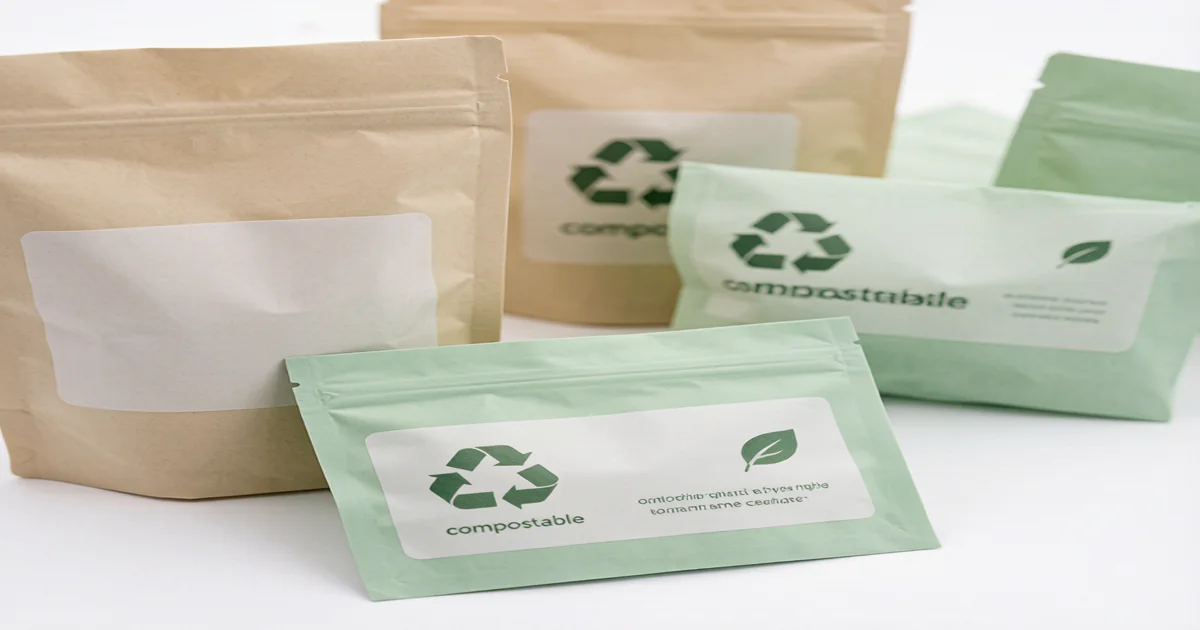
Degradable food packaging poucheshit genuine take-off in 2025. With the“15th Five-Year Plan”targeting 40% biodegradable content in e-commerce packaging (mandatory from 2028), and the EU PPWR imposing recyclability requirements on imported packaging,Degradable food packaging poucheshave moved from“a niche choice”to“a compliance requirement”.
Yet in customer consultations we keep finding the same pattern: roughly 80% of brands still assume“eco-friendly = expensive”and have little visibility into how the three mainstream materials — PLA, PBAT and PHA — actually perform. This article puts comparison data to work so you can choose with clear eyes.
PLA, PBAT, PHA: a full comparison of three mainstream degradable materials
Material sources and degradation principles of degradable food pouches
| Material | Raw material source | Degradation conditions | Industrial composting period | Home composting |
|——|———-|———-|————-|———-|
| PLA (polylactic acid) | Corn starch, sugarcane | Industrial composting (58°C+) | 3-6 months | Not supported |
| PBAT (copolyester) | Petrochemical-based + bio-based | Industrial composting + soil | 6-12 months | Partially supported |
| PHA (polyhydroxyalkanoate) | Microbial fermentation | Industrial composting + seawater + soil | 2-4 months | Supported |
> Key takeaway:“biodegradable”never means the pouch vanishes when casually discarded. PLA needs industrial composting above 58°C and breaks down very slowly in open nature. Verify the composting infrastructure in your target market before locking a material.
PLA degradable packaging: the most mature but also the most limited
PLA is today’s most commercially mature biodegradable material — near-BOPP clarity, solid printability and the friendliest price (CNY 28-35/kg). Its weak spots, though, are real:
– Poor heat resistance: softening starts above 50°C, ruling out hot filling or high-temperature foods
– Average barrier properties: oxygen transmission runs 3-5x higher than PET, so coating treatment is needed
– Demanding degradation conditions: without industrial composting facilities, breakdown can stretch across years
Application scenarios: short-shelf-life chilled foods (salads, sandwiches), dry goods (nuts, grains), and non-oily foods with modest barrier needs.
PBAT biodegradable packaging: PLA’s best “partner”
On its own, PBAT offers unremarkable mechanicals, but it has become the go-to blending partner for modifying PLA – PLA/PBAT films keep the clarity and printability of PLA while PBAT adds toughness and elongation at break.
| PLA/PBAT blend ratio | Tensile strength | Elongation at break | Suitable pouch types |
|———————-|———-|————-|———-|
| 70/30 | 45 MPa | 180% | Lightweight food pouches |
| 50/50 | 28 MPa | 350% | High-performance scenarios |
Practical advice: more than 90% of the“biodegradable food pouches”on the market are PLA/PBAT blends, with ratios tuned to cost and end use.
PHA degradable packaging: the future star, but still at a high price point
PHA’s headline strength isgenuine degradation in natural environments– microbes break it down in seawater, soil and freshwater, leaving harmless residues. The catch is price: currently 3-4x that of PLA (CNY 100-140/kg), which confines it to premium organic foods and high-value EU-bound exports.
Compliance and certification system for degradable food pouches
Domestic and international certification requirements for degradable food pouches
To bringDegradable food packaging pouchesto market, two hurdles must be cleared together: food-contact safety plus degradation performance certification.
| Market | Food-contact certification | Degradation performance certification | Label requirements |
|——|————-|————-|———-|
| China | GB 4806.1-2016 | GB/T 19277 (industrial composting) | Chinese wording “compostable” |
| EU | EU 10/2011 | EN 13432 (composting) + OK COMPOST HOME | Seedling logo |
| US | FDA 21 CFR | ASTM D6400 | BPI certification logo |
| International shipping | — | OK BIODEGRADABLE MARINE | Coral logo |
> Hands-on tips: for EU exports, the pouch itself must carry EN 13432 certification, and the complete pouch – printing inks included – has to pass testing. Certifying the base film alone will not clear customs scrutiny.
Cost analysis: how much more expensive are degradable pouches?
PLA/PBAT cost comparison for degradable food pouches
| Material structure | Base material cost (CNY/kg) | Made-pouch cost comparison | Premium payback period |
|———-|————-|————-|————-|
| PET/PE (traditional) | 18-22 | Baseline | — |
| PLA/PBAT 70/30 | 30-38 | +45%~60% | Covered by brand premium in 3-6 months |
| PLA/PBAT 50/50 | 35-42 | +65%~85% | Covered by brand premium in 6-10 months |
| PHA mono-material | 110-140 | +350%~420% | Only viable for premium positioning |
Key finding: Nielsen’s 2025 Chinese consumer survey reports 68% of respondents willing to pay a 10%-15% premium for eco-friendly packaging. A +50% packaging cost uplift can therefore be fully absorbed within about 6 months through modest price adjustments.
3 ways to reduce degradable food pouch costs
1. thinner-gauge design: PLA/PBAT film can be run at 12μm versus the 15μm of traditional PET/PE; less material, lower cost
2. mono-material structure: an all-PLA structure replaces the three-layer PLA/PBAT/adhesive lamination and lifts recycling rate to 95%
3. Lock in prices with large volumes: PLA pellet pricing swings hard; buyers using >50 tons per year can fix annual purchase prices
Decision framework: which one suits your product?
Decision tree for buying degradable food pouches
1. Is the product exported to the EU? -> yes: choose PLA/PBAT (with EN 13432 certification); no: continue
2. Does it contain oil or high moisture? -> yes: need PLA + high-barrier coating; no: continue
3. Is the unit price >CNY 80/kg (food)? -> yes: consider PHA to elevate brand positioning; no: PLA/PBAT is sufficient
4. Are industrial composting facilities available? → Yes: PLA is fully viable; No: consider PHA or traditional recyclable structures
For the selection logic of traditional food packaging pouches, please refer to our [Food Flexible Packaging Customization Pitfall-Avoidance Guide](#).
If your product also needsrigid packaging solutions(such as PLA blister trays, PLA-coated paper boxes, etc.), you can also learn about our sister brand plastic packaging customization platform for integrated biodegradable solutions from flexible to rigid packaging.
Summary: 3 core conclusions for biodegradable food packaging pouches
Looking back at this article,Degradable food packaging pouchesselection comes down to three conclusions:
1. PLA/PBAT is the most practical choice today— cost stays controllable, the supply chain is mature, and domestic plus international certification systems are complete
2. Degradation conditions determine material selection— where industrial composting exists, PLA works; for EU exports or“marine degradation”claims, move to PHA
3. The cost premium is absorbable— 68% of consumers will pay a premium for eco-friendly packaging, and pricing strategy can absorb the incremental packaging cost
> Eco-friendly packaging is not a“cost burden”but a ticket to the next round of brand competition.
Need professional biodegradable packaging solutions? Contact the PurestPack expert team for free material recommendations, certification consulting and sampling services.
—
*References: China Packaging Federation “2025 Biodegradable Packaging Industry Development Report”, European Commission EN 13432:2000 standard text, GB/T 19277.1-2011 “Determination of the Ultimate Aerobic Biodegradability of Plastic Materials Under Controlled Composting Conditions”*