

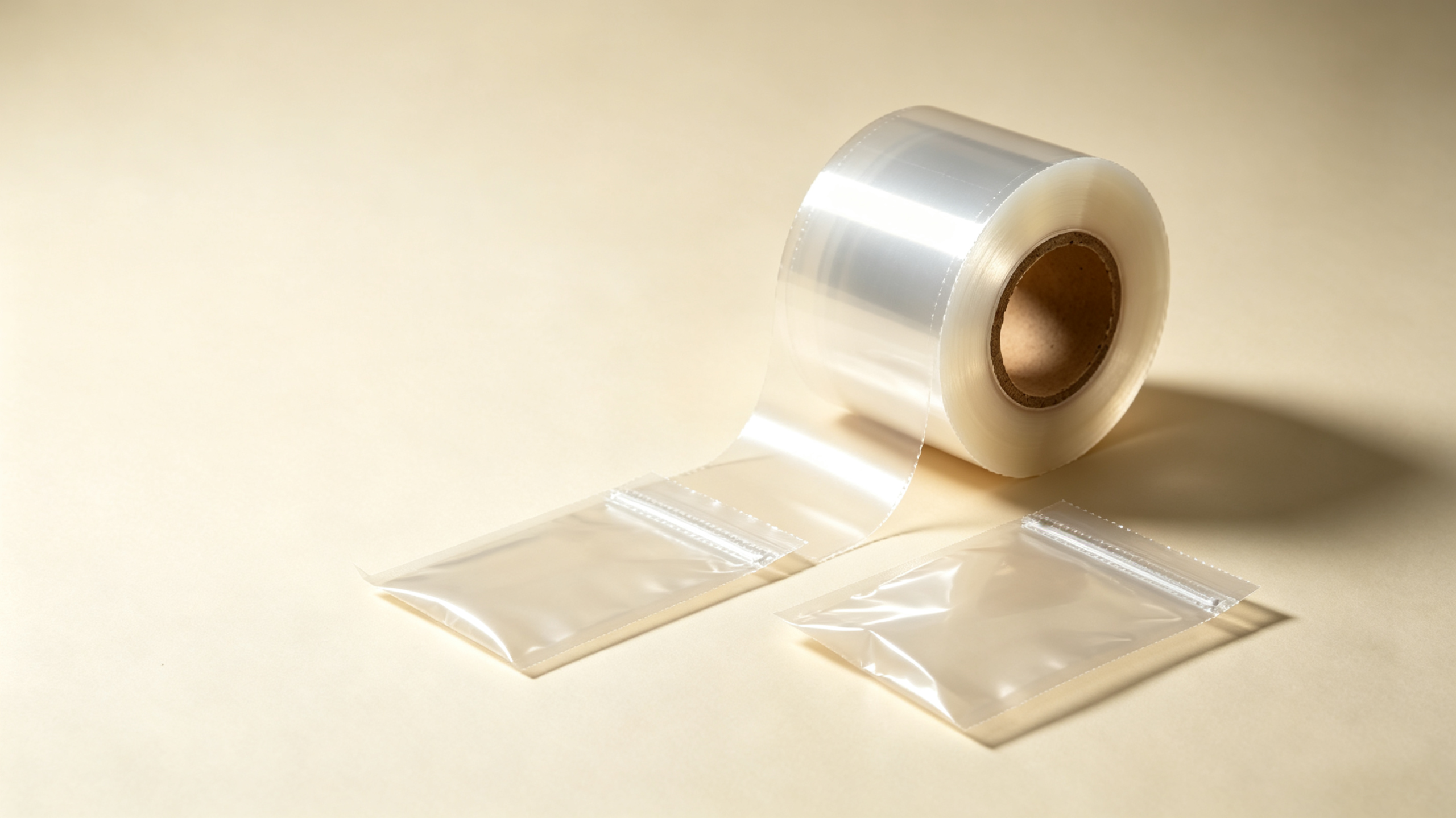
Pick up a stand-up pouch of dried mango and it feels crisp and rigid in the hand. Squeeze a bag of frozen berries and the film resists your grip instead of collapsing. That stiffness and clarity almost always come from the same place: a PET layer, usually no thicker than a human hair, doing the structural and visual work while other layers handle sealing and barrier. PET is the most widely specified outer film in flexible packaging, and understanding what it does — and what it cannot do — is the fastest way to read any laminate specification.
What PET actually is
PET (polyethylene terephthalate) is a polyester. In flexible packaging it is used almost exclusively as biaxially oriented film, meaning the sheet is stretched in both the machine and transverse directions during manufacture. That stretching is what gives the film its tensile strength, clarity and dimensional stability — the properties a formulator is really buying.
You will also see it written as BOPET (biaxially oriented PET), and by trade names such as Mylar. Chemically it is the same polymer used in beverage bottles, but the orientation and gauge are entirely different.
Key properties that matter in packaging
Clarity and gloss
PET routinely delivers light transmission above 90% with a high-gloss surface, which is why it is the standard substrate for reverse printing. When graphics are printed on the inside face of the film, the PET layer itself becomes a protective, glossy laminate over the ink — the print cannot scuff off in transit. For products that sell on appearance, this is the single most valuable thing PET offers.
Tensile strength and dimensional stability
Oriented PET has high tensile strength and resists stretching under load, so a pouch holds its shape rather than deforming. It also stays dimensionally stable at the temperatures encountered during printing, lamination and heat sealing — film that grows or shrinks unpredictably on press is a converter’s nightmare, and PET is forgiving by comparison.
Temperature range
PET performs from roughly -60°C up to about 150°C for short exposures, with continuous service commonly cited nearer 120°C. That covers freezer storage, ambient distribution and most pasteurisation processes. It does not, on its own, make a pouch retort-grade — that depends on the sealant layer and the adhesive system, not on the PET.
Barrier: modest, and worth stating plainly
PET provides a moderate oxygen barrier and a reasonable moisture barrier, but it is not a barrier material in the way foil or EVOH are. If a product needs a long ambient shelf life, PET will not deliver it alone. This is the most common misreading of a specification — seeing PET/PE and assuming the PET is doing the preservation work.
Sealing: it does not
PET has a high melting point and heat-seals poorly to itself. In every practical structure it is laminated to a sealant film, most often PE. PET is the face; something else closes the bag.
Where PET is used
Printed outer layer in laminates
This is the dominant application. PET/PE is the baseline structure for snack and confectionery packaging, and PET/AL/PE or PET/NY/PE appear wherever more barrier or toughness is needed. The PET carries the graphics and the scuff resistance.
Stand-up and flat-bottom pouches
PET supplies the stiffness that lets a pouch stand on shelf. Our Complete Guide to Stand-Up Pouches covers how the outer film choice interacts with gusset design and base stability.
Lidding film and windows
Thinner PET gauges are used as lidding for trays and as window patches in paper-based packaging, where clarity matters but full-barrier performance does not.
Choosing the right gauge
PET film is typically specified between 8µm and 25µm, and the choice is a cost-versus-stiffness decision:
- 8–12µm — the standard range for general-purpose laminates. Enough body for most pouch formats at the lowest material cost.
- 12–16µm — specified when the pouch needs noticeably more rigidity, or when the structure includes heavy or abrasive contents.
- 19–25µm — used for lidding, form-fill-seal webs requiring high stiffness, and applications where puncture resistance at the outer layer matters.
Going thicker is a legitimate way to add stiffness, but if the real problem is puncture resistance, adding nylon will solve it at lower weight than simply increasing PET gauge.
How PET compares with the alternatives
- PET vs BOPP — BOPP is cheaper and has a good moisture barrier, but lower tensile strength, lower temperature resistance and slightly hazier clarity. BOPP is common on snack flow-wraps; PET wins where stiffness, heat resistance or print quality matter.
- PET vs nylon — nylon offers far better puncture and flex-crack resistance but costs more and absorbs moisture. PET is the outer-layer default; nylon is added when the contents or the distribution chain justify it.
- PET vs kraft paper — kraft paper trades clarity and barrier for a natural look and paper-stream recyclability. The choice is usually brand-driven rather than technical.
Working with PET in production
Three practical points come up repeatedly. First, PET takes surface treatment well, but corona treatment levels decay over time — film stored too long before printing may need retreatment to hold ink adhesion. Second, because PET is hygroscopic to a modest degree and dimensionally stable only within its range, storage at stable humidity avoids registration surprises. Third, PET is often chosen for reverse printing, which means the ink is trapped between films; confirm with your converter that the ink system is rated for lamination and, where relevant, for the retort or pasteurisation conditions the pack will see.
Is PET recyclable?
PET bottle recycling streams are well established, but flexible PET film is a different matter — multi-layer laminates containing PET are generally not accepted in those streams because the layers cannot be separated. Mono-material developments are addressing this, and all-PET structures do exist, but they remain a niche. If recyclability is a hard requirement, raise it before the structure is fixed rather than after.
Choosing a structure for a new product? Contact Us — we can advise on gauge, lamination and cost trade-offs from a production standpoint.