

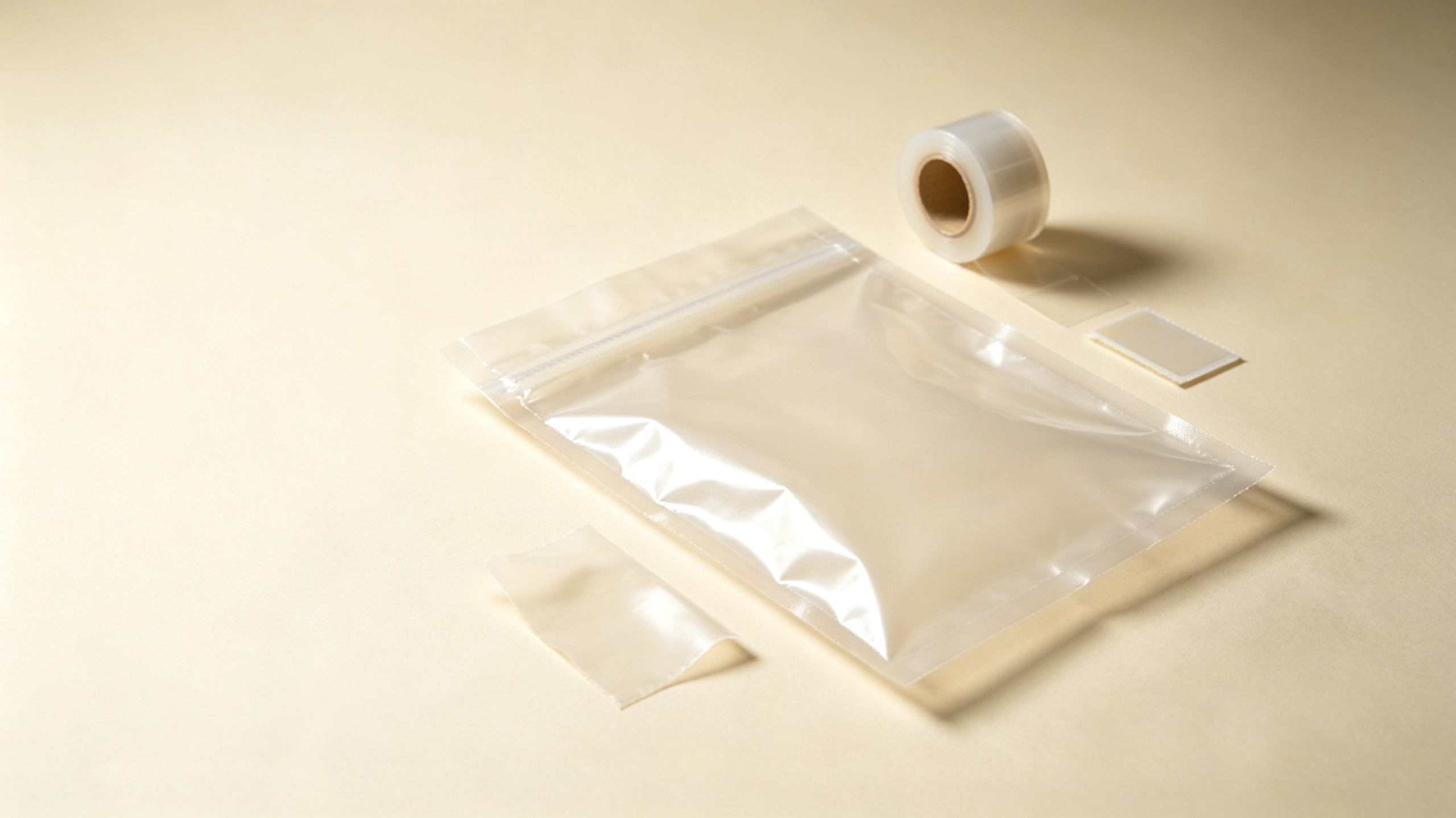
Nearly every flexible package you have ever opened was sealed shut by polyethylene. It is invisible in the specification — buried as the last entry in a structure code, the “/PE” that nobody discusses — and yet it is the layer that determines whether a pouch actually closes, whether it survives a drop in the freezer, and whether it can be recycled at end of life. PE is the least glamorous material in flexible packaging and quite possibly the most important.
One name, several materials
“Polyethylene” describes a family rather than a single film. The differences come from how the polymer chains branch during polymerisation, which sets the density, and density in turn drives stiffness, clarity, barrier and melting behaviour:
- LDPE (low-density polyethylene) — the traditional sealant. Soft, flexible, excellent hot tack, seals at roughly 105–115°C. Lower stiffness and lower temperature resistance.
- LLDPE (linear low-density) — stronger and more puncture-resistant than LDPE at equal gauge, with better seal-through-contamination. Slightly harder to process. Now the most common sealant in demanding applications.
- MDPE / HDPE (medium / high density) — stiffer, more opaque, better moisture barrier, higher melting point around 130°C. Used where the package needs body or grease resistance, and in paper lamination.
- mPE (metallocene PE) — engineered for very low seal-initiation temperature and high hot tack, which allows faster packing lines. Carries a cost premium.
In practice a sealant layer is often a blend — an LLDPE base with LDPE or mPE added to tune the sealing window.
Why PE became the default seal layer
Seal initiation temperature and hot tack
Two numbers govern sealing performance. Seal initiation temperature is the point at which a seal begins to form — lower means faster line speeds and less heat stress on the product. Hot tack is the strength of the seal while it is still molten, which matters enormously on vertical form-fill-seal lines where the product drops into the pouch before the seal has cooled. PE, particularly LLDPE and mPE, gives a good combination of both, which is why alternatives struggle to displace it.
Seal-through-contamination
Product dust, oil or moisture sitting in the seal area is the most common cause of leaking pouches. LLDPE and mPE sealants tolerate contamination significantly better than LDPE or PP, which is why they are specified for oily snacks, powders and wet products.
Low-temperature toughness
PE stays flexible well below freezing — down to -50°C for many grades — where other sealants become brittle and crack. Anything headed for a freezer depends on this property. It is the reason a frozen-food pouch can be dropped and handled without the seams shattering.
Barrier performance, and where it falls short
PE has a good water vapour barrier and a poor oxygen barrier. That combination has a clear practical consequence: PE-sealed pouches protect against moisture gain or loss very effectively, but they do not stop oxidation. A product that goes rancid rather than stale will not be protected by PE alone, regardless of thickness. That is the point at which a specification adds aluminium foil or EVOH.
Grease resistance is also only moderate for LDPE, better for HDPE, which matters for fatty products where oil migration can attack the seal over time.
When PE is the whole package
Single-layer PE does carry some applications on its own. Heavy-duty sacks, mailers, bread bags and household freezer bags are typically monolayer PE, where the requirement is containment rather than shelf life. There is also a large and growing category of PE-based shrink and stretch films used for secondary and transit packaging, different in orientation but the same base polymer.
Mono-material PE and the recyclability push
This is where most material development is happening. A conventional high-barrier laminate mixes polymers — PET, foil, nylon, PE — and the result cannot be mechanically recycled because the layers are inseparable. An all-PE structure, by contrast, can in principle enter existing PE film recycling streams where collection exists.
The engineering challenge has been replacing the barrier that foil or EVOH provided, using oriented PE (BOPE) for stiffness and, in some designs, thin barrier coatings. The performance is genuinely better than it was five years ago, though for very long shelf lives or highly oxygen-sensitive products, conventional laminates still hold an advantage. Regulations such as the EU’s PPWR are pushing the whole market in this direction, so it is worth asking your supplier what mono-material options exist for your product even if you stay with a conventional structure today.
When CPP takes over from PE
Cast polypropylene (CPP) is the alternative sealant, and it wins on one axis: temperature. CPP tolerates retort conditions above 121°C where standard PE would soften and fail. If the product is sterilised in the pouch, the sealant will almost certainly be CPP rather than PE. Everywhere else, PE’s sealing behaviour, toughness and cost keep it in front.
Specifying PE: what to tell your supplier
A useful specification conversation covers these points:
- Seal conditions — jaw temperature, dwell time and pressure on your line, which determine the sealant grade you need.
- Hot tack requirement — essential if you run high-speed vertical form-fill-seal.
- Product contamination — oil, powder or moisture in the seal area pushes you toward LLDPE or mPE.
- Storage temperature — frozen distribution demands a low-temperature-tough grade.
- End-of-life target — if recyclability matters, ask specifically about all-PE structures rather than assuming the current laminate qualifies.
Sealant selection is where a lot of avoidable field failures originate, and it is also one of the cheapest things to get right up front.
Having trouble with seal failures or freezer cracks? Contact Us — we can review your sealant specification against your packing conditions.