

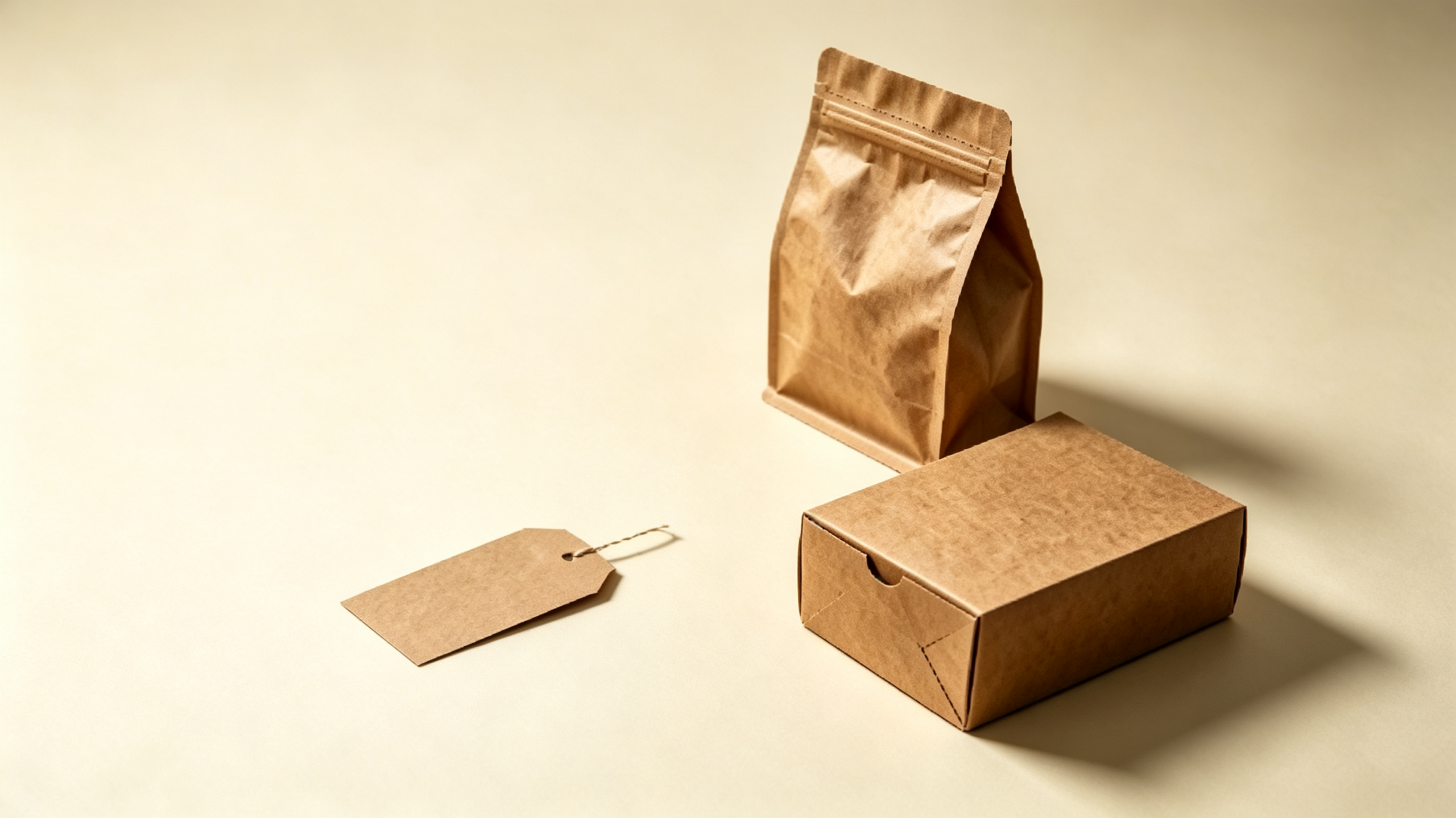
A kraft pouch communicates something before the customer reads a word. The warm brown surface, the slight fibre texture, the matte finish — all of it signals natural, considered, small-batch, and for coffee, tea, nuts and dried fruit that signal is worth real money. What the customer does not see is that underneath the paper sits a structure of plastic films doing the actual work of keeping the product fresh. Understanding that division of labour is what separates a kraft pouch that performs from one that merely looks the part.
What kraft paper is
Kraft paper is made from wood pulp processed by the kraft process, which uses a chemical treatment to remove lignin while leaving the cellulose fibres long and intact. Long fibres mean strength — that is what “kraft” denotes, from the German word for strength. The natural unbleached version is brown; bleaching produces white kraft, which takes print differently and reads as cleaner and more clinical.
In flexible packaging, kraft is used as an outer ply at weights typically between 40 and 120 gsm, most often 60–80 gsm for pouch applications. It is almost always laminated to films.
Key properties
Tensile and tear strength
Kraft is strong for its weight and resists tearing better than most papers, which is why it survives filling, sealing and distribution. This mechanical strength is genuine and is the property that made it the historical standard for industrial sacks.
Surface and texture
The visible fibre texture and matte finish are kraft’s main marketing asset. It prints well in the right idiom — bold, simple graphics read better than fine detail or photographic imagery, because the absorbent surface and the base colour affect how inks appear.
Breathability
Kraft is porous. In some applications that is useful: fresh produce, bread and some bakery items benefit from a package that lets moisture escape rather than trapping it. In most applications it is a problem that the laminate has to solve.
Why kraft always needs a laminate partner
A “paper pouch” is not a paper pouch. Kraft cannot heat-seal to itself in any practical way and offers no meaningful oxygen or moisture barrier, so every kraft flexible package is a composite. The typical build is kraft paper on the outside, a PE layer providing the seal, and — where shelf life demands it — a barrier layer such as aluminium foil or EVOH between them.
Common structures: kraft/PE for dry goods with short shelf lives; kraft/AL/PE for coffee and products needing a real barrier; kraft/PE with a metallised or coated layer for a middle option. Some designs leave a kraft exterior with a transparent film window, so the customer sees the product through a clear panel in an otherwise paper pack.
Moisture and barrier behaviour
Kraft absorbs water. Left unlaminated and exposed to humidity it loses strength, curls and can support mould growth. Even when laminated, the exposed outer surface will pick up moisture in humid conditions, which matters for two reasons. First, packs shipped through tropical or high-humidity climates can arrive looking tired and slightly warped. Second, if the laminate is breached at a seal or a crease, the paper wicks moisture inward rather than resisting it.
Practical responses include specifying a moisture-resistant coating or film lamination on the outer face, using a higher gsm paper for large formats that must hold shape, and testing in conditions that match the actual distribution route. For frozen or chilled products, kraft needs particular care because condensation on a cold pack is close to unavoidable.
Sustainability claims: what is actually defensible
This is where brands most often overreach, and it is worth being precise. Three separate claims get conflated:
- Recycled content — kraft can contain high levels of recycled fibre, and unbleached kraft with recycled content is a legitimate, verifiable claim.
- Certified fibre — FSC or PEFC certification confirms responsible sourcing. This is independently auditable and is the strongest single claim available for a kraft pack.
- Recyclability or compostability — this is the problematic one. A kraft/PE laminate is a multi-material composite and is generally not accepted in paper recycling streams, because the plastic layer contaminates the pulping process. A kraft pouch is not recyclable simply because it looks like paper.
There are paper-based mono-material structures in development that improve on this, and some industrial composting routes accept specific certified laminates, but neither is a general property of kraft packaging. If your brand plans to make an end-of-life claim, confirm it against the actual structure and the collection infrastructure in your market — a claim that is technically true in one country can be misleading in another.
Where kraft works best
Kraft suits products whose brand story is built on natural or craft positioning and whose barrier needs are moderate: whole-bean coffee, loose-leaf tea, nuts and dried fruit, granola, spices, and some pet treats and dry goods. It is less suited to products requiring very long ambient shelf life, anything light-sensitive that also needs to be visible, high-moisture or frozen products, and applications where photographic print quality is central to the design.
Coffee and tea are the strongest fit because the barrier requirement, while real, is well matched to a kraft/foil laminate. We cover those structures in more detail in the Custom Tea Pouch Packaging Guide and the Complete Guide to Coffee Pouches.
Printing and finishing on kraft
Kraft’s colour and absorbency change how ink behaves, and designs that work on white film often disappoint on brown paper. A few rules that hold up in practice:
- Expect a colour shift. Light inks on unbleached kraft will read warmer and duller. White ink as a base layer is often used under artwork that needs to pop.
- Keep it simple. Bold line work, solid areas and limited palettes suit the surface; fine gradients and photography generally do not.
- Consider print method. Flexographic printing is standard; digital is increasingly viable for short runs and versioning.
- Finishes change the proposition. Matte lamination preserves the natural feel, while a gloss varnish or foil stamping adds a premium accent — both mute the rustic character to some degree.
Specifying kraft: practical points
When you brief a kraft structure, these are the decisions that shape the outcome: paper weight and whether it is bleached or unbleached; the barrier layer and the target shelf life it needs to deliver; whether the outer face needs moisture-resistant treatment; the sealant grade and its compatibility with your packing line; and the certification or recycled-content claims you intend to make. Getting those five clear at the start avoids the most common failure — a beautiful pack that does not protect the product.
Planning a kraft pouch? Contact Us — we can advise on paper weight, barrier layer and finishes for your product.