
Material selection is a critical step in custom pouch making. When you start customizing pouches, do you often get lost among all the material names? What is PE? What is PET? Can kraft paper really hold food? Is PLA biodegradable film dependable? Don’t worry — this article will clear up the confusion. We are not going to dive into complex chemical formulas; we will focus on practical, real-world applications and explain the 6 most common custom pouch materials in plain language.
At a glance: six pouch materials in one table
Use this comparison to shortlist materials. Pouch performance, recyclability and compostability depend on the complete construction, not one layer alone; confirm the final structure with application testing.
| Material | Main strengths | Limits and construction notes | Typical applications |
|---|---|---|---|
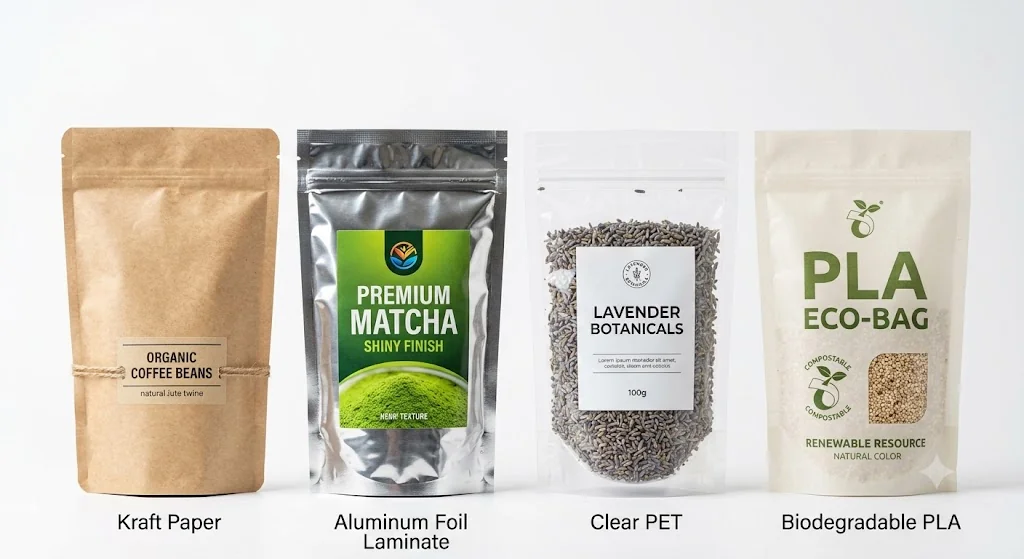
| Kraft paper | Rustic appearance and good print surface | Limited moisture and oxygen barrier on its own; pouches often need a separate barrier and sealant layer | Tea, bakery and dry goods |
| Aluminum foil laminate | Strong oxygen, moisture and light barrier | Opaque and generally higher cost; typically combined with outer and heat-seal layers | Coffee, nuts, tea and milk powder |
| PE | Moisture resistance, heat sealability and relatively low cost | Limited oxygen barrier without additional layers; commonly used as the sealant layer | Dry goods, snacks and frozen food |
| PET | Clarity, printability and dimensional strength | Usually needs a PE or CPP sealant layer to form a pouch | Display packaging for candy and biscuits |
| PA (nylon) | Puncture resistance and flexibility at low temperatures | Usually laminated with a heat-seal layer; moisture barrier depends on the full structure | Vacuum packs, frozen meat and seafood |
| PLA | Bio-based option with good clarity | Heat resistance and barrier properties need checking; compostability claims require verification for the finished pouch | Selected short-shelf-life and fresh products |
1. Kraft paper: the eco-friendly choice and top pick for texture
Kraft paper has become one of the most popular packaging materials in recent years, and for good reason: uncoated kraft paper has a distinctive natural look. Whether a finished pouch can be recycled or composted depends on its coatings, laminates and local collection systems. Kraft paper pouches offer strong tensile and burst strength plus a warm, rustic look — ideal for bakery items, tea and dry goods. The catch is that kraft paper’s moisture and oxygen barrier is weak, so it is not suitable for long-term food storage on its own. In practice, many manufacturers laminate a PE film or aluminum foil inside the kraft layer, keeping the paper appearance while solving the moisture and freshness problems. When you customize pouches, if brand tone and an eco image matter to you, kraft paper laminates are an excellent choice.
2. Aluminum foil laminates: the king of freshness
Aluminum foil laminates rank among the strongest barrier materials available, blocking almost all oxygen, moisture and light. They are typically used as the middle layer, laminated with PET, PE and other films to form the classic three-layer PET/AL/PE structure. The outer PET supplies the printing surface and mechanical strength, the middle foil provides the barrier, and the inner PE handles heat sealing. Foil laminate pouches are widely used for coffee, nuts, tea, milk powder, seasonings and other products with extremely high freshness requirements. The downsides are a higher material cost and an opaque foil layer that cannot show the product inside. On the other hand, this very opacity lets foil pouches produce more striking print results — with refined design they convey a premium quality feel.
3. PE (polyethylene): the most economical choice
PE (polyethylene) is one of the most common and most affordable packaging materials. PE pouches are soft, moisture-resistant and easy to heat-seal, and they are widely used as outer or inner packaging for dry goods, snacks and frozen food. Transparency can be adjusted through the formulation, ranging from semi-transparent to highly transparent. The advantages are clear: low price, mature processing and stable supply. The disadvantages: average oxygen barrier, a softer feel, and limited dimensional display. PE usually serves as the inner layer of laminated pouches; standalone PE outer pouches are relatively rare. When customizing, if your budget is tight and freshness requirements are modest, PE offers excellent value.
4. PET (polyester) film: a transparent, good-looking all-purpose material
PET (polyethylene terephthalate) is a highly transparent, high-strength packaging material with excellent printability and dimensional stability. PET film delivers high clarity and gloss, letting consumers see the product directly — ideal for display-oriented packaging such as candy, biscuits and frozen goods. PET also resists chemicals and oils well, making it suitable for oily products. However, PET’s heat-seal performance is poor, so it usually needs lamination with PE or CPP film to seal properly. If you want packaging that shows the product while still providing decent protection, PET laminates are a solid choice.
5. PA (nylon): the puncture-resistant powerhouse
PA (nylon) film is known for outstanding puncture resistance and flexibility — the first choice for frozen food, vacuum packaging and demanding industrial packaging. Nylon stays flexible at low temperatures without brittle cracking, which makes it especially suitable for frozen meat and seafood. Its oxygen barrier is also quite good, and it is often laminated with PE (in a PA/PE structure) to combine puncture resistance with heat sealing. The trade-offs: higher cost and a mediocre moisture barrier, so it usually needs to be paired with other materials in practice. If your product has sharp edges (think frozen chicken wings or bones) or must be shipped at extreme temperatures, PA nylon laminates are the safest option.
6. PLA (polylactic acid): a bio-based packaging option
PLA (polylactic acid) is a bio-based polymer that can be made from plant-derived feedstocks. Some PLA products are suitable for industrial composting, but compostability must be verified for the complete pouch and the applicable facility; see the US EPA guidance on compostable plastics. In recent years, driven by global plastic-restriction policies and growing consumer environmental awareness, demand for PLA pouches has risen quickly. PLA’s transparency and processing behavior are close to those of traditional plastics, but it has current limitations: limited heat resistance that depends on the formulation, higher cost and demanding degradation conditions. It suits short-shelf-life organic food, fresh produce and bakery products. Choosing PLA for custom pouches can be a strong talking point in a brand’s eco story, but you also need to tell consumers how to dispose of it correctly.
Summary: how to quickly choose the right custom pouch material?
After seeing all these materials, you may feel even more confused. In fact, custom food packaging pouch material selection can be simplified into three steps. First, define the product characteristics — does it need a high barrier? Does it have sharp edges? Is transparency required? Second, set the budget range — what is the maximum packaging cost per product? Third, balance brand positioning — premium brands lean toward foil or kraft laminates, while value lines opt for PE or PET. If you are still unsure, read our Packaging Materials Introductory Guide, or contact a custom pouch manufacturer directly, request samples and run actual tests before mass production — that is the most reliable approach.
Still have questions about pouch material selection? Contact PurestPack for guidance. We provide full-process service from material consultation and structural design to sampling and mass production, and we will recommend the optimal material solution for you free of charge.