

Walk down any supermarket snack aisle and a quiet experiment is running: pouches holding the same kind of product feel completely different — some soft and pliable, some crisp and stiff, some sturdy enough for the microwave. Packaging material science explains every one of those differences. Whether you operate a food business or are preparing to launch a brand of your own, knowing how materials differ keeps you from wasting budget and turns packaging into a smarter decision.
The Three Families of Packaging Materials
Flexible packaging on the market today draws from three material families: plastic, paper and aluminum foil. The categories sound straightforward, but the real power emerges in how they combine — stack the strengths of several materials together, building-block style, and you can create pouches for almost any product.
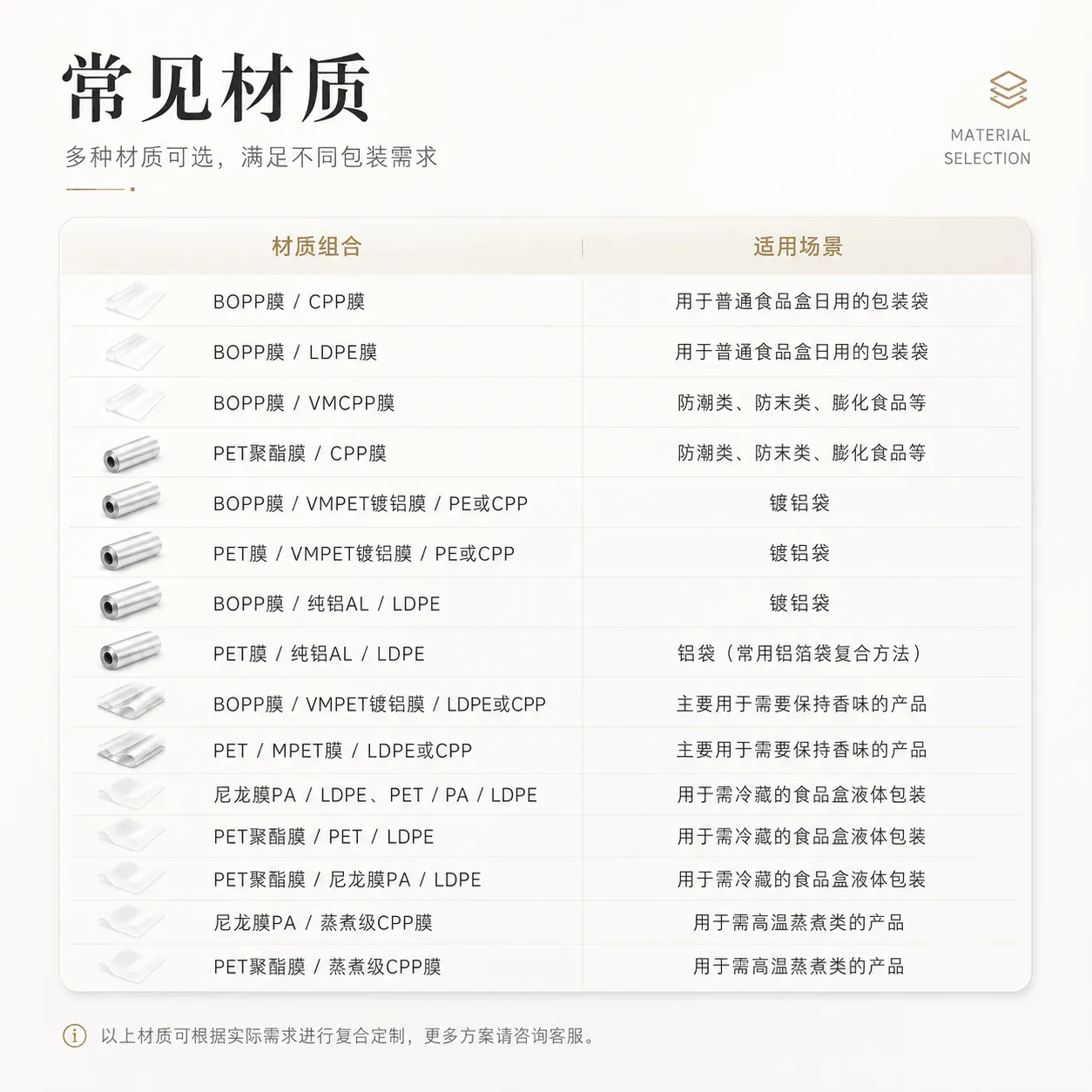
Plastics carry most of the workload. PE (polyethylene) brings toughness and handles heat sealing, which is why it forms the inner layer of most pouches; PET (polyester) is stiff and prints beautifully, making it the go-to outer layer for fine graphics; NY (nylon) resists puncture, a must for bone-in or sharp-edged food; PP (polypropylene) offers the best clarity, showing the product inside with almost no haze.
Paper delivers a natural, eco-friendly hand feel, but on its own it blocks neither moisture nor oxygen, so it is nearly always laminated with plastic or foil. Kraft paper pouches have a pleasing texture and suit coffee beans, tea and dried fruit.
aluminum foil remains the barrier king — shutting out light, oxygen and moisture simultaneously. Products that must store long-term, from coffee powder to milk powder and spices, almost always rely on foil-containing structures. Foil’s weakness is creasing and cracking, so it too needs a plastic partner before it works as packaging.
The “Stacking Game” of Laminated Materials
Because every single material carries some flaw, real pouches are almost never single-layer — they are laminates. The classic build runs three layers: an outer print layer, a middle barrier layer and an inner heat-seal layer.
Take the coffee bean pouch in your hand as an example: it is very likely PET + AL + PE. PET sits outside to carry high-definition printing and give the pack its premium finish; a layer of aluminum foil (AL) in the middle blocks light and oxygen so the beans stay fresh; PE lines the inside, heat-sealing the pouch leak-tight.
When that level of barrier isn’t necessary, metallized film (VMPET) can stand in for the foil — close performance at a gentler price. Fully transparent packaging needs nothing more than PET + PE, letting shoppers see the product directly.
With so many pouch shapes, how do you choose?
Material settled, pouch type comes next. Each format has products and scenarios where it naturally excels.
three-side seal pouch is the fundamental format — sealed along three sides, uniform in shape and cheap to make, ideal for small snack packs, powders and granular products.
stand-up pouch opens a gusseted bottom and stands on its own, presenting well on shelf. Liquids, sauces and laundry detergent all gravitate to this format.
Flat Bottom Pouch / Square Bottom Pouch sits on a flat base, holds a large volume and reads like a small box on shelf. Coffee beans, rice and pet food are its home turf.
shaped pouch throws convention out — penguin silhouettes, heart shapes, purpose-built vertical formats. These exist to grab attention and separate a product from everything around it.
Spouted Pouch adds a screw-cap spout for repeated dispensing. Kids’ snacks, juice and liquid detergent all use this format.
If you now understand packaging material basics and want to apply them to your own product, check out PurestPack’scustom packaging services, or learn more aboutStructural EngineeringandDigital Printing and how they help you bring your product packaging design to life.
Common Mistakes to Avoid
Certain mistakes repeat themselves in custom packaging projects; knowing them beforehand spares you a painful learning curve.
Mistake 1: Thicker is better.Plenty of buyers equate thickness with strength and quality. In reality, protection comes mainly from the material structure and lamination process, not raw thickness. A thin pouch built from the right combination protects perfectly well — while an over-thick pouch is harder to heat-seal and invites seal defects.
Mistake 2: Vacuum packaging suits every food.Extending shelf life is real, but vacuum is no cure-all. Crisp biscuits and chips get crushed under vacuum; sharp-cornered foods puncture the film. Gas-flush packaging — nitrogen flushed into the pouch — protects these products from both crushing and staleness.
Mistake 3: Only looking at price, not the MOQ.Every custom packaging order carries a minimum, and the numbers swing widely by format. A plain three-side seal pouch can start in the low thousands of pieces, while spouted and flat bottom pouches can demand tens of thousands because of complex tooling and process steps. Budget for the MOQ, not just the unit price.
A Few Practical Material Selection Principles
At this point the shape of the decision should be clear — packaging selection balances a handful of factors: protection, cost, display effect and environmental requirements.
First, choose by product characteristics.Dry goods, coffee and milk powder that sit in storage for months need high-barrier foil packaging. Fast-moving snacks with short shelf lives manage fine with a simple transparent laminate. High-oil foods (nuts, jerky) demand strong oxygen barrier materials, or they turn stale quickly.
Second, choose by sales channel.Online products need shipping-tough packaging with robust seals. Shelf retail demands good looks and ideally a self-standing format. Livestream commerce adds the unboxing experience to the list.
Third, consider the sustainability trend.Consumers increasingly weigh packaging sustainability in their choices. Recyclable mono-material structures (all-PE, for example) are emerging as a genuine trend — barrier falls short of foil laminates, but for short-shelf-life products it is fully sufficient and far easier to recycle.
What is the process for custom packaging?
First-time custom packaging buyers can expect the process to run roughly like this:
Begin by talking through your needs with the manufacturer — what product goes inside, what shelf life is required, what budget applies. They will recommend materials and pouch types for your situation. Next comes sample confirmation: a physical sample is made so you can check the appearance and test seal integrity. Only after you approve does mass production start.
The path looks choice-heavy, but the core is simple:what protection your product needs and what your budget tier is— a professional packaging manufacturer handles the rest. Packaging looks complicated, yet at heart it is just finding your product a well-fitting“outfit”.
If you have questions about packaging for your specific product, visit Huasu Packaging for more packaging solutions and product cases.
Interested in custom packaging? Welcome to contact Huasu Packaging — we provide one-stop packaging services from material selection and structural design to mass production, with free professional advice.
We hope this article gives you confidence in choosing packaging. If you have any further questions, feel free to leave a comment.