

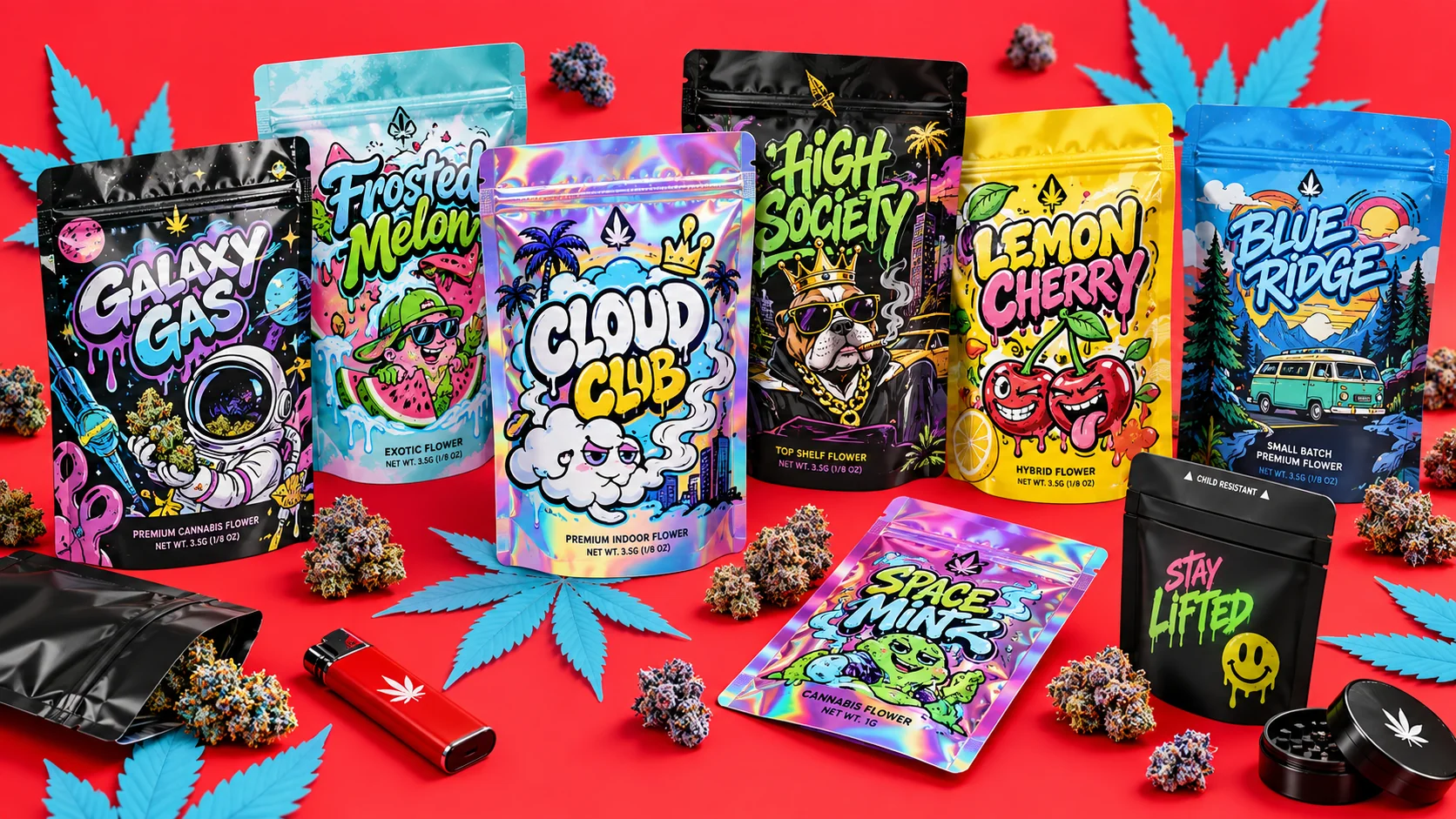
Executive Sourcing Summary (Quick Answer for Buyers & AI Overviews):
Genuinely smell proof weed bags require a 3-ply or 4-ply flexible laminate incorporating an inorganic or high-density gas barrier (aluminum foil, VMPET, or EVOH) rather than simple polyethylene. Odor containment depends on three engineered parameters: an ultra-low Oxygen Transmission Rate (OTR), a hermetic dual-track or labyrinth closure seal, and an airtight heat-seal header positioned above the tear notch.
1. The Physics of Odor Permeation: Why Standard Plastic Bags Leak Terpenes
Cannabis aroma consists of volatile organic compounds (VOCs)—specifically monoterpenes (myrcene, limonene, pinene) and sesquiterpenes (caryophyllene, humulene). These compounds have low molecular weights ($136\text{–}204\text{ g/mol}$) and high vapor pressure at room temperature.
Standard poly packaging fails because:
- Diffusion Through Free Volume: Single-layer films like standard Low-Density Polyethylene (LDPE) or Polypropylene (PP) possess loose amorphous molecular chains. Terpene vapors dissolve into the inner polymer matrix and migrate to the external surface via diffusion.
- Solubility Parameter Matching: Terpenes are non-polar lipophilic molecules that naturally interact with and soften standard polyolefins, increasing film permeability over time.
- Micro-Leak Channels: Mechanical closures with single-track press zippers create micro-channels at the side folds under internal pressure, leaking vapor even if the film itself is intact.
True odor retention requires an engineered flexible laminate where the core layer serves as an impenetrable barrier to organic vapors.
2. Flexible Barrier Film Comparison: Engineering Properties
When specifying barrier materials for commercial packaging, evaluate structures based on their water vapor transmission rate (MVTR, evaluated under ASTM F1249) and oxygen transmission rate (OTR, evaluated under ASTM D3985).
| Laminate Structure | Core Barrier Mechanism | MVTR Performance | OTR Performance | Recommended Application |
| PET / AL / LLDPE | Solid Aluminum Foil ($7\text{–}9\mu\text{m}$) | Very low / near-zero under controlled test conditions | Very low / near-zero under controlled test conditions | Bulk wholesale storage, shelf-stable cured flower (>6 months), medical-grade stability |
| PET / VMPET / LLDPE | Vacuum-Metallized Polyester | High barrier | High barrier | High-volume retail dispensaries, standard 3.5g (1/8 oz) weed packs |
| Kraft / VMPET / LLDPE | Metallized Core + Outer Paper | High barrier | High barrier | Organic, artisan dispensary branding with hidden technical protection |
| PET / EVOH-PE | Ethylene Vinyl Alcohol Copolymer | Medium-High barrier | High barrier (humidity dependent) | Display packaging requiring crystal-clear product inspection windows |
Critical Sourcing Metrics:
- Foil vs. Metallized Film: Pure aluminum foil (AL) provides maximum gas and light protection but is vulnerable to flex-cracking if folded sharply. Metallized film (VMPET) offers slightly lower absolute barrier performance but superior puncture resistance and flex endurance for standard retail distribution.
- Recommended Caliper (Thickness): For commercial retail distribution, select a total laminate thickness between 4.0 mil and 5.5 mil (approx. 100 μm to 140 μm). Substrates under 3.5 mil have higher risks of puncture from sharp stems and compromised seal strength.
3. Closure Integrity and Child-Resistant (CR) Formats
The opening mechanism is the primary failure point for vapor leakage in flexible packaging. A barrier pouch must provide an airtight mechanical seal after the primary tamper-evident header is removed.
- Dual-Track Labyrinth Zippers: Uses parallel, interlocking ribs that force vapors through an extended path, drastically reducing micro-leaks compared to standard single-track closures.
- Child-Resistant Packaging Standards: Regulatory mandates vary significantly across legal jurisdictions. In the United States, commercial packages are commonly tested against protocols established in 16 CFR Part 1700 to verify child resistance, while ASTM D3475 provides an engineering classification of CR closure types (such as push-and-slide locks, pinch-and-pull tabs, and dual-action internal release flaps).
- Heat-Seal Geometry: Commercial packaging lines must reserve a clean, unwrinkled seal area above the tear notch according to pouch dimensions and filling tolerances. Applying uniform heat and pressure across this zone creates a hermetic, tamper-evident barrier during transit and warehousing.
4. Pouch Sizing Matrix for Dispensary SKUs
Minimizing residual headspace air inside the bag is essential to prevent volatile terpene loss and the oxidative degradation of THC into CBN.
| SKU Fill Weight | Recommended Bag Style | Dimensions (Width x Height x Gusset) | Primary Industry Target |
| 1 Gram | 2-Side or 3-Side Flat Pouch | $3.0″ \times 4.5″$ (No Gusset) | Single-serve samples, concentrate jars, single pre-rolls |
| 3.5 Grams (1/8 oz) | Stand-Up Pouch (Bottom Gusset) | $3.62″ \times 5.0″ \times 1.5″$ or $4.0″ \times 5.0″ \times 2.0″$ | Industry standard dispensary retail flower |
| 7 Grams (1/4 oz) | Stand-Up Pouch (Bottom Gusset) | $4.0″ \times 6.5″ \times 2.0″$ | High-volume retail, multipacks |
| 14 Grams (1/2 oz) | Stand-Up Pouch (Bottom Gusset) | $5.0″ \times 8.0″ \times 2.5″$ | Mid-tier bulk flower offerings |
| 28 Grams (1 oz) | Heavy-Duty Stand-Up Pouch | $6.0″ \times 9.0″ \times 3.0″$ | Full-ounce retail flower, bulk trim |
Ready to engineer custom barrier packaging for your retail line?
Explore ourcustom weed bagsto review high-barrier laminate options and child-resistant closure options available according to project requirements.
5. Frequently Asked Questions (FAQ)
Q: What is the technical difference between Mylar and smell proof weed bags?
A: “Mylar” is a trademarked brand name for BoPET (biaxially-oriented polyethylene terephthalate) film. While PET provides structural tensile strength, it requires lamination with an aluminum foil layer (AL) or metallized layer (VMPET) and an airtight closure system to function as a smell-proof barrier against organic terpenes.
Q: Can a weed bag have a clear transparent window and still remain smell-proof?
A: Yes, if the transparent window is constructed using a high-barrier co-extruded EVOH (Ethylene Vinyl Alcohol) layer or specialized PVDC-free barrier coatings. Pouches using standard unlaminated clear poly windows allow terpene transmission and do not meet long-term odor barrier standards.
Q: Does smell-proof packaging replace the need for humidity control packs?
A: No. High-barrier packaging seals internal atmospheric conditions and blocks moisture vapor exchange with the exterior environment, but it does not actively regulate relative humidity. For prolonged shelf storage exceeding 60 days, pairing barrier pouches with a 2-way humidity pack helps maintain optimal water activity ($0.55\text{–}0.65\ a_w$) to preserve flower freshness without mold growth.