

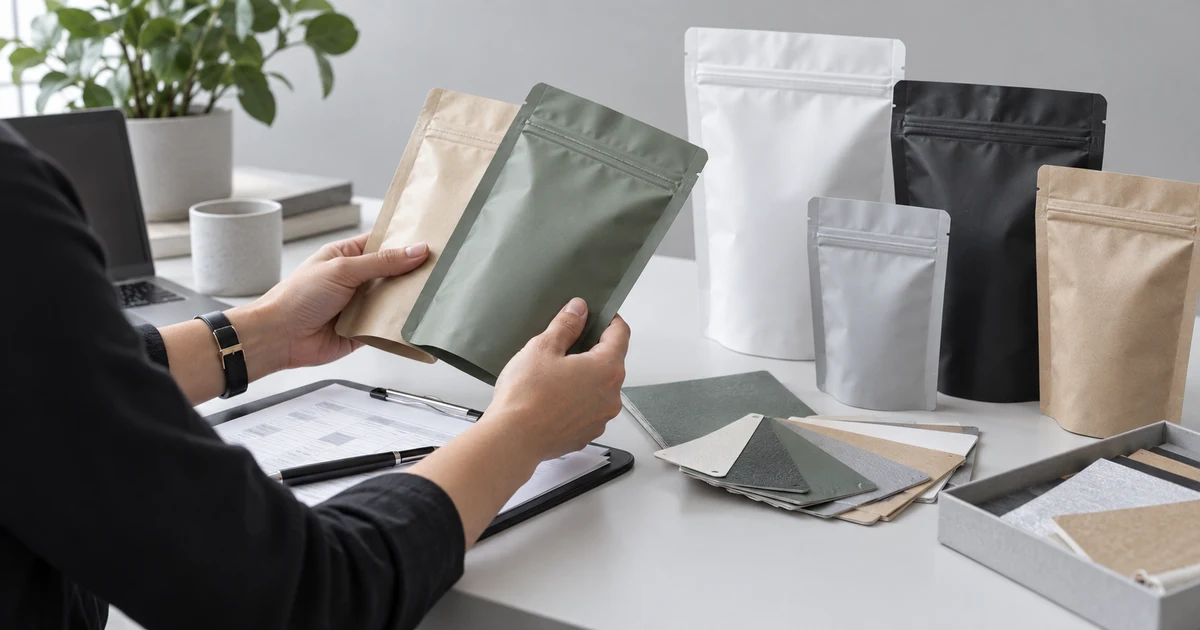
Choosing a custom stand up pouch supplier is not simply a matter of comparing pouch photos and unit prices. A suitable partner must be able to translate your product, filling process, shelf-life target, design and delivery needs into a repeatable packaging specification. Before you request a quotation, prepare the product details, expected fill quantity, pouch dimensions or target fill weight, quantity per design and destination market. Then compare every supplier against the same requirements.
This guide gives brand owners and procurement teams a practical way to shortlist suppliers, review samples and request comparable quotations without relying on unsupported marketing claims.
The short answer: what makes a supplier a good fit?
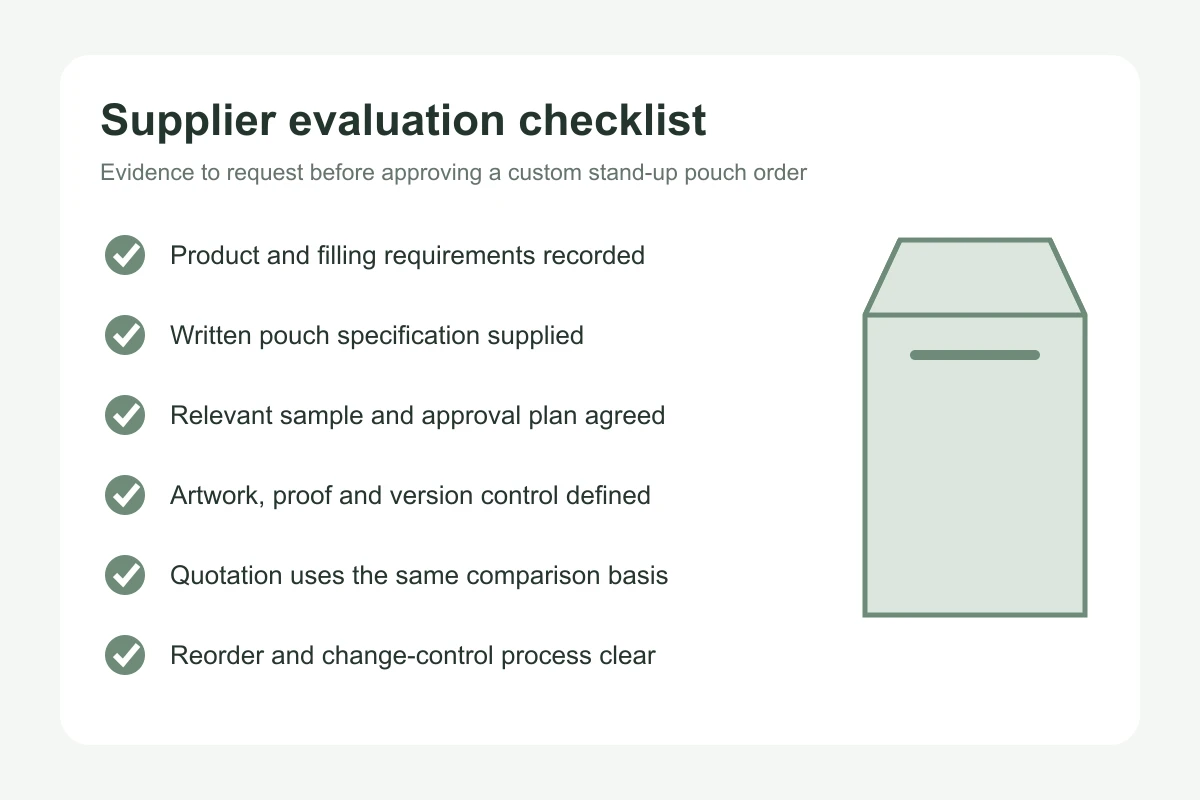
A good supplier fit combines five things: compatibility with the packed product, the ability to manufacture the required pouch format, a documented approval process, clear commercial terms and reliable communication for repeat orders. The best choice therefore depends on your project. A supplier that works well for a simple dry-food pouch may not be the right choice for a liquid, an aggressive household product or a package that must run on specific filling equipment.
Start by asking for evidence. Written specifications, relevant samples, artwork files, approval records and a clear quotation are more useful than broad claims about quality or experience.
Prepare these five inputs before contacting suppliers
- Product information: what will be packed, including relevant characteristics such as powder, granule, liquid, oil content, aroma sensitivity or sharp edges.
- Pack size: target fill weight or volume, preferred finished dimensions and whether you have an existing successful pouch to reference.
- Use and filling conditions: how the pouch will be filled and sealed, expected storage conditions and the destination market.
- Features and appearance: zipper, valve, window, tear notch, hang hole, surface finish and artwork status.
- Commercial requirements: quantity per size and design, desired delivery window, shipping destination and preferred trade terms.
Sending this information at the beginning reduces guesswork. It also helps each printed stand up pouch manufacturer quote on a similar basis.
Confirm that the supplier can make the pouch you need
A stand-up pouch is a format, not a complete specification. Bottom construction, opening style, closure, window, valve and finish all affect how the package is made and used. Ask which combinations the supplier actually produces, then request a sample that represents the proposed construction as closely as possible.
A sample gallery is useful for inspiration, but it does not prove that every displayed material, accessory or size is available for your order. Ask the supplier to identify which elements of a sample match your proposed pouch and which will change.
If you are still defining the format, review the available custom stand-up pouch options and send your product and filling requirements for a project-specific discussion.
Evaluate material and product fit
Do not select a material structure only because it is commonly used for a similar product. The packed product, desired shelf life, filling temperature, distribution route and consumer use can change the requirements. Ask the supplier how it moves from those inputs to a proposed structure and what information is still needed before the recommendation can be confirmed.
Request a written specification that identifies the agreed construction, thickness basis, dimensions, features and print finish. If the project depends on barrier performance, chemical compatibility, hot filling, freezing, retort processing or another demanding condition, obtain suitable technical review and validation before approving production.
For useful background before discussing structures, see this overview of flexible packaging materials. Treat general material guidance as a starting point rather than approval for a specific product.
Compare printing and artwork support
Ask how the supplier will review your artwork before production. The discussion should cover dielines, artwork file requirements, the number of designs, proofing, colour approval, variable elements and the placement of functional features. Confirm the print route proposed for your order instead of assuming that every order uses the same process.
Request the current dieline for the exact pouch dimensions and construction. Artwork created on an old or generic template can place text, barcodes or key graphics too close to seals, folds, zippers or gussets. Assign one person on your team to approve the final artwork version and keep a copy of the approved file.
Understand the differences between sample types
“Can you send a sample?” is too broad. A stock sample may demonstrate pouch handling and a feature such as a zipper, while a printed mock-up may help review artwork placement. A production sample is closer to the final manufacturing specification. Ask what each sample can and cannot confirm, whether it uses the intended materials and components, and who is responsible for approval.
Pre-production sample approval checklist
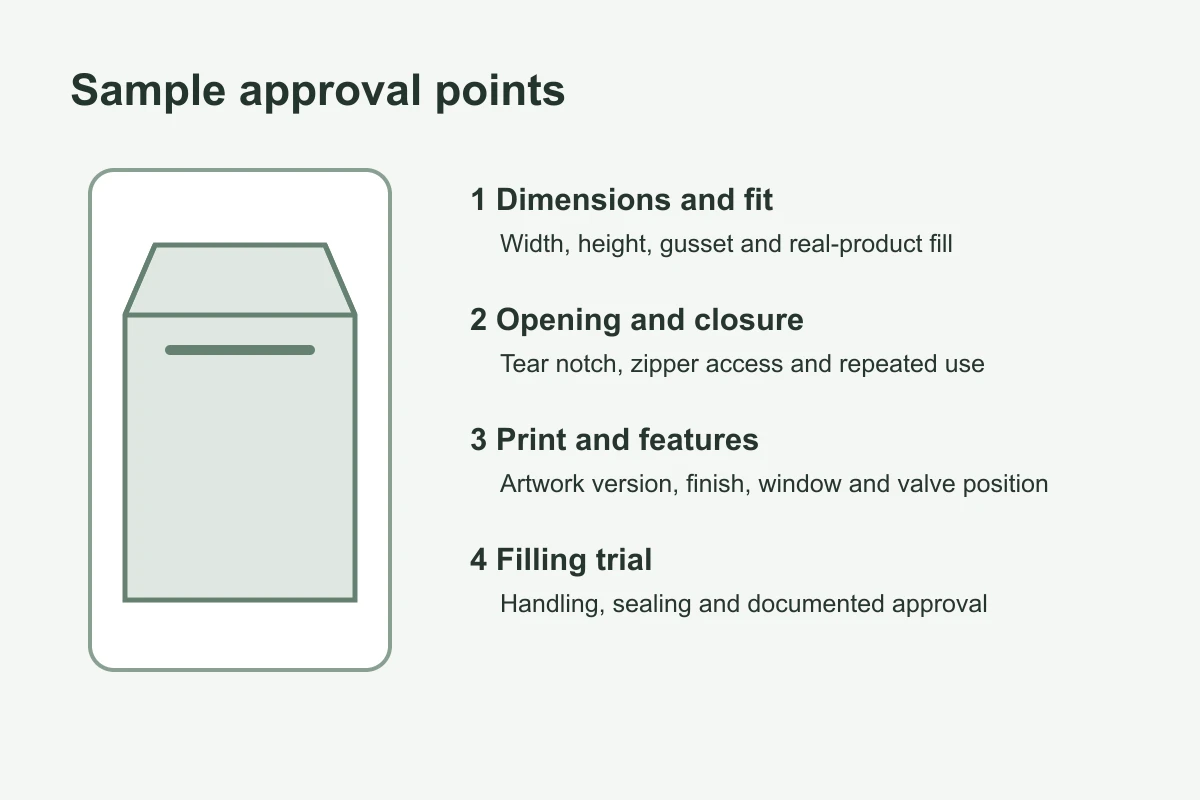
- Confirm finished width, height, gusset and usable fill area.
- Check that the real product fits and that the pouch stands as expected after filling.
- Review opening, tear notch and zipper access with the intended user in mind.
- Check the position of seals, artwork, window, valve and other features.
- Approve the correct artwork version, orientation, finish and colour reference.
- Run a filling and sealing trial when the process or equipment makes it necessary.
- Record what was approved and any agreed changes before production starts.
For coffee applications, this guide to coffee pouch barrier films and valves explains why product protection and functional components should be evaluated together.
Compare quotations using the same specification
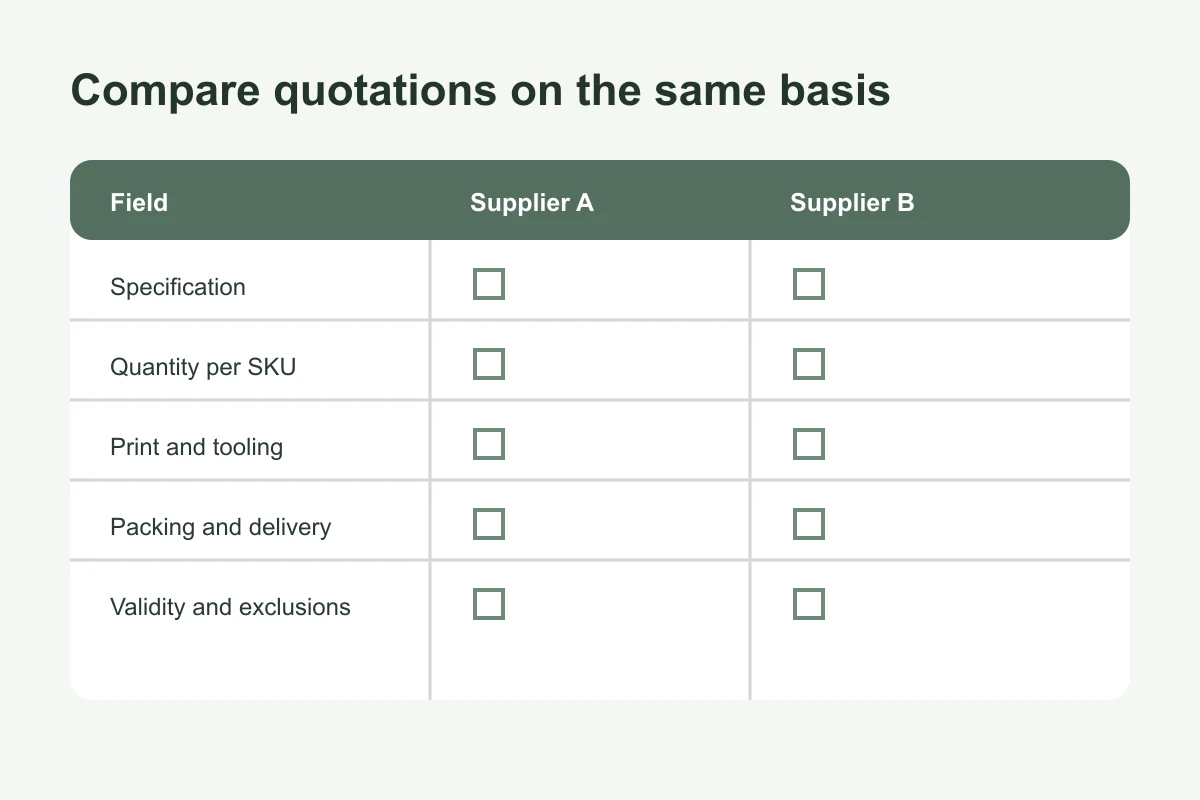
Two quotations are comparable only when they cover the same requirements. A lower price can result from a different material, size, feature set, print basis, quantity allocation or shipping term. Before choosing a wholesale stand up pouches offer, ask each supplier to confirm the fields below in writing.
| Decision point | Information to request | Evidence to verify | Why it affects the order | Buyer action |
|---|---|---|---|---|
| Product fit | Product, filling and storage inputs used | Written recommendation and stated assumptions | Similar-looking pouches can serve different conditions | Correct missing or inaccurate inputs |
| Pouch specification | Dimensions, construction, material, thickness basis and features | Specification sheet and representative sample | Differences change function and price | Use one comparison specification |
| Printing | Print route, designs, proof and colour approval method | Dieline, proof and approved artwork record | Setup and version control affect cost and consistency | Confirm every SKU and artwork version |
| Samples | Sample type, purpose, cost and timing | Sample plan with approval responsibility | Not every sample validates final performance | Document what each sample proves |
| Quantity | Quantity per size, material and artwork | Quotation quantity basis and permitted variance | A combined total may hide SKU-level differences | Compare the same allocation |
| Commercial terms | Tooling, packing, delivery terms, validity and payment terms | Itemised quotation | Unit price alone does not show total commitment | Calculate the complete purchasing cost |
| Quality and reorders | Approval records, change control and defect process | Agreed reference and documented procedure | Repeatability depends on controlled specifications | Keep signed approvals with the purchase record |
Assess export service and repeat-order control
For an international order, clarify who owns communication, which shipping documents can be supplied, how cartons and pallets will be identified, which Incoterm applies and when shipment planning begins. If a quotation uses a destination term, confirm what is included and what remains the buyer’s responsibility.
Repeat orders need more than an old invoice number. Ask how the supplier identifies the approved specification and artwork, handles proposed material substitutions, records requested changes and manages colour expectations. On your side, use revision-controlled files and state clearly whether a reorder is unchanged.
12-point supplier shortlist checklist
- The supplier asks for product and filling information before recommending a structure.
- The required pouch construction and feature combination are confirmed.
- The proposed specification and its assumptions are provided in writing.
- Performance-dependent claims are supported by an appropriate validation plan.
- The supplier provides the correct dieline and artwork requirements.
- The proof and colour approval process is clear.
- Each sample type has a defined purpose.
- Pre-production approval responsibilities are documented.
- The quotation lists quantity per size and design.
- Tooling, packing, delivery terms and quotation validity are visible.
- Quality concerns and corrective steps have an agreed communication route.
- Reorder specifications and artwork versions can be identified reliably.
Red flags to investigate
Pause when a supplier recommends a structure without asking about the product, promises universal performance, cannot explain what a sample represents, quotes without a defined specification or avoids documenting changes. These signals do not automatically disqualify a supplier, but they require clear answers before you place an order.
Frequently asked questions
What information should I send a stand-up pouch supplier?
Send the product, fill weight or volume, preferred dimensions, filling and sealing method, storage and destination conditions, required features, quantity per design, artwork status and delivery destination. Include an existing successful sample or specification when available.
Should I request samples before placing a custom order?
Yes. First decide what the sample needs to confirm. A stock pouch, printed mock-up and production sample answer different questions. For a demanding application, agree on the testing and approval process before production.
How can I compare two stand-up pouch quotations?
Normalize the dimensions, material and thickness basis, features, print requirements, quantity per SKU, tooling, sample costs, packing and delivery terms. Record exclusions and assumptions instead of comparing unit prices alone.
Does a low MOQ always mean a lower project cost?
No. A smaller order may reduce inventory exposure but can have different setup economics, freight allocation or unit pricing. Compare the complete purchase commitment and the risk of obsolete packaging, not only the minimum quantity.
Request a project-specific review
Send your product, target fill quantity, pouch dimensions or fill weight, quantity per design, destination market and artwork status to PURESTPACK. After the requirements are reviewed, request relevant physical samples and a project-specific quotation.