

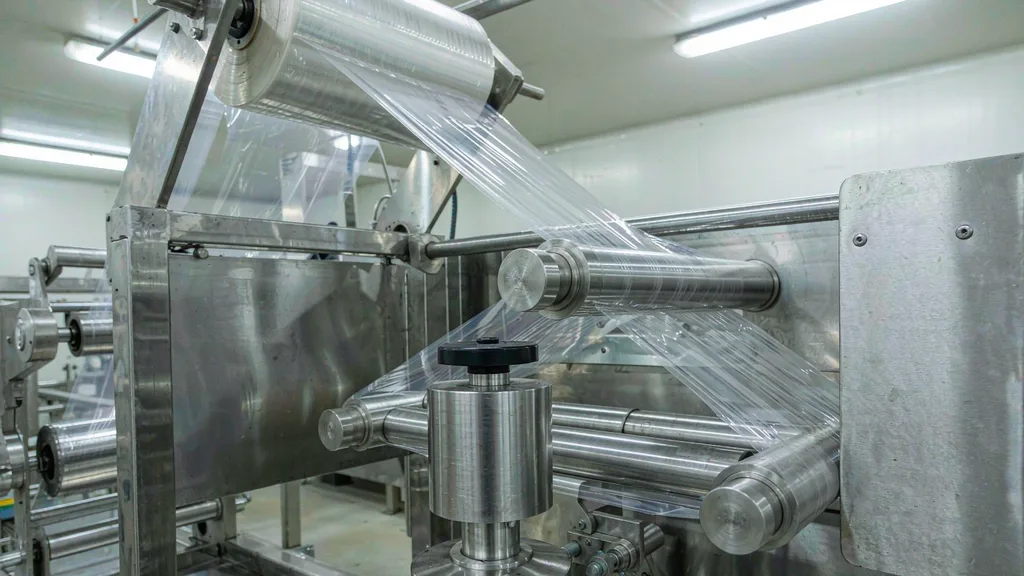
Static on a packaging line is charge built up as film unwinds and rubs over rollers, and it shows up as film that will not separate, dust pulled into the seal area, and product sticking to the wrong place. Fix it in this order: raise relative humidity to 50–60%, ground the machine, then add ionisation. Antistatic additive in the film is a specification decision, not a machine fix.
Where the Charge Comes From
Polyethylene, polypropylene and polyester are all electrical insulators. Surface resistivity above 10^11 ohms per square means charge has nowhere to go and simply accumulates. The charge is generated by contact and separation, called tribocharging, every time the film web touches and leaves a roller, a forming collar or a guide.
Three operating conditions make it worse. Low relative humidity, especially below 40% RH, removes the thin moisture film that would otherwise bleed charge away. High line speed multiplies the number of contact-separation events per second. And a freshly corona-treated surface, which is deliberately made more polar to hold ink, tends to hold charge differently from untreated film — see our corona treatment and dyne level guide for why that surface behaves the way it does.
Several kilovolts per centimetre are unremarkable on a dry running line, enough to make two film sheets cling hard enough to resist the unwind tension.
What Static Does on the Line
Static is rarely the root cause of a defect on its own. It is the mechanism that turns a tolerable condition into a reject.
- Film cling and blocking. Sheets will not separate at the pick-and-place or at the forming collar, causing double feeds, skewed bags and unplanned stops.
- Dust attraction. A charged surface pulls airborne dust, powder and product fines straight into the seal area, which is one of the most common causes of leaking seals on dry products.
- Product misplacement. Powder and light granules jump toward the charged film instead of falling into the bag, leaving product in the seal.
- Print and code defects. Ink can feather into fine whiskers, and inkjet or thermal transfer codes can shift or mist when the substrate is charged.
- Operator shocks. Not a quality issue, but repeated shocks near moving machinery is a safety and ergonomics complaint that should not be ignored.
The last two are often misdiagnosed as print or coding faults. If the defect follows the weather, assume static before changing print settings.
How to Measure It
Three measurements are practical on a plant floor. Surface resistivity, measured in ohms per square, tells you whether the material can dissipate charge at all. Static decay time tells you how fast a charged surface loses it, which is the number that actually predicts line behaviour. A handheld electrostatic field meter, read in kilovolts, gives a quick spot check of where charge is concentrated.
The classification used in ESD control programmes divides materials into conductive, static dissipative and insulative bands by surface resistivity, with ANSI/ESD S541 covering packaging materials and ASTM D257 covering the measurement method. IEC 61340-5-1 sets the general requirements for an ESD control programme. Bare untreated polyolefin film sits in the insulative band, which is why it needs help from either an additive or an external ioniser.
Where to place the measurement points:
- Film surface immediately after unwind, before the forming collar.
- Film surface at the sealing jaw, where dust contamination matters most.
- Any idler roller that has been replaced or re-covered.
- The floor and operator position, if shocks are being reported.
Six Controls That Actually Work
Raise relative humidity First
Conditioning the packing hall to 50–60% RH is the cheapest and most reliable control. Surface moisture lets charge bleed away continuously. Below 40% RH, almost every other measure becomes less effective. This is also the control that helps film handling generally, as described in our packaging film roll defects guide.
Ground the Machine and the Rollers
Every metal roller, frame section and guide should be bonded to a common ground. A single ungrounded idler can charge an entire web. Check continuity with a meter rather than by eye, and re-check after any maintenance that involves removing a roller.
Install Ionisation at the Right Points
Ionising bars neutralise charge by flooding the area with both positive and negative ions. Place them after unwind, at the forming collar, and immediately before the sealing jaw. A bar installed in the wrong place does nothing, and a bar that has not been cleaned stops working long before it fails electrically.
Use Passive Discharge Where Ionisation Is Not Practical
Static tinsel, carbon-fibre brushes and grounded strings cost very little and work well at low to moderate speeds. They need to sit close to the web without touching it and must be cleaned and replaced on a schedule.
Specify Antistatic Additive in the Film
Internal antistatic additives migrate to the film surface and attract a thin moisture layer that dissipates charge. This is a material specification, so it belongs in the purchase spec rather than in a machine setting. Two cautions: migration takes time, so freshly produced film may not perform at full effectiveness immediately; and humidity dependence means the additive works poorly in very dry conditions. Our flexible packaging RFQ guide shows where to put such requirements so they are quoted rather than assumed.
Slow Down and Reduce Web Tension
Speed and tension both increase charge generation. A temporary speed reduction is a valid diagnostic: if the defect disappears at lower speed, charge generation is confirmed as a contributing factor.
Antistatic Additive vs Coating: What to Specify
Two approaches exist. An internal additive is compounded into the resin and migrates to the surface over time, giving long-lived performance that survives handling. A surface coating is applied during film production and gives immediate performance but can be wiped off or degraded by corona treatment, printing and lamination.
For food-contact film, any antistatic chemistry must be authorised for food contact in the destination market. In the EU, substances used in plastic food-contact materials must be listed in Regulation (EU) No 10/2011, and the supplier should provide a compliance declaration covering the additive. This is the same documentation discipline described in our food contact migration testing guide.
What to Write Into the Film Specification
- Surface resistivity target and the test method, with the conditioning RH stated.
- Static decay time limit, since this predicts line behaviour better than resistivity alone.
- Whether antistatic performance is required on one or both film surfaces.
- Confirmation that the additive is authorised for the intended food contact and temperature range.
- Shelf life of the antistatic performance, since migration behaviour changes as the roll ages.
Frequently Asked Questions (FAQ)
Why does my packaging film stick together on the line?
Film clings because tribocharging as the web unwinds over rollers leaves an electrostatic charge on an insulating surface, and the charged sheets attract each other. Dry air below 40% RH is the most common aggravating factor, followed by high line speed and ungrounded rollers.
What relative humidity stops static on a packaging line?
Holding the packing hall at 50–60% RH is the cheapest and most reliable control, because surface moisture lets charge bleed away continuously. Below 40% RH, ionisers and antistatic additives both become noticeably less effective.
How do you measure static on packaging film?
Measure surface resistivity in ohms per square using ASTM D257, static decay time, and spot charge with a handheld electrostatic field meter in kilovolts. Take readings after unwind, at the forming collar and at the sealing jaw, because that is where the defects occur.
Is an antistatic additive in the film a machine fix or a spec fix?
It is a specification fix. Internal antistatic additives are compounded into the resin and migrate to the surface, so they must be requested in the film purchase specification. Migration also takes time, so very fresh film may not perform at full effectiveness immediately.
Can static cause leaking seals?
Yes. A charged film surface pulls airborne dust, powder and product fines into the seal area, and contamination in the seal is one of the most common causes of leaks on dry products. Ionisation immediately before the sealing jaw is the usual remedy.
Does antistatic film need food-contact approval?
Yes. Any antistatic additive in a food-contact layer must be authorised in the destination market; in the EU this means listing in Regulation (EU) No 10/2011. Ask the film supplier for a compliance declaration that explicitly covers the additive and the intended contact conditions.
Two further references from OMOpack on the brand side: stand-up pouch sizing and matte vs gloss pouch finishes, both of which change how a surface behaves on the line.