

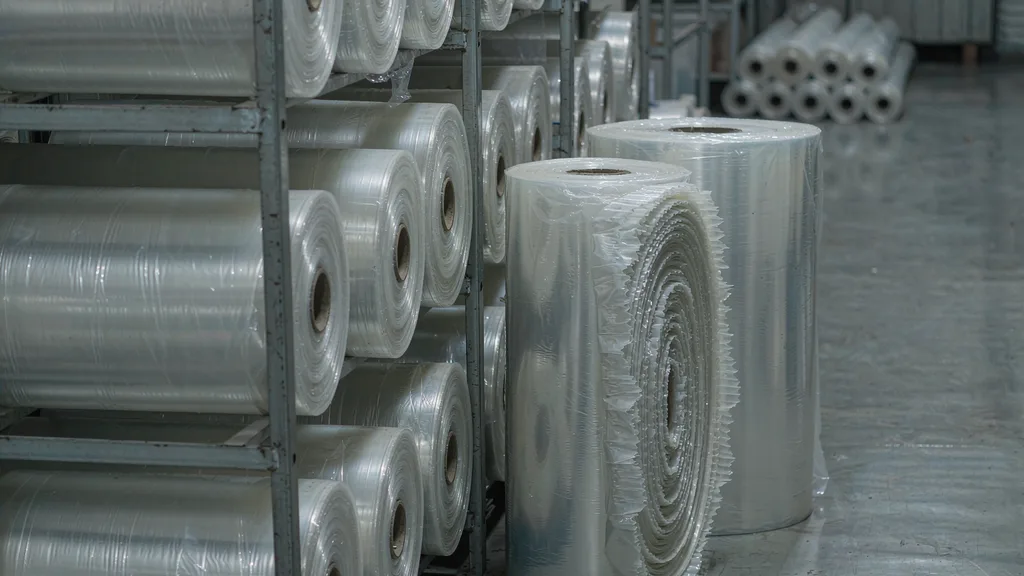
Most film-related line stops do not come from the film’s chemistry — they come from roll geometry and handling. Telescope, gauge bands and blocking are the three defects that turn a well-made laminate into an unusable roll, and each has a distinct root cause, a quick shop-floor check and a different evidence trail when you claim.
Which Roll Defects Cause Most Line Stops?
A roll of laminate is a precision-wound object: layers of film under tension, wound around a core, expected to unwind at hundreds of meters per minute without drifting. When winding, storage or handling goes wrong, defects appear that the packing line feels immediately.
| Defect | What the line sees | Typical root cause |
|---|---|---|
| Telescope (dishing, lensing) | Roll edge steps sideways; film creases as it unwinds | Uneven winding tension; rough handling; poor storage |
| Gauge bands | Thick streaks; uneven seals; bag length drift | Die or extrusion variation upstream; trapped air at winding |
| Blocking | Layers will not separate; film tears on unwind | Residual solvent; high storage temperature or pressure |
| Starved/soft rolls | Film sag; registration wander | Loose rewind tension; core slippage |
| Core damage | Roll cannot be mounted; film tears at start | Forklift contact; dropped rolls |
On a mid-speed bag line, a roll change every 20–40 minutes means a badly wound roll costs more in downtime and restart waste than its full purchase price. That is why the roll — not just the film — belongs in your incoming inspection.
Telescope: Why Rolls Lean Sideways
Telescope is a sideways displacement of the roll’s layers, so the edge looks like a stepped lens rather than a flat circle. It forms at winding, when tension across the web is uneven, or afterwards, when a roll is dropped, pushed on its edge, or stored where temperature swings let layers slip.
The practical consequences compound quickly. A telescoped roll does not track straight through the guide rollers; the web wanders, registration drifts, and operators respond by slowing the line or pulling the film off-center, which then causes off-center seals downstream — a symptom the filling side experiences as mis-centered seals, described from the equipment perspective in pouch filling and sealing. Creases introduced during unwind become permanent weak points that later show up as pinhole leaks.
Prevention is mostly logistics discipline:
- Store rolls upright or on purpose-built racks, never stacked on their edges.
- Keep warehouse temperature reasonably stable; large swings relax wound-in tension and let layers slip.
- Train forklift handling: clamp pressure and edge contact are the most common post-winding causes.
- Specify a maximum telescope tolerance with your supplier in millimeters, so “looks acceptable” becomes a measurable condition.
Gauge Bands: The Streaks That Show Up in the Seal
Gauge bands are longitudinal streaks of locally thicker or thinner film. They come from the film’s production — die bolts, coating variation, or air entrapped during winding at a thickness ridge — and they survive all the way to the pouch.
On the packing line, gauge bands produce symptoms that are easy to misdiagnose as seal-parameter problems: seals that hold everywhere except one stripe, occasional leaks at the same position on every bag, and tension fluctuation as the thick band passes through the nip rollers. Because a 10-micron band on a 100-micron laminate is a 10% thickness change, a seal window tuned on average thickness may sit outside its window at the band.
The measurement method is standardized (ASTM D6988 covers thickness determination of plastic film test specimens), and a 20-minute audit tells you what you need: measure film thickness across the full web width with a dead-weight or contact micrometer at 25–50 mm intervals, and plot the profile. A laminator’s specification typically holds thickness within ±7–10% of nominal; a single band exceeding that across a narrow strip is an upstream quality signal worth escalating. This is also the boundary case for downgauging: a thinner film has less margin to absorb a gauge band of the same absolute size.
Blocking: When Layers Will Not Separate
Blocking is the adhesion of film layer to film layer inside the roll, so the roll will not unwind cleanly. It happens for two reasons: residual solvent or low-molecular-weight additives migrating to the film surface — a conversion issue — and storage at elevated temperature or under heavy compression, which lets layers fuse under pressure — a storage issue.
Standard test practice exists for the phenomenon (ASTM D1893 measures blocking of plastic film on an inclined plane), but the shop-floor version is quicker: try to unwind the outer 10 meters of a suspect roll by hand. A healthy roll separates with a light sound and no surface damage. A roll with the beginnings of blocking feels tacky and leaves gloss marks where layers touched.
Storage hygiene matters more here than anywhere else. Rolls stored stacked flat under their own weight, in a hot area near shrink tunnels or printing presses, are the classic blocking candidates. Our film storage guide details the temperature, orientation and humidity conditions that keep laminate rolls in specification between receipt and use.
How to Inspect Incoming Rolls in 20 Minutes
A structured look at every delivery catches most problems before they reach the line:
- Visual edge check: roll edges flat and flush, no telescope steps, no crushed corners.
- Hardness check: press a durometer or firm thumb into the roll face; rolls that are visibly soft at the core were wound loose and will not run flat.
- Unwind test: unwind 5–10 meters slowly; look for layer separation noise, gloss marks (blocking), and web wandering.
- Thickness profile: spot-check across the web width; compare against ±10% of nominal.
- Seal spot check: heat-seal a small specimen at your standard parameters and pull it (ASTM F88-style); a laminate that seals inconsistently on the bench will misbehave worse at speed.
- Documentation match: verify roll number, structure and lot codes against the delivery paperwork so traceability exists if a claim follows.
Log the results per roll. When a roll later misbehaves, the difference between “we think it arrived like that” and a documented inspection record decides whether the claim lands. For a new structure or a new supplier, this inspection routine should fold into a formal acceptance trial — the film qualification protocol sets that out step by step — and for brand-side buyers deciding how much pouch they actually need, the finished-pouch counterpart is covered in stand-up pouch sizing.
What a Useful Claim Contains
If a defect does reach the line, the claim that gets resolved quickly contains: roll and lot numbers, photographs of the defect in place (not after unwinding), the inspection record from receipt, and a description of the line symptoms with waste quantities. Send back a 2-meter sample when asked; a converter can diagnose a winding or blocking problem far faster from film than from a description.
FAQ
What is telescope on a film roll?
Telescope is a sideways step in a roll’s layers, making the edge look like a stepped dish instead of a flat circle. It comes from uneven winding tension at production or from rough handling and poor storage afterwards, and it causes web wander, registration drift and creases on the packing line.
How do gauge bands affect my sealed bags?
A gauge band is a local thickness streak, often 5–10% of the laminate’s total gauge. Seals made over a thick band can fall outside their temperature and pressure window, producing periodic leaks at the same bag position, while tension variation from the band disturbs print registration and bag length.
What causes film layers to block together inside a roll?
Two mechanisms: residual solvent or surface-active additives migrating to the film surface during conversion, and storage at elevated temperature or under compression, which lets adjacent layers fuse. The first is a supplier issue; the second is warehouse handling and belongs to the buyer to control.
How can I check film rolls quickly when they arrive?
Inspect edges for telescope, press the roll face to feel hardness, hand-unwind 5–10 meters to check layer separation, spot-check thickness across the web, and heat-seal a bench specimen at your standard parameters. Log results per roll number so any later claim has documentation behind it.
Who pays when a film roll is defective?
It depends on when the defect formed and who controlled that stage. Winding, gauge and conversion defects are supplier responsibility; telescope from forklift damage, blocking from hot storage, and core crushing during internal handling usually are not. This is exactly why incoming inspection records matter — they assign the cause.
Should I reject a roll that runs but shows minor telescope?
If the web tracks, seals hold and waste stays within your normal changeover allowance, running it is a cost decision, not a quality one. Escalate with measurements only when it forces slowdowns, creases in finished pouches or waste above your documented threshold.
