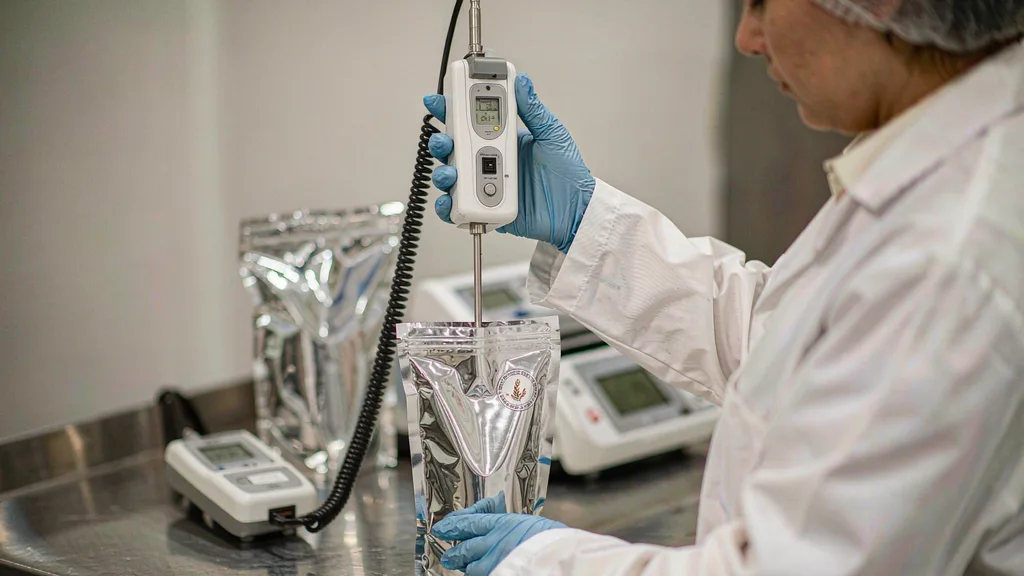

A retort pouch line for wet pet food is judged less by peak speed than by whether every bag that leaves the cooker can be traced to a fill weight, a seal check and a cook record. Fat and gravy make the seal step unforgiving; thermal processing makes the documentation unforgiving. This article stays on the line: loading and fill weight, headspace, sealing checks, and the batch records a retort operation needs to keep when the product is pet food in a pouch.
It is written for production and QA leads who already know their cooker. Film selection and product-risk detail for wet recipes belong in parallel notes; here the question is how the line proves each batch was filled, sealed and cooked inside the validated window. Related process reading includes our notes on heat seal parameters and food contact migration testing.
How Do You Control Fill Weight Before the Sealer?
Wet pet food fills vary with temperature, viscosity and chunk distribution. A target weight that looks stable on a cold morning can drift after the kettle sits, because gravy thins and chunks settle in the hopper. The line needs a weigh check at a frequency tied to that drift, not only to a generic SPC template. Rejects for underfill protect the customer; rejects for overfill protect the seal, because excess product is what migrates into the seal band.
Multi-head or piston fillers both work when the recipe is matched to the dosing method. Chunky gravy prefers a path that does not shear pieces into paste at the nozzle; pate prefers a path that does not aerate. Neither preference is visible in a dry commissioning run. Commission with the commercial recipe, and record nozzle height against pouch opening so operators can restore the setting after a changeover.
How Should Headspace and Venting Be Set on the Line?
Headspace decides how the pouch behaves in the retort basket. Too little, and expanding vapour stresses seals and corners. Too much, and pouches pillow, block flow between layers, and cook unevenly. Pet food gravy also spatters: a large headspace that looked safe on water trials can still throw product into the seal during the transport shake between filler and sealer.
Some lines add a mechanical squeeze or vacuum step before sealing to set headspace. Those steps must be validated with the real film, because a film that softens early will crease and create false seals. Keep the headspace target in the batch record as a measured range, not only as a machine recipe number.
Which Sealing Checks Belong on a Retort Pouch Line?
Seal checks on a retort pouch line should answer three questions: was the band clean, was the weld continuous, and did it survive the cook? A peel or pull test on a warm pouch at the sealer answers only part of the second question. Oil contamination answers the first. Post-cook leak or burst sampling answers the third.
Practical cadence mixes every-bag vision or sensor checks with periodic destructive tests. Vision catches folded edges and obvious product in the seal; it will not catch a thin fat film. Periodic contaminated-seal challenges during start-up of a new film lot close that gap. Guidance on peel versus lock seals in flexible packs is summarised in our peelable packaging film guide; wet pet food usually wants a lock seal that survives the cook, not a consumer peel.
Jaw temperature, pressure and dwell belong in the batch record with the time they were verified. After a film change or a jam clearance, re-verify before counting bags as commercial.
What Batch Records Should a Retort Operation Keep?
| Record block | What to capture | Why it matters |
|---|---|---|
| Identity | Product code, recipe version, film lot, pouch lot, shift, line ID | Links complaint or cooker deviation to materials |
| Fill | Target weight, check frequency, rejects, nozzle setting | Explains seal contamination and underfill risk |
| Seal | Jaw setpoints, verification time, destructive sample IDs | Proves sealer was inside window |
| Cook | Basket ID, load pattern, come-up, cook, cool, critical temperature probes | Core of thermal process authority |
| Release | Leak/burst sample results, hold status, QA sign-off | Stops unfinished cook lots from shipping |
Digital historians help, but only if the film lot and pouch lot are keyed to the same batch ID as the cooker chart. Paper cook charts still appear in audits; if you use them, photograph or scan before the ink fades.
What Are the Scope and Limits of This Line Guide?
This applies to in-pouch thermal processing of wet pet food on a dedicated or shared retort pouch line, including rotary and still cookers that hold flexible pouches in racks or shuttles. It assumes a validated process schedule already exists for the container.
It does not replace a scheduled process filing, a thermal authority calculation, or hygienic design review of the filler. Dry kibble lines, tray lines with separate lids, and cold-fill wet packs sit outside this scope.
Keep reject Pareto charts for dirty seals and corner leaks beside the cooker deviation log; the two datasets together usually show whether the problem is filling geometry or thermal load.
Conclusion: A Line-Side Confirmation Order for Retort Pouches
- Confirm recipe viscosity and chunk profile match the filler path before locking fill weight limits.
- Set headspace with commercial film and gravy; record the measured range on the first three baskets of a trial.
- Verify seal setpoints, then run clean and gravy-wiped samples through the cook; file sample IDs in the batch record.
- Check that film lot, pouch lot and cooker chart share one batch key before the lot is released.
- Review reject codes weekly for “dirty seal” and corner leaks; rising counts usually mean fill geometry drifted, not that the film “went bad” overnight.
For stand-up pouch formats used upstream of retort or for non-retort SKUs on the same campus, see the stand-up pouch structure guide. Layer food-contact expectations against the evaluations summarised by EFSA on food contact materials.
Frequently Asked Questions
How often should fill weight be checked on a wet pet food gravy line?
Often enough to catch viscosity drift within a kettle, which is usually tighter than a dry powder cadence. Start with checks at start-up, after every kettle change, and at a fixed bag interval; tighten if reject charts show weight walking during a single kettle.
Can vision inspection replace destructive seal tests on a retort pouch line?
No. Vision finds folds, misalignment and obvious product in the seal. It misses thin oil films and weak welds that still look closed. Keep periodic pull and post-cook leak tests in the plan.
What belongs in the cooker section of a pet food retort batch record?
Basket identity, load pattern, come-up / cook / cool times, critical temperature readings, and any deviation with disposition. Without those fields, a later complaint cannot be tied to a thermal history.
Why do seal rejects rise after a film lot change even when sealer setpoints stay unchanged?
Because sealant thickness, COF and gauge tolerance shift between lots. Re-verify jaws and run a short contaminated-seal challenge whenever the film lot changes, then record the verification in the batch file.