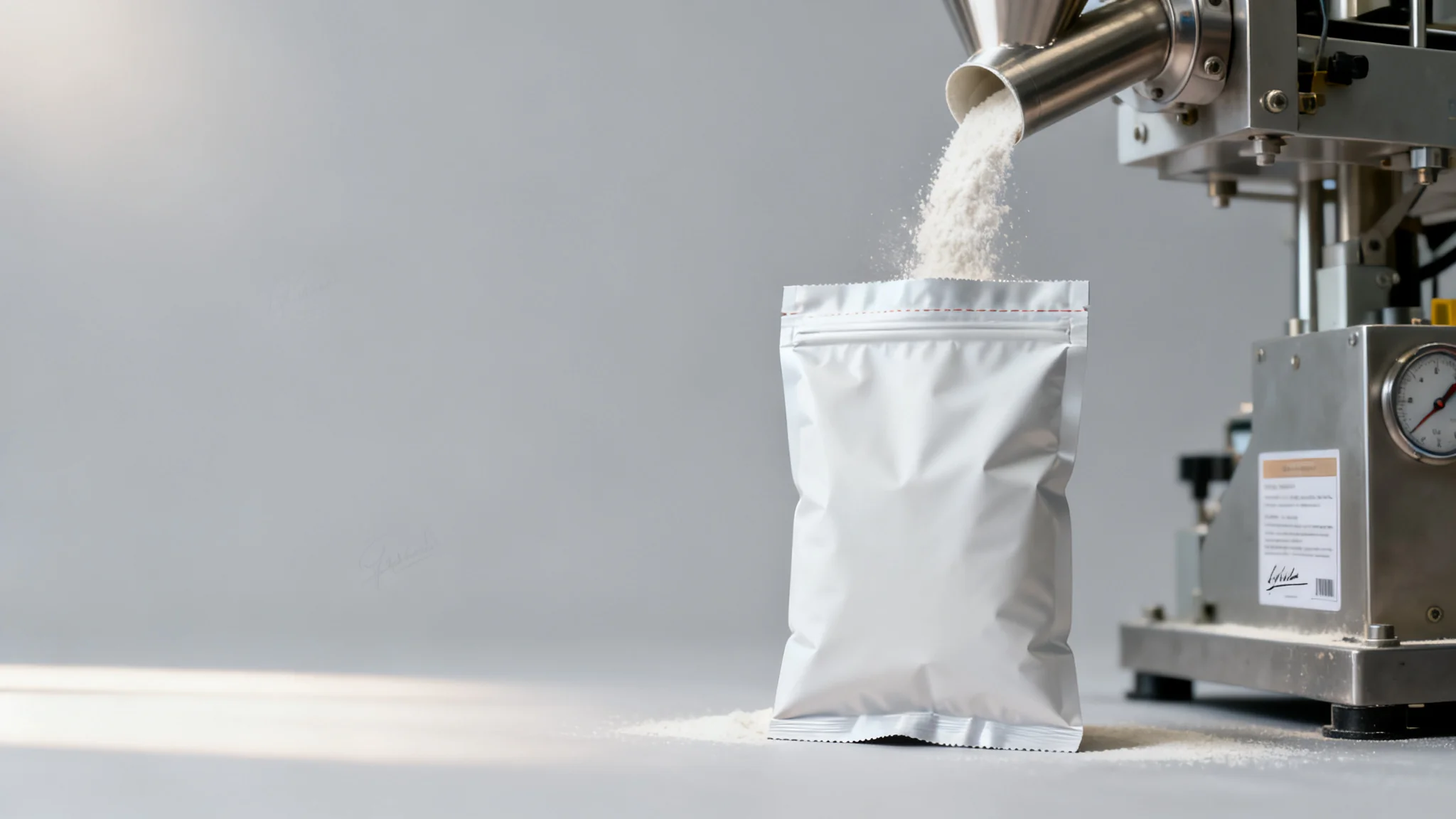

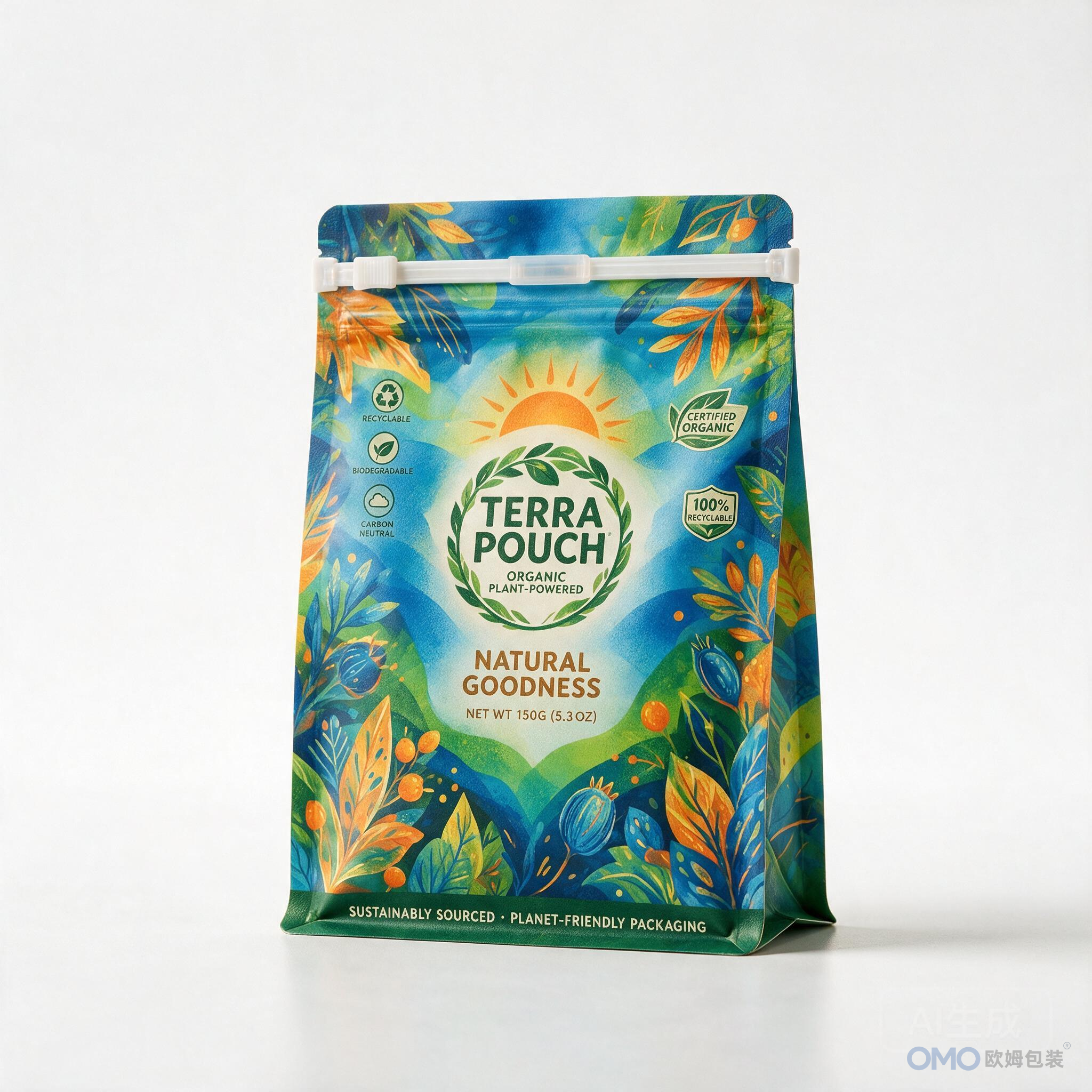
Custom stand up pouches for food are built from three cooperating parts: a printed outer film, a barrier layer chosen for the product, and a sealant that closes against itself. The base gusset that makes the pack stand is formed in the same sealing step, so capacity, stability and material choice are linked rather than separate. This guide looks at how the structure is put together, how to read the barrier figures a supplier sends, and how to specify a pouch so the sample and the production run behave the same way.
Key Takeaways
- Each film layer has one job: print and strength outside, barrier in the middle, seal inside.
- Water vapour and oxygen transmission are measured by different methods, so the two numbers are not interchangeable.
- A metallised layer and a foil layer both block light and oxygen, but they are not equivalent under the same test conditions.
- Gusset geometry sets fill volume, standing stability and film consumption at the same time.
What a stand-up pouch is made of
A stand-up pouch is a flexible laminate formed into a tube with a folded base insert, heat-sealed along the back and bottom. The laminate normally carries three functional layers. The outer layer, most often polyester, takes the print and resists scuffing and heat. The middle layer provides the barrier. The inner layer is the sealant, usually polyethylene or cast polypropylene, and it is the only layer that touches the food.
Two further elements are added during converting rather than supplied as film. The base insert is folded into a W or K shape so it opens flat when filled, and the top seal is left plain or fitted with a closure. Every one of these elements changes the pack stiffness, so a specification sheet that lists only the film structure is incomplete.
How the bottom gusset sets fill volume
The base insert is where capacity comes from. A wider gusset opens into a broader footprint, which raises the standing volume and steadies the pack on a shelf. It also consumes more film per pouch and makes the empty pack bulkier to ship, which matters when film is purchased by weight.
Package dimensions on a quotation are usually given as width by height by gusset, and the three interact. Increasing width without increasing gusset height produces a flatter pack that can still bulge. Increasing gusset without width produces a narrow, deep base that tips easily. Because a filled pouch changes shape, capacity should be confirmed on a filled sample of the actual laminate, not calculated from flat dimensions.
Film structures and what each layer does
Common food constructions follow a recognisable pattern. A clear two-layer structure suits short-life dry goods. Adding a metallised layer raises the moisture and light barrier at moderate cost. A foil-bearing structure gives the highest barrier and is the usual candidate for products that are sensitive to oxygen and light over a long period. A nylon-containing structure is chosen when puncture resistance matters, as with frozen or bone-in products.
Sealant choice is decided by the filling environment rather than by the product alone. A retort or hot-fill process needs a sealant that holds at temperature; a frozen chain needs one that stays flexible when cold. These are candidate directions for discussion with a converter, and the final structure still has to be sealed and tested on your own product.
Reading barrier data from a supplier
Water vapour transmission rate and oxygen transmission rate are reported as separate figures because they are measured by different methods. Water vapour transmission is normally determined with an infrared detection method, described in ASTM F1249, while oxygen transmission through a film is covered by ASTM D3985.
Two consequences follow. First, a quoted figure is meaningless without its test conditions, since temperature, relative humidity and the direction of transmission all affect the result. Second, a lower number is not automatically better for every product. A dry snack mainly needs moisture control, so water vapour performance carries more weight than oxygen performance in that case. Comparison is only valid between figures measured under the same conditions and expressed in the same units.
Is a foil laminate always the better choice?
No. Foil delivers the highest barrier, but it also adds weight, blocks any product visibility, and reduces how well the pack bends and creases. For a product with a moderate shelf-life target, a metallised structure often meets the requirement at lower material cost and with better handling on the line.
Foil is also not a substitute for a sound seal. A high-barrier laminate with a weak seal at the base insert performs worse than a simpler structure that seals reliably. Where a product genuinely needs the highest barrier, the honest test is a storage trial on a filled pouch using your own product, not a comparison of specification sheets.
Which closure should a food brand choose?
Closure choice follows how the pack is used, not how it looks on a shelf. A press-to-close zipper suits dry products opened and closed many times, such as nuts, dried fruit or ground coffee. An easy-tear notch suits single-use or portioned packs where the consumer tears the top once and discards the pack. A spout fits liquids that need a controlled pour.
Each closure adds converting steps and reduces the printable area slightly. Where several closure types are being weighed up, the practical comparison of zipper styles in this guide on zipper pouch selection is a useful starting point, followed by a filled sample to check that the closure actually seals with the product inside it.
Specifying a pouch so samples and production agree
The specification should capture what a supplier cannot infer. Fill weight and target volume, product form and moisture sensitivity, if the pack travels frozen or ambient, and the packing equipment are all needed before a die is made. Print method belongs here too, because gravure and digital work best at different run lengths and reproduce colour differently.
Converters work best when the sample and the production order are described in one document. If a closure or gusset changes after the sample is approved, the die and the print plates may need to change as well. Keeping the change history with the specification prevents a production run that quietly differs from the pouch that was signed off.
Limits of the stand-up format
A stand-up pouch is a poor fit for products that need a rigid wall, such as a pack that must stack under load in a display, and for very heavy fills where the base insert has to carry the whole weight. At the top of the weight range the base seal becomes the limiting feature.
The format is also a weak choice for a product whose protection depends on a fully evacuated pack. Vacuum and high-vacuum formats put different demands on the laminate and the seal geometry, and squeezing a stand-up structure into that role is rarely the economical route.
What to send a converter before sampling
Four things shorten the loop. A product sample, so pit, aroma and moisture behaviour can be understood first hand. The fill weight and target fill volume rather than the present pack size. A description of the packing line, including how the pouch is opened, filled and sealed. And any mandatory label content, since the print area available changes once a zipper or a spout is added.
Where the product is dry and flows well, a reference to an existing proven pouch is often the fastest brief. Where the product is sticky, oily or sharp, the sample matters more than the drawing. Prepared with those four items, choosing among the stand-up pouch formats becomes a discussion about structure rather than guesswork, and the services page sets out how design, sampling and production are handled in sequence.
Conclusion
Custom stand up pouches for food are specified by working outward from the product: what it is sensitive to, how long it must be protected, and how the pack will be filled and then used. That sequence fixes the film structure, the sealant and the closure, and it leaves the gusset and dimensions to be confirmed on a filled sample. The figures in a specification sheet describe the material, not the finished pack, so the barrier, seal and drop behaviour of the actual pouch still have to be verified before the design is approved.
Frequently Asked Questions
Can a metallised film replace a foil laminate directly?
Not directly. A metallised layer and a foil layer both block light and oxygen, but they are produced differently and are measured separately, so a substitution changes the barrier figures rather than simply matching them. For a moderate shelf-life target a metallised structure may be sufficient, while a long-life oxygen-sensitive product usually needs the foil. The decision belongs in a storage trial on your own product, not in a comparison of data sheets.
Why does the gusset width change the film weight I pay for?
Because a wider base insert uses more film and produces a bulkier roll. The gusset is folded into the base, so increasing it adds material to every pouch as well as raising the fill volume and the standing footprint. That is why two pouches with the same front panel can consume noticeably different amounts of laminate. Confirm the minimum gusset that keeps the pack steady before ordering.
What has to be fixed before a printed sample is approved?
The film structure, the closure and the gusset all have to be settled first, because each one affects the print area and the die. Approving artwork against a structure that later changes usually means new plates. Bring the fill weight, the packing method and the label content to the same meeting as the design, then treat the approved physical sample as the reference for the production run.
Is a stand-up pouch suitable for a hot-filled product?
Sometimes, but the sealant has to be chosen for the fill temperature rather than for the product. A standard polyethylene sealant may soften at the temperatures used in hot fill, so a heat-resistant sealant is the candidate direction. The base insert carries the greatest stress during hot fill, so a filled test at production temperature is the honest way to check the design before a die is cut.