

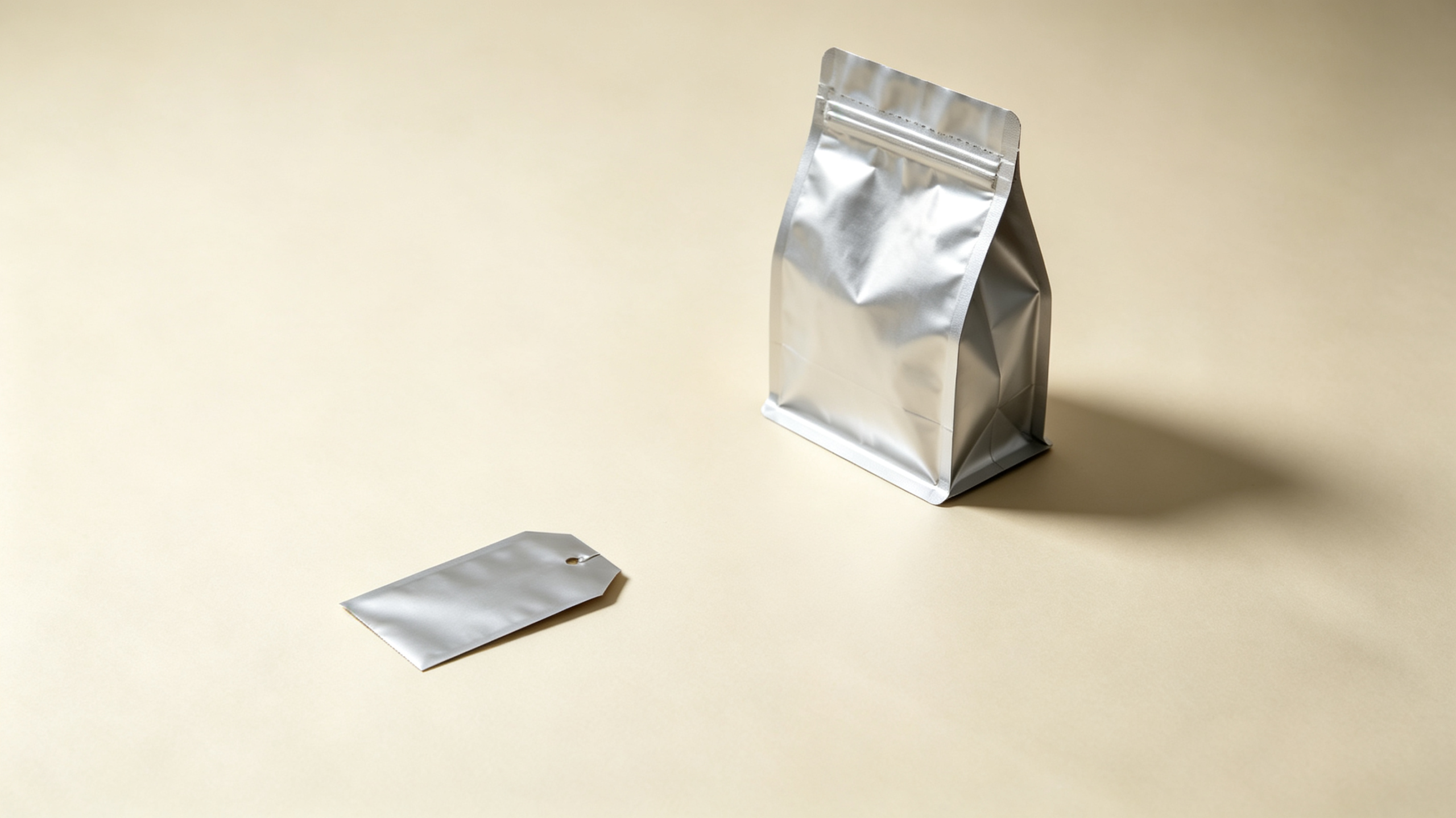
A bag of whole-bean coffee opened eighteen months after packing still smells like coffee. That is not the pouch shape or the valve doing the work — it is a layer of aluminium perhaps nine microns thick, thinner than a sheet of household cling film, standing between the beans and the oxygen that would flatten them. Foil remains the reference point against which every other barrier material is measured, and while newer options have narrowed the gap, nothing has displaced it at the top of the performance range.
Why foil still sets the barrier benchmark
Aluminium foil is not a barrier material in the sense of slowing transmission — at the gauges used in packaging it blocks transmission outright. Oxygen, water vapour, light and aroma effectively do not pass through an intact foil layer. Transmission rates are reported as approaching zero, which is why foil specifications rarely quote an oxygen transmission rate the way EVOH or nylon specifications do.
Foil also brings total light exclusion, which matters more than suppliers sometimes explain. Photo-oxidation — light driving fat rancidity — is a genuine spoilage route for coffee, nuts, dairy powder and many spices. A transparent high-barrier film can stop oxygen and still let the product spoil through light exposure.
Choosing a gauge: 7, 9 or 12 micron
Packaging foil is commonly supplied at 7µm, 9µm and 12µm, and the choice is about mechanical integrity rather than barrier — even 7µm blocks essentially everything.
- 7µm — the lightest practical gauge. Adequate for flat, low-stress pouches with gentle handling, but more prone to pinholing. Common in cost-sensitive, short-distribution applications.
- 9µm — the industry default. Good balance of cost, pinhole resistance and conversion behaviour for most coffee, snack and dry-food pouches.
- 12µm — specified where the pack will be heavily handled, retorted, or is large enough that flexing across a wide panel is likely. Also used for deep-draw lidding and pharmaceutical formats.
Going thicker buys mechanical durability, not barrier. If pinholing is the problem, gauge is one lever; adding or thickening the nylon layer that shields the foil is often the other.
The pinhole problem
Foil’s one real weakness is mechanical. Aluminium has poor flex-crack resistance and essentially no elastic recovery — bend it repeatedly and it develops microscopic pinholes. A foil laminate can leave the converter with a perfect barrier and arrive at the customer with thousands of invisible holes, because every fold and every vibration in transit works the foil.
The consequences are subtle and expensive: the pack does not leak, it simply stops protecting, and the product quietly loses shelf life without any visible sign. Practical mitigations:
- Laminate, never use foil alone. Polymer layers on both faces absorb and distribute the flexing strain.
- Pair foil with nylon. PA/AL/CPP is the standard retort structure precisely because the nylon protects the foil mechanically while the foil provides the barrier.
- Design the pack to minimise foil stress — avoid sharp creases, over-tight gussets and undersized pouch dimensions that force the film to fold hard.
- Verify, do not assume. Pinhole counts and flex-crack testing after simulated distribution catch problems before a launch does.
Where foil earns its cost
Coffee and tea
Oxygen and light are both spoilage routes here, and shelf life is measured in months to years under ambient conditions. Foil laminates are the default, usually with a degassing valve for freshly roasted coffee. We go into the structure choices in our Complete Guide to Coffee Pouches, and the same logic applies to tea pouch packaging.
Retort and sterilisation
Foil tolerates 121°C retort processing without issue and, combined with a CPP sealant, produces a pack that is shelf-stable at ambient temperature for a year or more. Very few transparent structures match this.
Pharmaceutical and high-value products
Moisture-sensitive and light-sensitive products — diagnostics, pharmaceutical powders, certain supplements — rely on foil because failure is not an acceptable outcome and the material cost is small relative to the product value.
Foil versus metallised film versus EVOH
- Foil — near-total barrier, opaque, good heat tolerance, mechanically vulnerable, higher cost, complicates recycling.
- Metallised film (VM-PET, VM-CPP) — a microscopic aluminium layer vapour-deposited onto a polymer film. Barrier is a fraction of foil’s but far better than untreated film, and it is much more flex-resistant and lighter. The usual choice when you need moderate barrier and good durability at lower cost.
- EVOH — excellent oxygen barrier and transparent, but moisture-sensitive and, unlike foil, provides no light barrier. Chosen when product visibility is required.
The honest summary: if the product must not see oxygen or light and the pack can be opaque, foil is still the answer. If either of those conditions does not hold, one of the alternatives is usually better value.
Recyclability, and what you can claim
A foil laminate is a multi-material structure and is not mechanically recyclable in conventional streams. This is the main reason brands explore alternatives. It is worth being precise in marketing claims: an aluminium layer is infinitely recyclable in principle, but in a bonded laminate it cannot be separated and recovered, so “recyclable” is generally not an accurate claim for a foil pouch. If end-of-life messaging matters to your brand, that conversation should happen before the structure is locked in.
Deciding between foil, metallised film and EVOH? Contact Us — we can match the barrier to your target shelf life rather than over-specifying.