

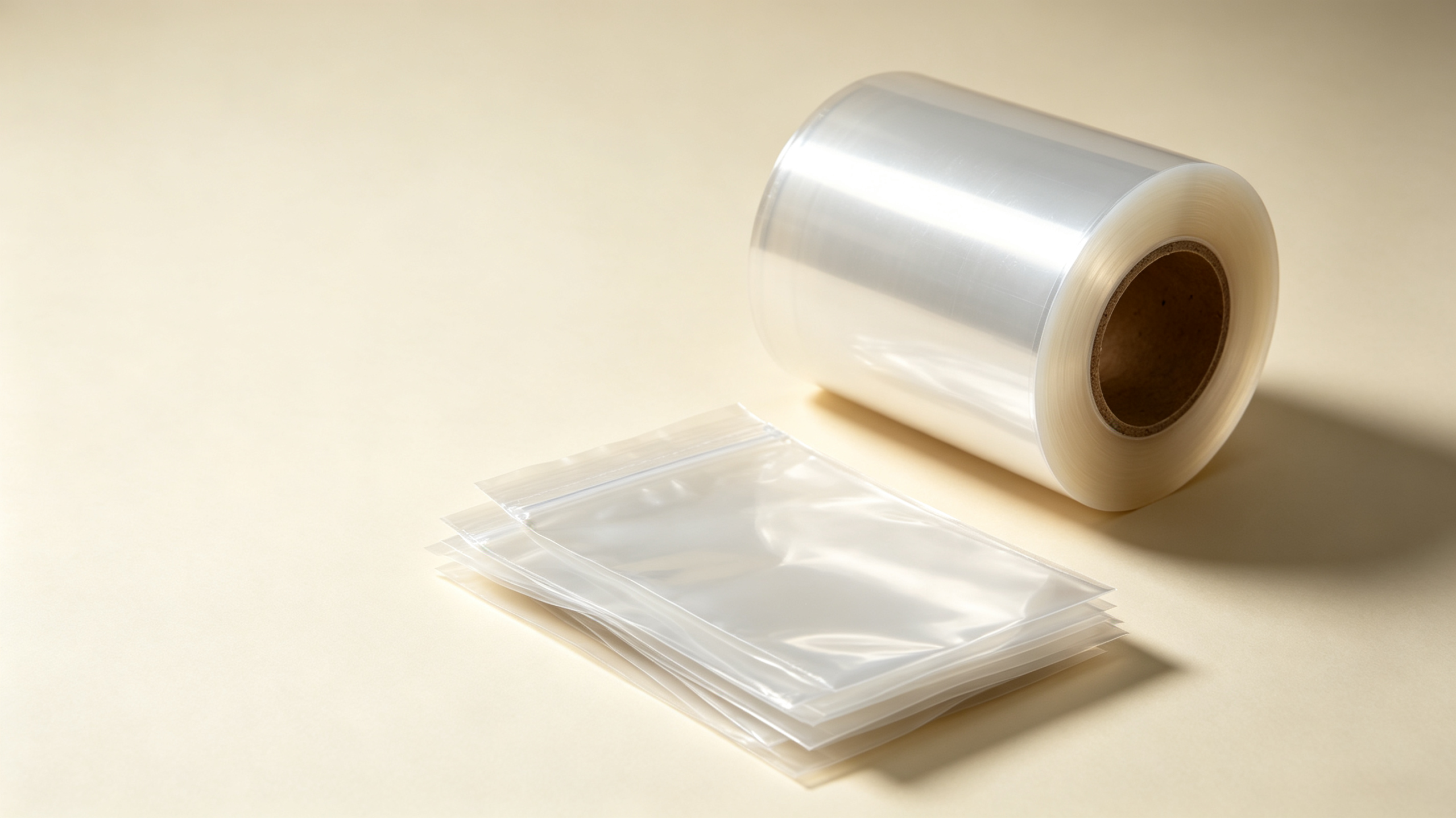
Sliced ham in a supermarket chiller sits in a pack the customer can see straight through, and it stays pink and fresh for weeks rather than days. Twenty years ago that combination was not available: you could have transparency or you could have a long shelf life, and choosing one meant giving up the other. EVOH is the material that broke that trade-off, and it now sits inside a large share of the high-barrier flexible packaging produced for chilled and ambient foods.
What EVOH is
EVOH (ethylene vinyl alcohol copolymer) is a high-barrier resin. It is almost never used as a standalone film — you will not buy a pouch made of EVOH. Instead it is co-extruded or laminated into a multi-layer structure as one thin layer, typically 3µm to 10µm thick, positioned where its barrier properties can be protected and put to work.
The polymer combines ethylene segments, which give processability and moisture resistance, with vinyl alcohol segments, which provide the barrier. The ratio between them is the main specification variable.
Why the barrier is so high
The vinyl alcohol portions of the chain pack together tightly and interact strongly with each other, leaving very little free volume for gas molecules to diffuse through. In dry conditions EVOH’s oxygen barrier is comparable to that of aluminium foil — orders of magnitude better than PE or nylon. It also blocks aroma and flavour compounds effectively, which matters as much as oxygen for products whose value is in their smell.
Unusually among barrier materials, EVOH is also transparent and glossy. That is the property that made it commercially important, because it allowed brands to keep clear packaging while extending shelf life.
The moisture problem
Here is the caveat that governs every EVOH specification. EVOH is hygroscopic, and when it absorbs moisture its oxygen barrier deteriorates sharply — the water molecules disrupt the tight intermolecular bonding that produces the barrier in the first place. A structure that performs beautifully at low humidity can lose most of its barrier advantage in a wet, high-humidity application.
The industry’s answer is structural rather than chemical: EVOH is always buried inside the laminate, sandwiched between hydrophobic layers, usually PE, that shield it from both the product’s moisture and the external atmosphere. This is why you will see EVOH in the middle of a structure code and never on the outside.
Two practical implications follow. Retort and hot-fill applications are difficult for EVOH, because the process itself drives moisture into the resin — the barrier can take time to recover afterwards, and in some cases does not fully. And barrier figures quoted on a data sheet are measured under defined humidity; always ask what relative humidity the number was taken at before comparing grades.
Ethylene content: the trade-off
EVOH grades are commonly described by ethylene content, typically in the 27–48 mol% range.
Lower ethylene, around 27–32 mol%
The best oxygen barrier, but more moisture-sensitive and harder to process. Used where maximum barrier is the priority.
Higher ethylene, around 38–48 mol%
Slightly lower barrier, but noticeably better moisture tolerance and easier orientation and thermoforming. Used in retort applications and deep-draw formats.
Selecting a grade is essentially deciding where on that curve your product sits. A chilled, relatively dry product can use a low-ethylene grade and take the barrier; a wet or thermally processed product usually needs the moisture tolerance of a higher-ethylene grade.
Where EVOH sits in a structure
Typical laminate builds
A typical arrangement looks like this: an outer layer for printing and stiffness, often PET or nylon; then tie layers; then the EVOH core; then tie layers again; then an inner PE sealant. The tie layers are adhesive resins without which EVOH will not bond reliably to PE or PP. Common flexible builds include PET/EVOH/PE for clear high-barrier pouches, and PA/EVOH/PE where puncture resistance is also needed.
Rigid and semi-rigid formats
EVOH also appears in rigid and semi-rigid packaging — trays and bottles for ketchup, mayonnaise and similar products — where the same barrier logic applies to a different package geometry.
EVOH versus foil versus metallised film
- EVOH — excellent oxygen barrier, fully transparent, no light barrier, moisture-sensitive, moderate cost. Best when visibility matters and the product is not light-sensitive.
- Foil — near-total barrier including light, opaque, mechanically vulnerable, higher cost. Best for long ambient shelf lives and light-sensitive products.
- Metallised film — moderate barrier, partial light blocking, durable and cheap. A middle option for cost-sensitive applications with moderate requirements.
A useful way to frame the choice: EVOH solves oxygen, foil solves oxygen plus light plus time. If your spoilage mechanism is purely oxidative and you want the customer to see the product, EVOH is usually the right call.
Processing considerations
EVOH processes well within its window but has a few requirements worth planning for. It is thermally sensitive, so melt temperature control matters and long residence times in the extruder should be avoided. Scrap and edge trim containing EVOH cannot simply be reground back into the same layer without care, since reprocessing degrades barrier. And because the resin must be protected from moisture, structures are usually converted and used within a defined window rather than held in open stock indefinitely.
Recycling and the mono-material question
EVOH is chemically incompatible with PE and PP recycling streams. In the small quantities used in a laminate — a few percent by weight — it is generally tolerated in PE recycling, and there are grades designed specifically to be compatible at low loading levels. In larger concentrations it causes problems, which is why mono-material barrier development focuses on very thin EVOH layers or alternative coatings. If recyclability is a stated target, raise the loading level and the specific grade with your supplier rather than assuming it is a non-issue.
Specifying EVOH: questions worth asking
- What relative humidity was the barrier figure measured at? This determines whether the number means anything for your product.
- What ethylene content, and why? The answer should reference your product’s moisture level and process conditions.
- What is the layer thickness, and is it the minimum that meets the shelf-life target? EVOH is expensive; over-specifying thickness is a common, avoidable cost.
- How is the EVOH protected on both sides? If it is not fully enclosed behind moisture-resistant layers, the structure will underperform.
- Does the process involve retort or hot fill? If so, ask for post-process barrier recovery data rather than pre-process figures.
Need a clear high-barrier structure? Contact Us — we can help size the EVOH layer to your actual shelf-life target.