

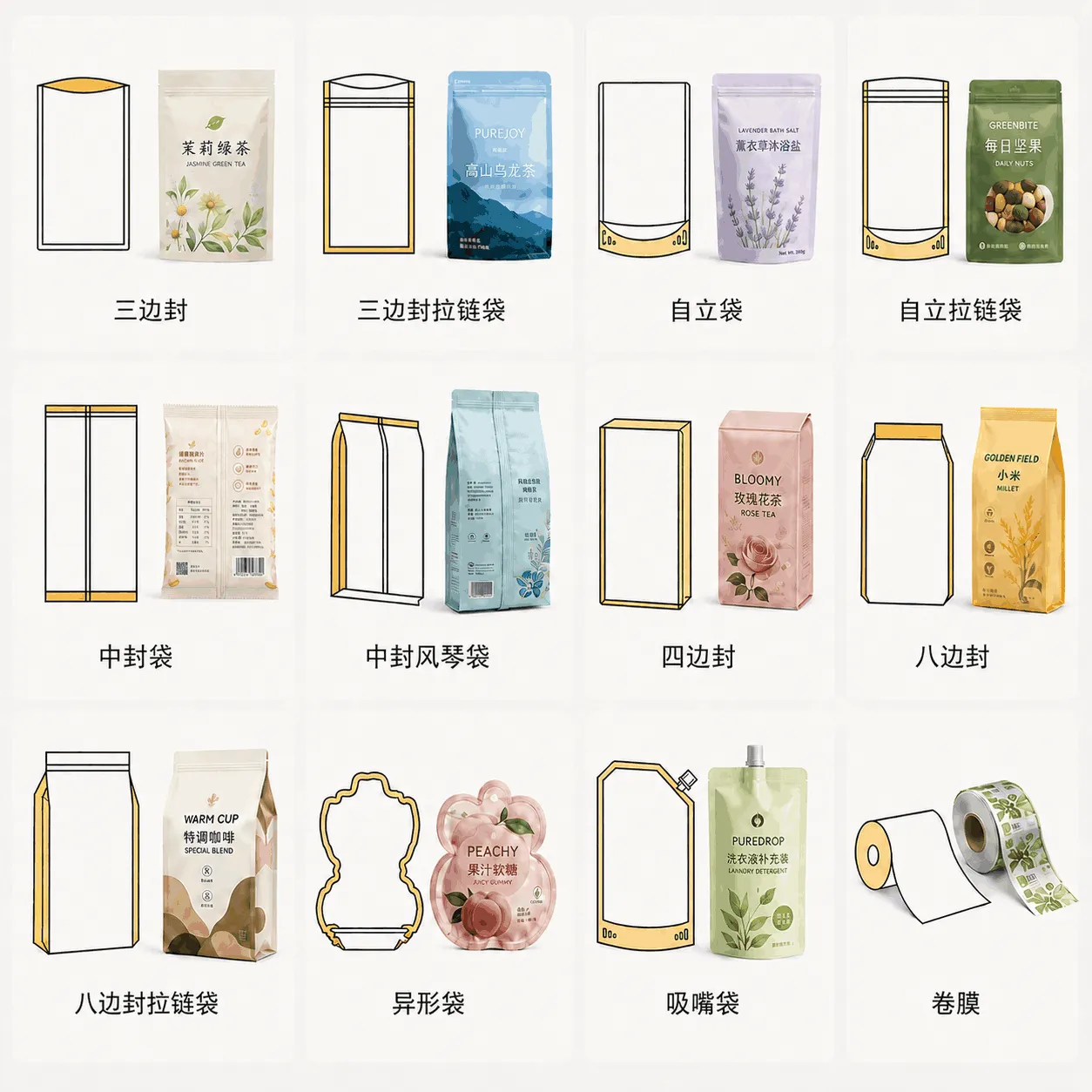
Why Is the Flexible Pouch Type So Important?
Pouch type selection comes before everything else in packaging design. Start a packaging project and most people jump straight to”what artwork to print and what material to use”, skipping a more fundamental question — which pouch format fits the product. The format governs how the product is filled, stored and displayed, and it drives both shelf appeal and user experience. Get the type wrong and even brilliant design goes to waste.
Flexible pouch types look endlessly varied, but the field narrows to a handful of workhorses. Here we walk through the 6 formats you will actually encounter, so their differences and use cases become clear at a glance.
Stand-up pouch
Features: a folded bottom opens so the pouch stands steadily on shelf, with side gussets expanding accordion-style. Add a zipper and the pouch reseals again and again — a genuine convenience for consumers.
Best for:Coffee beans, tea, freeze-dried food, pet treats, nuts, milk powder and beyond — anything that benefits from”standing up for display”. A transparent window version lets shoppers see the contents directly, which lifts purchase confidence.
Common specifications: From 20g to 5kg, covering trial packs through family sizes. Barrier typically comes from PET/AL/PE or PET/MPET/PE structures.
8-Side Seal Pouch (Flat Bottom Pouch / 8-Side Seal)
Features: a flat base plus eight sealed side edges gives the format its name. Its defining strengths are a perfectly flat bottom, the steadiest upright stance of any pouch, and the largest flat front display area for the best print results — the most premium silhouette in flexible packaging.
Best for:Specialty coffee (200g+ especially), premium tea, nut snacks, pet food staples and freeze-dried products. Specialty coffee brands favor it heavily because the pouch”stands”on shelf as neatly as a small box and delivers strong visual impact.
Note:Manufacturing is relatively involved, and pricing runs 15-30% above stand-up pouches. For high unit price, premium-positioned products the premium pays for itself; for high-volume, low-price lines, stand-up is the smarter spend.
3-Side Seal Pouch
Features:The plainest format of all — three sealed sides, one opening.FDA food packaging guidelines pouches cannot stand upright and are mainly laid flat. The process is the simplest, fastest to make and lowest in unit price.
Best for:Trial packs, small sample packs, single-use seasoning sachets and wet wipes. When the product simply needs flat packaging or serves as a gift/sample pack, nothing beats the 3-side seal on value.
4-Side Seal Pouch
Features:all four edges sealed, producing a flat, envelope-like form. It doesn’t stand, but both faces are perfectly flat and print beautifully.
Best for:Flat products — seaweed sheets, face masks, dried powder goods and small snacks. Seal integrity is excellent, which suits products intended for long-term storage.
Side gusset bag
Features:accordion folds run along the sides or bottom, expanding for large capacity yet folding down compactly. Both bottom-gusset and side-gusset versions exist.
Best for:Bulk coffee powder, pet food (2.5kg+), bakery ingredients, chemical powders — anything where volume matters. For the same outer dimensions, gusset pouches hold the most.
Back Seal Pouch (Center Seal / Back Seal)
Features:the seal runs down the spine, forming a tube. Chip bags in any supermarket are textbook back seal pouches. Production speeds are extremely high, which makes it the natural format for volume.
Best for:Puffed snacks like chips, frozen food, rice and flour — the high-volume, low-price tier. Among mass-production options, back seal is one of the most economical.
Practical Advice for Choosing a Flexible Pouch Type
Weigh these points as you choose:
- Product form — granular, powder, liquid or solid? Powders and liquids suit stand-up or 8-side seal pouches; solid blocks can use gusset pouches.
- Display method — sold standing on the shelf or hanging? Choose stand-up or 8-side seal pouches if standing display is needed.
- Brand positioning — premium lines use 8-side seal pouches, value lines use stand-up pouches, sample packs use 3-side seal pouches.
- minimum order quantity (MOQ) — small batches (500-5,000 pcs) recommend stand-up or 3-side seal pouches; for large volumes (10,000+) all types work, and 8-side seal tooling costs can be amortized.
Still undecided? The simplest move is to ask your packaging supplier to propose a few options side by side. An actual sample in hand beats any amount of armchair analysis.
Questions about pouch selection?Welcome toContact PurestPack, and we provide free consultation from pouch type recommendation to structural design, helping you find the packaging solution best suited to your product.