

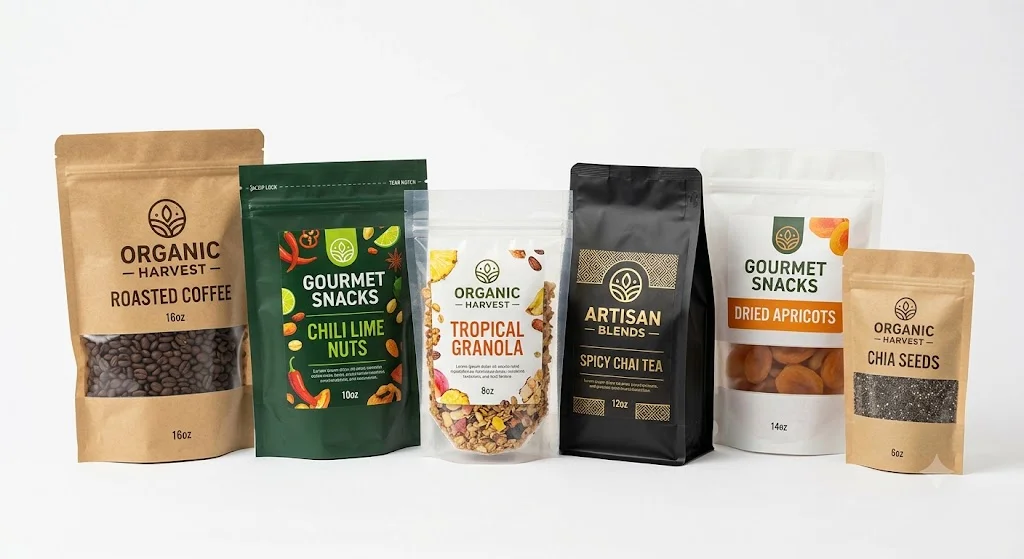
Custom Food Pouches: choose the right materials and processes to make your product naturally appealing
Choosing custom food pouches is a decision every food business eventually faces, and it rarely feels simple. You have probably had this experience: while walking down a supermarket aisle, your attention lands on a snack with particularly appealing packaging — you pick it up, scan the ingredient list, and end up putting it in your basket. In today’s food industry, packaging has long stopped being merely “a bag to hold things”. It is the product’s first business card, a silent salesperson, and in many cases it directly decides whether consumers are willing to pay a premium for your product.
Market studies suggest that for more than 70% of consumers trying a food brand for the first time, the visual appeal of the packaging is one of the key factors driving the purchase. That is precisely why well-chosen custom food packaging pouches can turn an ordinary product into a “shelf star”. Yet with so many materials and manufacturing processes available, first-time buyers often do not know where to begin. This article walks you through everything from material selection to printing in a single pass. If you are still unsure about how different films compare, start with our earlier article on the5 Key Factors in Choosing Food Packaging Pouches as a basic introduction.
1. How to choose the common materials for custom food pouches?
Material selection is the first and most impactful step in custom pouch production, because it largely determines both cost and quality. Choose correctly, and your custom food packaging pouches are already halfway to success. The mainstream food packaging materials used today include the following:
1. Kraft paper pouches
Kraft paper has a natural, eco-friendly image and a warm, tactile feel, making it suitable for baked goods, dried fruit, tea, grains and cereals. A PE coating on the inside can provide oil and moisture resistance while preserving the paper look and texture. As the “green packaging” wave has gathered momentum, kraft pouches have become especially popular for coffee beans, artisan bread and organic foods. The material also prints beautifully — both flexographic and digital processes deliver a clean finish. According to theUS FDA food contact material standards, kraft paper, as a natural fiber material, has a long record of safe use in food packaging.
2. Aluminum foil pouches
Foil pouches offer exceptionally strong barrier properties, holding back moisture, light and oxygen with ease — exactly what long-storage foods such as tea, milk powder, coffee powder, freeze-dried products and pet treats require. Their metallic sheen also suits mid-to-high-end branding. A typical foil pouch is built from three or more laminated layers: outer PET for printing, a middle AL foil for barrier, and inner PE for heat sealing, a structure that performs reliably. Pouches of this kind are especially well matched to products with demanding shelf-life requirements.
3. Laminated pouches (plastic/nylon laminates)
This is the most versatile pouch category. By combining different films — PET/AL/PE, NY/PE, PET/PE and others — manufacturers can achieve transparency, puncture resistance, retort tolerance and more. Typical applications include snacks, frozen food, cooked dishes, seasonings and sauce sachets. The nylon layer in particular greatly improves puncture resistance, which is why NY-based structures are recommended for bone-in meat treats. For a fuller comparison of material pricing and performance, refer to our article on thePros and cons comparison of 6 common packaging materials.
4. Biodegradable material pouches
With environmental regulations tightening around the world, biodegradable films such as PLA (polylactic acid) and PBAT have entered the mainstream conversation. They are still more expensive than conventional films and have limited heat resistance, but they align well with future consumption trends and suit brands with an eco-friendly positioning. One important caveat: biodegradable materials do not decompose in every environment, so always confirm the required degradation conditions with your supplier before committing. The EU’sPackaging and Packaging Waste Directive (PPWD) certification requirements for biodegradable packaging are a useful reference point.
2. The printing process determines the “appearance” of custom food pouches
Once the film is chosen, the printing process shapes how the finished custom food packaging pouches actually look. Different processes deliver very different levels of perceived quality, and matching the process to your order volume and budget can significantly optimize costs.
Flexographic printing (Flexo)
Flexo suits large-volume production and delivers a low per-unit cost once the plate investment is amortized. Colors come out rich and even, which makes flexo a mainstream choice for everyday snack packaging. Its main limitation is plate-making: minimum runs typically start at around 5,000 pieces, and any design change means new plates.
Gravure printing
Gravure offers even greater color depth, extremely high precision and accurate registration, making it the preferred option for premium products and brands that demand faithful color reproduction. The trade-offs are higher plate costs and large minimum order quantities, which make small-batch customization uneconomical. If your product moves steadily through supermarket channels, gravure is usually the optimal choice.
Digital printing
Digital printing needs no plates at all and can produce from a single piece, which makes it the best option for small-batch customization. It is ideal for new product trials, e-commerce orders in limited quantities, personalized packaging and region-specific editions. The technology has advanced rapidly in recent years — color fidelity and precision now approach gravure levels, and it even supports one-bag-one-code traceability.
Hot foil stamping (gold/silver)
Foil stamping applies a layer of gold or silver foil to selected areas of the package, instantly raising its perceived value. It is a favorite for gift boxes, premium souvenir packs and holiday-limited editions. Foil stamping is usually combined with embossing, so logos and patterns gain both a metallic sheen and a tactile three-dimensional feel.
3. Four Practical Pitfall-Avoidance Tips for Custom Food Pouches
1. Confirm the food’s properties first: oily foods such as nuts, fried chicken and chips need an oil-resistant coating or OPP lamination; frozen foods require low-temperature-resistant films that will not crack in cold storage; retort foods need pouches that withstand 121°C. Do not settle for a one-size-fits-all solution — different foods place completely different physical and chemical demands on your custom food packaging pouches.
2. Allow enough time for sampling: always sign off on physical samples before mass production. Color deviation, how smoothly the zipper glides, whether seal strength meets the standard, whether film thickness is uniform — these things can only be judged once you hold the sample in your hands. We recommend setting aside at least 7-10 days for sample approval and revisions.
3. Pay attention to the sealing method: three-side seal, center seal, stand-up pouch, gusset pouch, zipper closure, easy-tear opening — each option changes the user experience in a different way. For e-commerce shipments, an easy-tear opening is recommended to improve the unboxing experience; products consumed over multiple sittings, such as tea and nuts, should add a zipper so they can be resealed and stored easily.
4. Eco-certification as a bonus: if your packaging uses FSC-certified paper or OK Compost-certified biodegradable materials, you can print the corresponding labels on the pack. This keeps you aligned with the global sustainability trend and, importantly, supports brand premium — a growing number of consumers are willing to pay 5%-10% more for eco-friendly packaging.
4. Custom food pouches as brand ambassadors
A well-designed custom food packaging pouch must do more than hold the product — it has to sell it. These three points are key to turning packaging into genuine brand strength:
Visual consistency: the color scheme, typography and logo placement on the pouch must stay in line with the brand’s overall visual identity. Online and offline channels in particular should share a single visual language so that consumers recognize your brand at a glance on the shelf. It is worth creating a simple brand guideline booklet that the packaging design team can follow.
Information hierarchy: put the product name and core selling points on the front (for example “no added sugar” or “high protein”), and move detailed descriptions, ingredient lists and nutrition facts to the sides or back. Do not crowd everything onto the front panel — a consumer’s attention lasts only 3-5 seconds, so give them the most valuable information in the shortest time.
Tactile marketing: touch is the most direct sensory experience after sight. Matte lamination feels more premium than gloss film — it produces no glare and shows no fingerprints; spot UV raised effects guide fingers toward specific areas and add interactivity; and kraft paper’s rough texture itself signals “natural” and “handmade”. These details may seem minor, but consumers notice the difference the moment they pick up the pack.
Summary: choose the right custom food pouch and make your product stand out
Custom food pouches are a systematic project that requires weighing materials, processes, cost and brand positioning together. There is no “best” packaging — only the solution that is “most suitable” for your product and budget. Before you begin, answer three questions: which channel will I sell through? Who is my target customer? What is my price range? Walking into discussions with a packaging factory equipped with these three answers makes the whole process far more efficient and helps you avoid detours. For price and performance comparisons between materials, you can also refer to our other detailedGuide to Choosing Custom Pouch Materials.
Interested in custom food packaging pouches? Welcome to Contact PurestPack. We offer one-stop service covering material selection, structural design, printing, sampling and mass production, and our professional team provides free customization advice to help your product stand out on the shelf.