

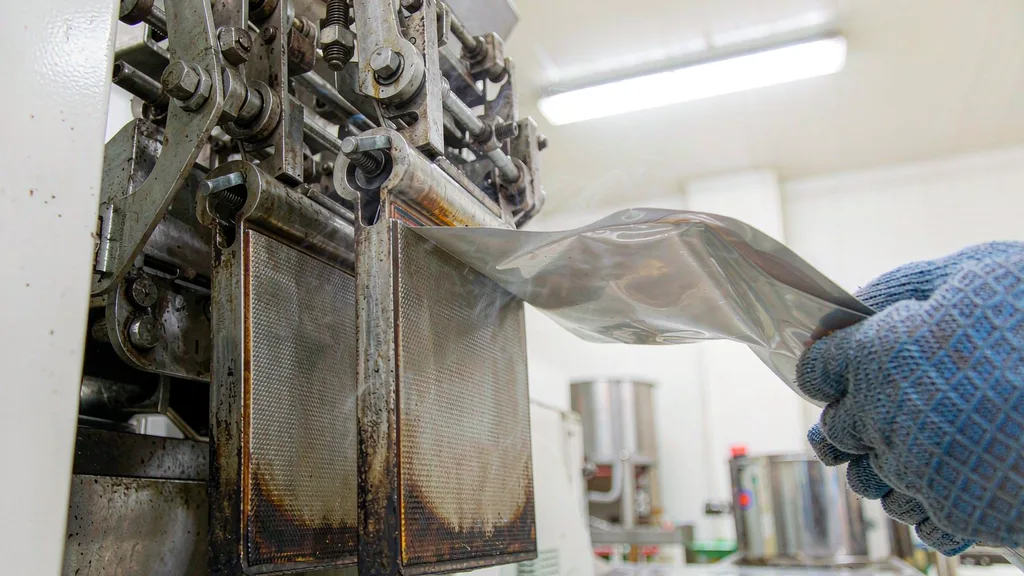
Most seal failures on a filling line trace back to three settings: temperature, dwell time and pressure. A heat seal is simply a controlled melt-and-press operation — the sealant layer reaches a semi-molten state, flows across the mating surfaces, and solidifies under force — so every defect you will ever see is caused by one of those three variables being wrong, or by something interfering with the melt itself, like product dust in the seal area. This article explains how to find a working window for your film, what typical settings look like for common sealant layers, and how to read the five defects that appear most often in daily production.
What the Three Heat Seal Parameters Actually Control
Temperature determines whether the sealant melts at all. Every sealant resin has a melting point — polyethylene blends typically soften between 105 and 135 degrees Celsius — and the jaw temperature must be set well above that so heat actually soaks through the film during the short dwell. Dwell time controls how long the melt has to flow and bond; too short and the interface never fully fuses, too long and you cook the film. Pressure controls film-to-film contact and squeeze-out; too little leaves voids, too much thins the sealant bead at the seal edge.
The key concept is the seal window: the range of temperature and time in which the seal reaches adequate strength without deforming the film. A wide window means the line runs forgivingly; a narrow window means every speed change and temperature drift shows up as defects. ASTM F2029 is the standard laboratory practice for mapping this window for a given film — a plot of seal strength versus jaw temperature at fixed dwell — and any competent film supplier can provide one for the structure they sell you. If your film has never been mapped, ask for it before you start turning knobs on the machine.
Typical Starting Points by Sealant Layer
The table below collects commonly used starting ranges for jaw temperature on horizontal and vertical machines. Treat them as starting points only — actual settings depend on film thickness, laminate structure, machine heat-up losses and line speed.
| Sealant layer | Typical melting range | Starting jaw temperature | Notes |
|---|---|---|---|
| PE blend (LLDPE-based) | 105–135 °C | 130–170 °C | The workhorse for most food pouches |
| CPP (cast polypropylene) | 130–155 °C | 140–180 °C | Common in retort and hot-fill structures |
| EVA copolymer | 70–100 °C | 100–140 °C | Low-temperature sealing, lower hot-tack |
| PE with easy-peel blend | 105–135 °C | 120–160 °C | Controlled peel, verify opening force |
Two practical adjustments matter more than the base numbers. Frozen and chilled products chill the film as it travels, so the effective temperature at the jaw drops and the setting must rise — this is one reason frozen food packaging lines run hotter settings than ambient snack lines even on identical film. And if your product is powdery or oily, no temperature setting will save a contaminated seal: the fix belongs upstream in filling discipline, as covered in this sauce pouch filling-temperature guide from OMOPACK, a flexible-packaging producer working daily with small and mid-size food brands.
Five Common Seal Defects and What They Mean
Reading the seal tells you which parameter to move. The five patterns below cover the vast majority of daily production issues:
- Weak seal that peels apart cleanly: temperature too low or dwell too short. The interface melted but never fused. Raise temperature in 5–10 degree steps, or extend dwell if the film is starting to distort.
- Burn-through or wrinkled, brittle seal: temperature too high or dwell too long. The sealant was squeezed out of the seal and the structural layer overheated. Reduce temperature first; dwell second.
- Channel leaks along the seal: pressure too high, crushing a path through the seal, or a wrinkle entering the jaws. Check bag flattening and product placement before blaming the film.
- Contaminated seal (product in the interface): filling splash or dust in the seal zone. Fix with filling temperature, product viscosity or an air-clean step — not with heat.
- Seal fine at start of shift, drifting by end of shift: jaw temperature controller losing calibration, or film gauge variation between rolls. Log settings per roll lot; this is exactly the drift a repeatable film qualification protocol is designed to catch before a new film reaches the line.
A note on verification: seal appearance is not a test. Pull-test seals per ASTM F88 to get peel strength numbers, and use burst testing per ASTM F1140 or F2054 to check whole-package integrity under pressure. Production lines that only eyeball seals discover channel leaks in the warehouse instead of at the machine.
How to Lock In a Repeatable Process
Write the window down as a machine recipe tied to the film structure, not to the operator’s habit. A usable spec has four numbers: jaw temperature, dwell time, jaw pressure (or cylinder pressure), and the acceptable peel-strength range verified by ASTM F88. When a new film lot or a new structure arrives, run the qualification, confirm the window still holds, and only then release the recipe to the line. Lines that skip this step quietly re-discover their process every time a film supplier adjusts a formulation.
For long-running food production, it is also worth agreeing seal-strength acceptance values with the film supplier in the purchase specification, so that a disputed batch is judged by numbers rather than by whose opinion of a torn seal wins. Their side of that conversation — how factories specify barrier and sealant layers and verify them — is described in this PE sealant film guide, and their food-contact testing requirements guide explains which compliance documents should already be in place before any seal discussion starts.
FAQ
What are the three main heat seal parameters?
Temperature, dwell time and jaw pressure. Temperature brings the sealant to a melt, dwell time lets the melt fuse, and pressure ensures full film-to-film contact. Every common seal defect maps back to one of the three, or to contamination in the seal area.
What temperature should I set for sealing PE film?
Start between 130 and 170 degrees Celsius for a typical LLDPE-based sealant, then tune in small steps. The correct value depends on film thickness, laminate structure and line speed, so always confirm with the film supplier’s seal window data.
How do I find the seal window for a new film?
Run a matrix of temperature settings at fixed dwell and pressure, peel-test each condition per ASTM F88, and plot strength against temperature. The plateau of adequate strength is the window. ASTM F2029 describes this procedure for the laboratory.
Why do my seals leak only sometimes?
Intermittent leaks usually come from wrinkles entering the jaws, product contamination in the seal zone, or drifting jaw temperature across a shift. Log settings and inspect the seal zone upstream before changing film.
What is the difference between seal strength and seal integrity?
Seal strength measures the force needed to peel a seal, tested per ASTM F88. Seal integrity asks whether the whole package leaks under pressure, tested by burst methods such as ASTM F1140 or F2054. A package needs both: strong enough to survive handling and tight enough to hold barrier.
Can I fix a contaminated seal by raising temperature?
No. Product dust or liquid in the interface blocks fusion no matter how hot the jaws are. Fix the contamination at the filler — through filling temperature, viscosity control or an air-clean step — and keep the seal zone clean.
