

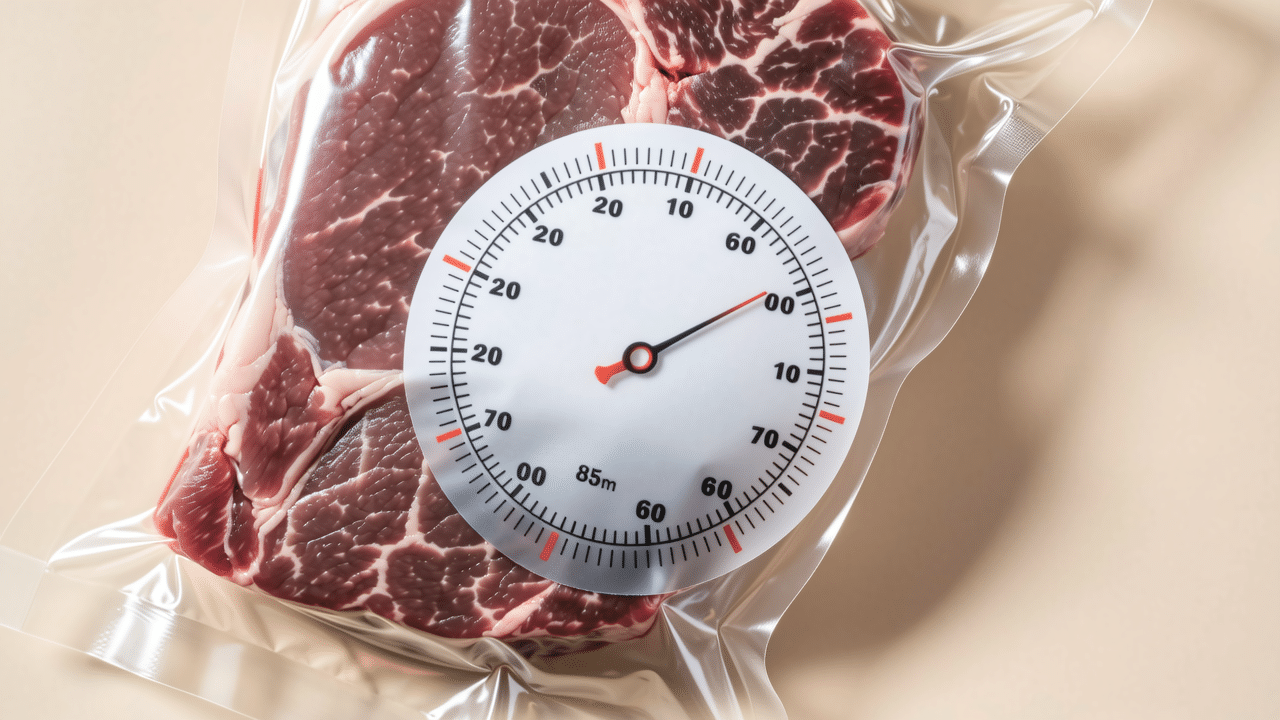
Time-temperature indicators are small labels that change appearance when a product has been exposed to too much heat over time. For chilled and frozen food, vaccines and biologics, they turn an invisible history into something a person can see at a glance. This guide explains how time-temperature indicators work, where they are worth the cost, and what to check when you specify them for a flexible package.
What a Time-Temperature Indicator Actually Measures
A time-temperature indicator, usually shortened to TTI, integrates temperature exposure over time. Instead of recording a single peak temperature, it accumulates the effect of every warm hour, so a product held at 4 degrees Celsius for three days can be distinguished from one that spent four hours at 20 degrees, even if both saw the same maximum.
The label itself is passive. It usually works through a controlled reaction, such as an enzymatic, chemical or diffusion process, that changes color or moves a visible bar as it progresses. Because the reaction rate follows roughly the same temperature dependence as the spoilage or degradation it is meant to track, the indicator can be tuned so that its end point lines up with a real quality limit.
Types of Time-Temperature Indicators
Three families dominate. Full-history indicators change gradually and are read continuously. Threshold indicators change once a defined temperature is exceeded. Time-temperature integrators, the most quantitative of the three, combine both: they only start responding above a set temperature and then accumulate exposure.
Applications map onto the type. Full-history labels suit chilled ready meals and fresh meat, where cumulative abuse matters. Threshold labels are common on heat-sensitive pharmaceuticals and on shipments that must not freeze. Integrators are used where a shelf-life decision has to be made, for example on vaccines or on high-value seafood.
Where TTIs Fit in Flexible Packaging
TTIs are most useful when three conditions hold: the product degrades gradually with temperature, the value at risk is high, and there is a decision to be made at the point of reading. Chilled meat and seafood in vacuum pouches are a good example, because the pack is already sealed and inert, so the main remaining risk is the temperature history in the cold chain. The same logic applies to industrial vacuum sealing, where a broken cold chain is otherwise undetectable.
TTIs also pair well with barrier materials. A high-barrier pouch protects against oxygen and moisture, but it cannot protect against warmth, and an indicator closes that gap. For dry goods with a long shelf life, the indicator adds little, and the money is better spent on packaging structure and sealing quality instead.
Specifying a TTI for Your Package
Start from the product, not the label. Define the temperature limit that actually matters, the shelf life at the reference temperature, and the response you need, whether that is a gradual color shift or a single trigger. Then ask the supplier for the activation temperature, the time to end point at that temperature, and the tolerance on both.
Placement matters as much as the chemistry. The indicator should sit on or beside the product surface, not on the outer carton, or it will measure air temperature rather than product temperature. On flexible packs, apply it to a flat area that will not flex during handling, and make sure the adhesive survives condensation. Consider whether the label must stay readable after the pouch has been opened and reclosed with a zipper or slider.
Limits and Practical Caveats
TTIs are an indicator, not a measurement instrument. Different products respond differently, and a label calibrated for one product will not transfer cleanly to another without re-calibration. Cost is another factor: the label has to be justified by the value of the product or by a compliance requirement, rather than added as a marketing decoration.
Finally, an indicator is only meaningful if someone acts on it. If the reading is not tied to a clear rule, such as reject, expedite or carry out a quality check, the label becomes cost without benefit.
Summary and Recommendations
Time-temperature indicators turn an invisible cold-chain history into a visible, actionable signal. They earn their place on high-value, temperature-sensitive products packed in vacuum or high-barrier pouches, where the packaging already controls oxygen and moisture but cannot control warmth. Match the indicator type to the decision you need to make, place it correctly, and agree calibration and tolerance with the supplier up front.
To discuss barrier pouches, vacuum structures or label placement for your product, contact PURESTPACK.
