

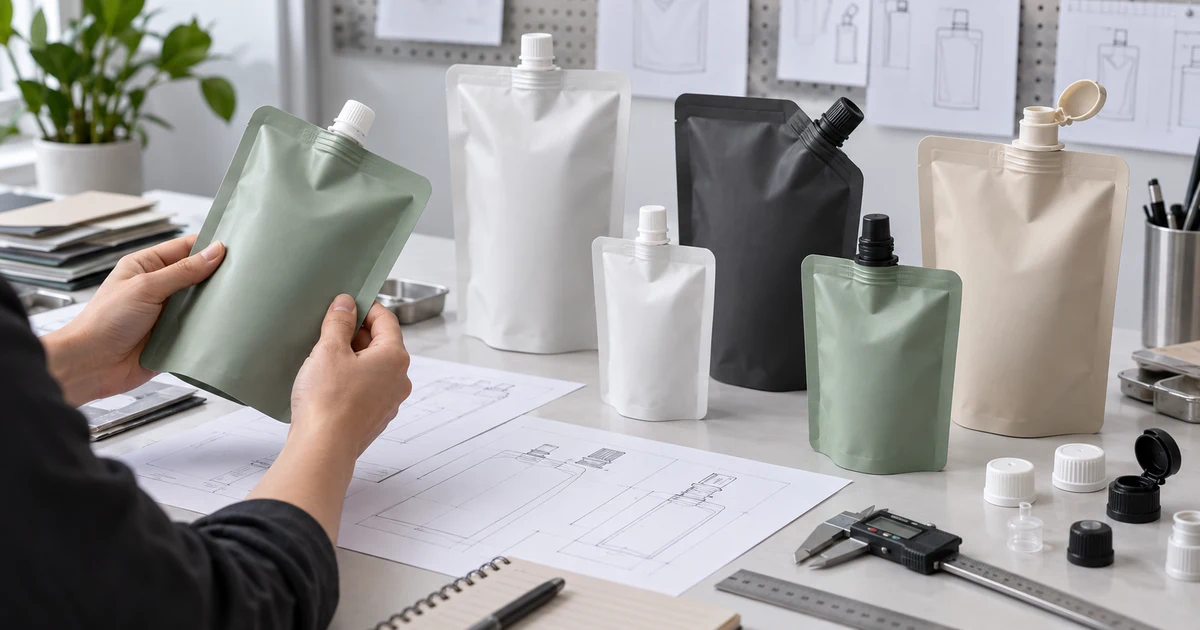
A reliable custom spout pouch manufacturer must treat the pouch, spout, cap, packed product and filling process as one system. A pouch that looks suitable in a catalogue may not match the product viscosity, filling temperature, closure method or distribution conditions. Buyers should therefore compare suppliers using written specifications, relevant samples and an agreed validation plan rather than relying on a universal “leak-proof” claim.
This guide helps food, beverage, detergent and personal-care brands prepare a useful RFQ, compare spouted pouch suppliers and approve a project with clearer evidence.
Define the product before comparing suppliers
Begin with the packed product. Tell the supplier whether it is a thin liquid, viscous gel, concentrate or product containing particles. Include relevant information about composition, fill temperature, expected shelf life, storage, transport and intended consumer use. A product photograph is not enough to select a material structure or closure.
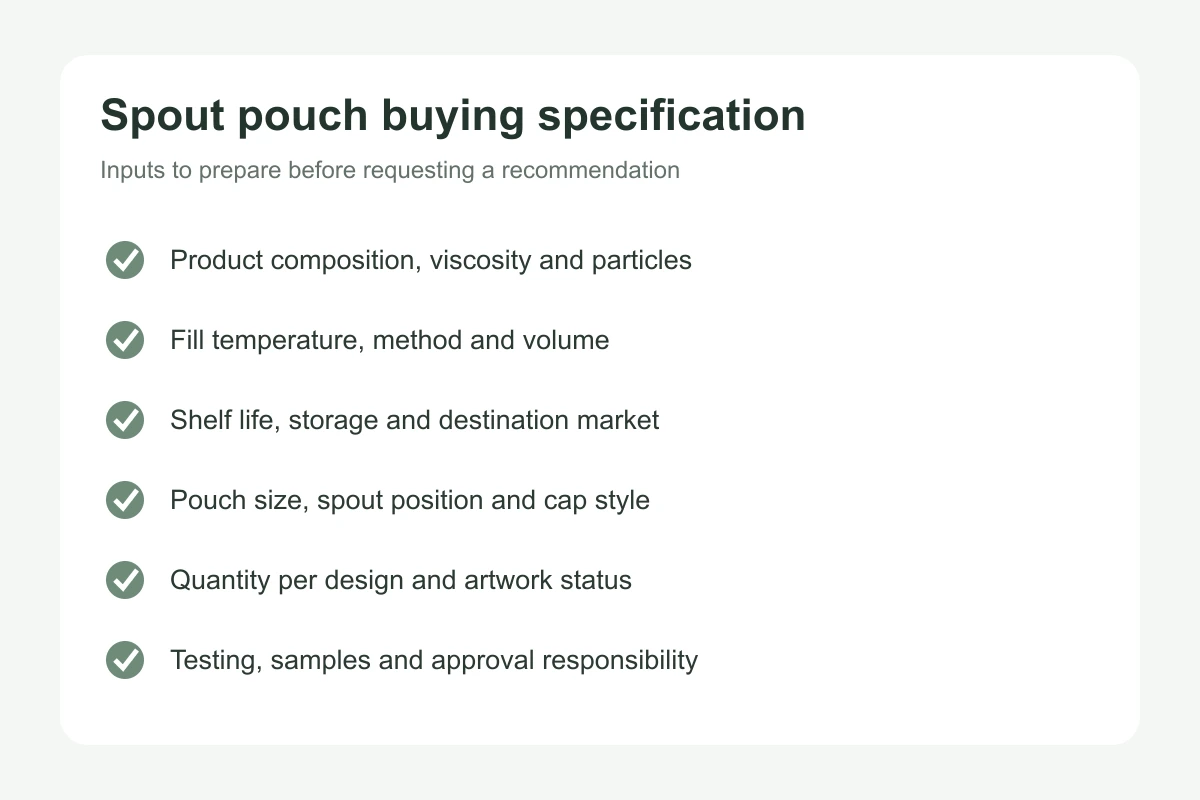
Prepare these inputs before asking for a recommendation:
- Product type, composition and any compatibility concerns.
- Viscosity and the size or concentration of particles, if present.
- Fill temperature, fill volume and filling method.
- Expected shelf life, storage and destination market.
- Preferred pouch size, spout position, cap style and opening experience.
- Quantity per design, artwork status and delivery destination.
Identify which details are confirmed and which still require testing. This prevents assumptions from becoming part of the order unnoticed.
Confirm the available pouch and spout configurations
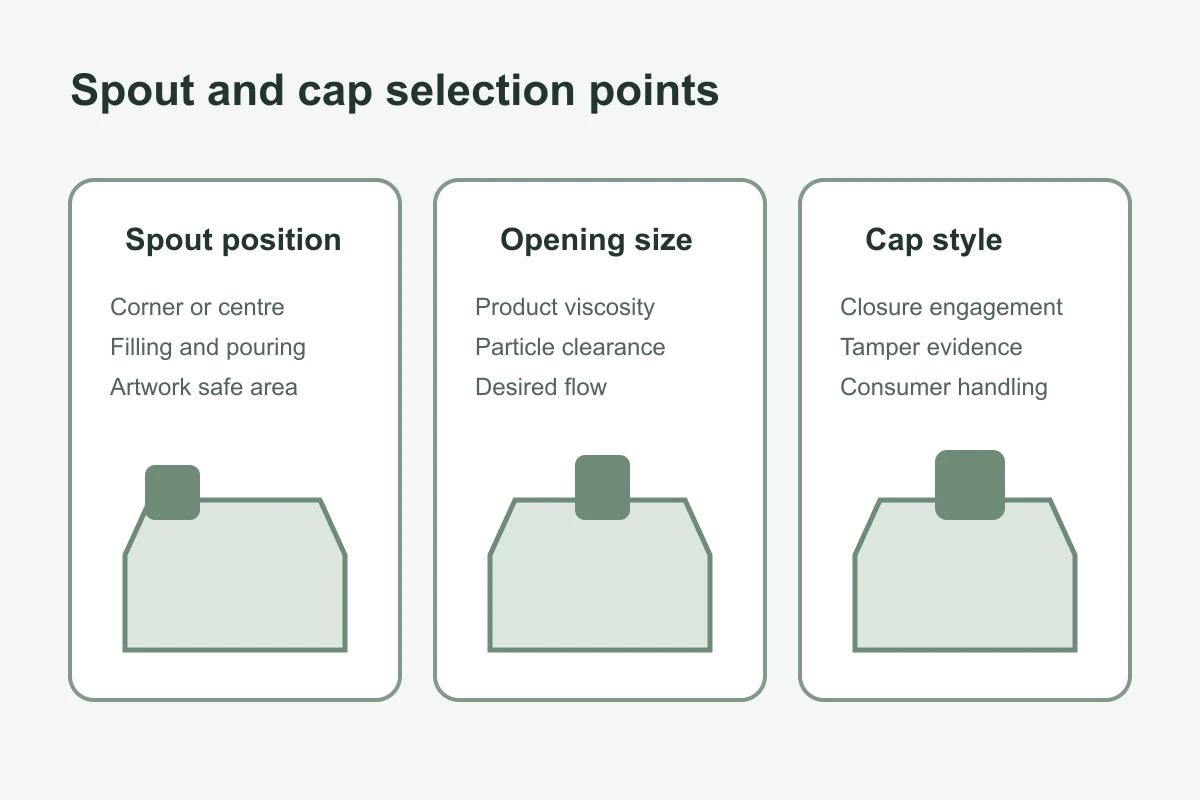
Spout position, diameter, cap design, tamper evidence, handle and pouch shape affect filling, pouring and consumer use. Ask the supplier which combinations it actually manufactures and which components are standard for the proposed project. Do not assume that every cap shown in a sample gallery fits every spout neck or pouch construction.
A corner spout may support one pouring experience while a centre spout may suit another format or filling setup. The correct choice depends on the product, desired flow, pack size and equipment. A larger opening is not automatically better: it may change component cost, closure feel and the amount of product released during use.
Review the available custom spout pouch formats, then send the product and filling details for a project-specific discussion.
Verify product and material compatibility
A common laminate should not be assumed to suit every food, detergent or cosmetic formula. Oils, fragrances, alcohols, acids, surfactants and other ingredients can interact differently with packaging materials, seals and closures. The required barrier also depends on the product and shelf-life target.
Ask how the liquid pouch manufacturer converts product information into a proposed structure. Request a written specification and identify what remains conditional on testing. For a sensitive formula or demanding process, arrange suitable compatibility and filled-product testing with qualified technical review. Define the test conditions, duration and acceptance criteria before relying on the result. Where the packed product is intended for food contact, the supplier should also state which regime the structure is declared against; the EFSA food contact materials framework is the reference used for the European market.
Our overview of flexible packaging materials can support an initial discussion, but general material properties do not replace project approval.
Review leak-control and closure quality
“Leak proof” is an absolute statement and should not replace a defined quality plan. Ask how the spout weld, cap engagement, seals and finished pouch are checked. The supplier should be able to explain the relevant inspection points, sampling approach and acceptance criteria for the agreed specification.
Leak risk can arise from several sources: an unsuitable material combination, contamination in a seal, incomplete spout welding, damaged threads, incorrect cap application, filling-process stress or transport conditions. A meaningful review therefore looks at the full system rather than one component. Gross leaks are themselves detected by defined methods — ASTM F2096 covers the internal-pressurisation bubble test — so it is worth agreeing in advance which method and sample size will be used.
Request sample evidence and define what the sample represents. An empty stock sample can demonstrate handling and closure feel, but it may not validate the selected product, production structure or filling process.
Ask how defects are isolated and communicated if a weld, closure or seal falls outside the agreed criteria. Clarify whether inspection records, retained samples or lot identification will be available for the order. The purpose is not to demand paperwork for its own sake; it is to make sure that the buyer and supplier use the same definition of an acceptable finished pouch.
Evaluate filling and sealing support
Confirm whether the customer fills through the spout or through an open pouch edge. If the pouch is filled through the spout, clarify who supplies or applies the cap and what equipment information is required. If it is filled through an open edge, define the final sealing step and how the spout and cap are protected during handling.
Give the supplier information about the intended filling equipment, nozzle, speed, product temperature and cleaning or handling conditions. Ask which pouch dimensions and component tolerances need to be confirmed for equipment fit. Project-specific operating settings should be reviewed with the equipment manufacturer or a qualified engineer.
Compare samples, print and appearance
Approve function before decoration. Start with a sample that helps evaluate product fit, filling, opening, pouring, reclosing and handling. Then review artwork placement, proofing, colours, finish, windows and the relationship between graphics and the spout position.
Use the correct dieline for the selected pouch and spout location. Keep important text, barcodes and graphics away from seals, folds and component weld areas. Record the approved artwork revision, specification and sample reference together so they remain traceable on repeat orders.
Functional sample review
- Confirm finished dimensions and usable fill volume with the actual product.
- Check spout position, opening size, cap engagement and tamper-evident feature.
- Evaluate filling, cap application and sealing under representative conditions.
- Observe pouring, dispensing, reclosing and residue around the opening.
- Check pouch handling, standing and transport orientation as appropriate.
- Document results, changes and final approval responsibility.
Compare quotations on the same specification
Normalize each quotation before comparing prices. The quantity per design, pouch dimensions, material structure, spout and cap combination, testing, printing, tooling, packing and delivery term should be aligned. Otherwise, a lower unit price may represent a different product.
| Decision point | Information to request | Evidence to verify | Why it affects the order | Buyer action |
|---|---|---|---|---|
| Product fit | Formula, viscosity, particles, temperature and shelf life | Written assumptions and compatibility plan | The product can affect materials, seals and components | Provide complete and accurate product inputs |
| Configuration | Pouch size, spout position, diameter and cap style | Drawing and representative physical sample | Components affect filling and user experience | Approve the exact combination |
| Filling | Fill route, equipment, nozzle and cap application | Trial plan and recorded results | Equipment fit cannot be confirmed from appearance | Test under representative conditions |
| Quality | Seal, weld, closure and inspection criteria | Agreed specification and acceptance method | Broad claims do not define acceptable output | Document responsibilities and limits |
| Printing | Dieline, proof, colours, finish and feature placement | Approved artwork revision and reference | The spout and seals change the artwork area | Use one controlled approval file |
| Commercial terms | Quantity per design, tooling, packing, Incoterm and validity | Itemised quotation | Different inclusions distort unit-price comparison | Compare the complete order commitment |
Use a supplier shortlisting checklist
For an international order, confirm the communication owner, packing method, available shipping documents, Incoterm and destination responsibilities. Ask how the supplier will identify the approved pouch, spout, cap and artwork on a repeat order. A reorder should reference controlled specifications rather than only an old invoice number. Proposed component, material or artwork changes should be reviewed and approved in writing before production.
Also compare quotation validity, payment terms, sample charges, tooling, component availability and the handling of quantity variance. These commercial details can affect the total commitment even when two quoted unit prices appear similar. Record open questions and resolve them before issuing a purchase order.
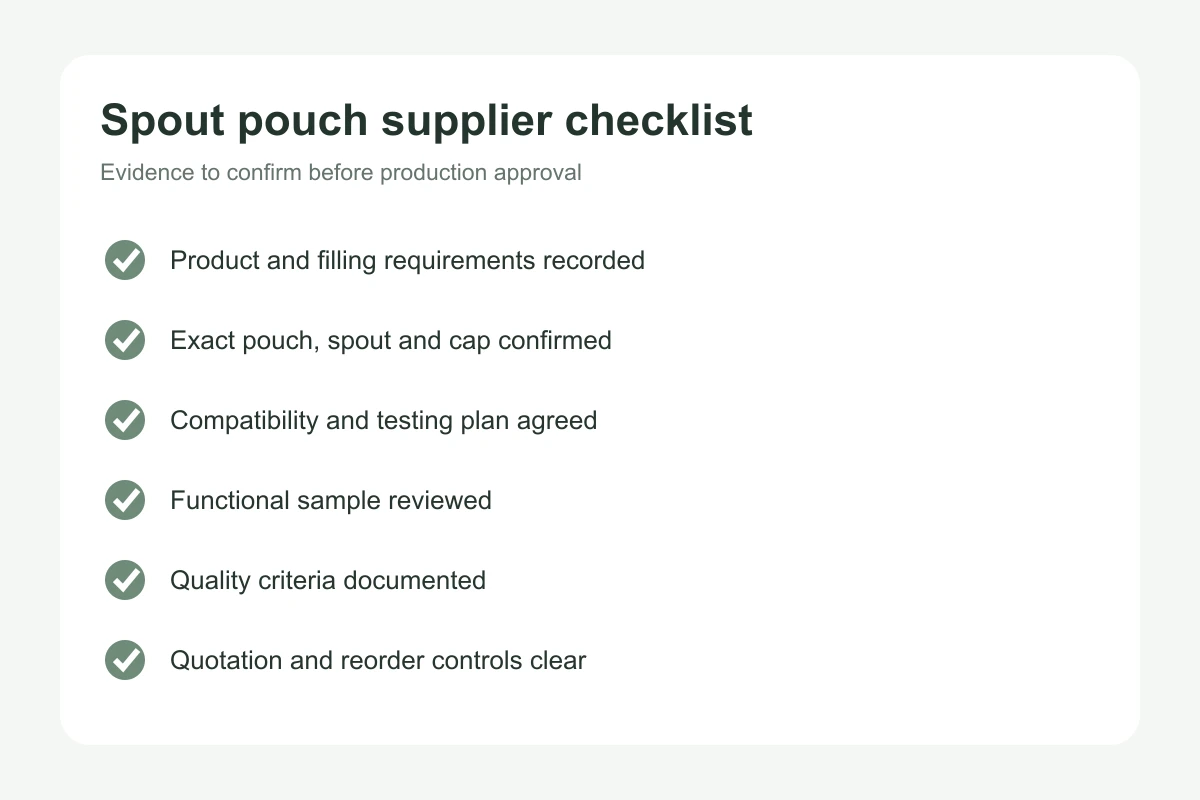
- The supplier asks for product and filling information before recommending a pouch.
- The exact spout, cap and pouch combination is identified.
- Material and compatibility assumptions are provided in writing.
- Samples are relevant to the proposed construction and component set.
- Filling and cap-application responsibilities are clear.
- Quality checks use defined criteria rather than absolute promises.
- The correct dieline and artwork approval process are supplied.
- The quotation states quantity per design and all key inclusions.
- Shipping terms, packing and documentation are confirmed.
- Repeat-order specifications and changes are controlled.
Red flags to investigate
Ask more questions when a supplier recommends one structure for every liquid, guarantees zero leaks without defining test conditions, cannot identify the proposed spout and cap, or quotes without product and filling information. Treat unexplained substitutions and undocumented sample differences as approval issues.
Frequently asked questions
What information should I send a spout pouch manufacturer?
Send the product composition, viscosity and particle information; fill temperature and method; fill volume; shelf-life and storage requirements; preferred spout and cap; quantity per design; artwork status; destination; and any existing successful package or filling-equipment information.
How do I choose the correct spout diameter?
Base the choice on viscosity, particles, desired flow, fill method, consumer use and available components. Ask for representative samples and verify the selected opening with the real product and intended filling process.
How should a buyer test a spout pouch for leaks?
Use a project-specific plan covering the filled product, closure application, pouch orientation, storage, handling and distribution conditions. Agree on acceptance criteria and obtain qualified technical guidance for demanding applications.
Can the same spout pouch be used for food and detergent?
Do not assume so. Different formulations, regulatory requirements and use conditions may require different materials, closures and validation. Each application should receive its own compatibility and specification review.
Request a project-specific spout pouch review
Send PURESTPACK the product, viscosity, particle information, filling method, fill volume, spout preference, quantity per design and destination market. After the specification is reviewed, request relevant physical samples and a project-specific quotation.
Include photographs or samples of the current package, known filling constraints and the intended user opening experience. Complete inputs help the review focus on realistic options and reduce avoidable specification changes later.
