A mono-material PE pouch is a flexible package built almost entirely from polyethylene — more than 90% of its weight — so it can be recycled in the existing PE film stream. You can switch from a PET/AL/PE laminate without losing shelf life by replacing foil with a PE-compatible barrier (EVOH ≤ 5% or an AlOx/SiOx coating), re-testing against your product’s OTR/WVTR targets, and keeping every component inside CEFLEX and RecyClass limits.
Why Are Brands Moving Away From Multi-Layer Laminates?
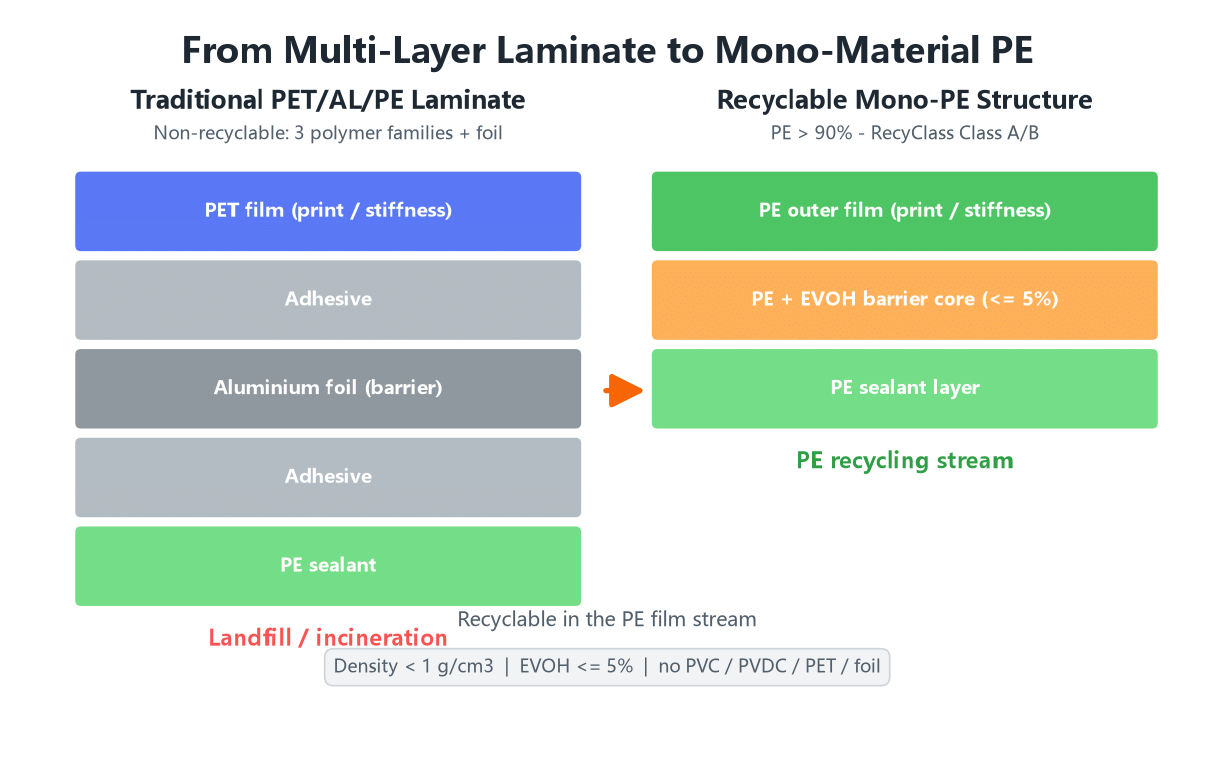
Traditional flexible pouches combine PET for print and stiffness, aluminium foil for barrier, and PE for sealing. That combination delivers excellent protection, but the three polymers cannot be separated economically, so the whole pouch is classified as non-recyclable in most recycling systems.
The pressure to change comes from three directions:
- Regulation. The EU Packaging and Packaging Waste Regulation (PPWR, Regulation (EU) 2025/40) requires all packaging placed on the EU market to be designed for recyclability, with recyclability grading applying from 2030.
- Brand commitments. Major FMCG groups signed the Ellen MacArthur Foundation Global Commitment, pledging that 100% of their packaging would be reusable, recyclable or compostable. Amcor, one of the world’s largest flexible packaging producers, reports that 94% of its flexible portfolio is already designed for recycling.
- Cost. In markets with extended producer responsibility (EPR), eco-modulated fees mean a recyclable mono-PE pouch can cost less per tonne to place on the market than an unrecyclable laminate.
What Makes a PE Pouch Actually Recyclable?
Recyclability is not a marketing label — it is defined by measurable structure thresholds. The CEFLEX “Designing for a Circular Economy” guidelines (2020), developed with the Ellen MacArthur Foundation, set the reference for Europe:
| Structure element | Preferable criteria | Minimum criteria |
|---|---|---|
| Main polymer | > 90% mono-PE | ≥ 80% polyolefins |
| Density | < 1 g/cm³ | < 1 g/cm³ |
| Barrier layers | Each < 10% (CEFLEX minimum; RecyClass grading requires EVOH ≤ 5%) | Each < 10% |
| Forbidden | PVC, PVDC, aluminium foil, PET, fibres, biodegradable polymers | Same |
RecyClass grades PE films on a letter scale: Class A requires PE content above 95%, Class B above 90%, with all other components fully compatible with recycling. EVOH is accepted up to 5% in a polyolefin film, and laminating adhesives should stay at or below 3–5% depending on class.
Practical takeaway for buyers: when you ask a supplier for a “recyclable pouch”, specify the target grading (Class A or B), and require the percentage of PE by weight for the complete structure — including zipper, spout and valve. “PE-based” and “recyclable” are not the same claim.
How Do You Replace the Aluminium Foil Barrier?
This is the heart of the switch. In a PET/AL/PE laminate, the foil provides the oxygen and light barrier. A mono-PE structure must recreate that performance with PE-compatible technologies:
- EVOH core layer (≤ 5%). A thin EVOH layer co-extruded inside the PE structure blocks oxygen. Below the 5% threshold it does not interfere with PE reprocessing.
- AlOx or SiOx coated PE. A transparent metal-oxide coating on PE film restores a high barrier and keeps the density below 1 g/cm³, so the film floats during washing and sorting.
- Metallised PE (for non-sorting-critical uses). Metallisation raises barrier but is rated lower in RecyClass guidance than uncoated solutions — use it only where the target stream accepts it.
Shelf-life is defined by your product, not by the foil. Before converting, run an oxygen and water-vapour transmission (OTR/WVTR) analysis of the current structure — oxygen transmission rate to ASTM D3985 and water vapour transmission rate to ASTM F1249 — then require the mono-PE candidate to match or exceed those values. In our conversion projects, coffee, dried food and pet food applications routinely meet their original shelf-life targets with a Class A mono-PE structure — but the only valid proof is an accelerated shelf-life test on the finished pouch with your actual product.
What Happens to Stiffness, Printing and Sealing?
Buyers often worry that removing PET and foil makes the pouch flimsy or hard to print. Modern mono-PE films answer these concerns:
- Stiffness comes from high-density PE (HDPE) blended layers and film orientation, not from PET. A well-designed mono-PE pouch stands on shelf like a PET laminate.
- Printing moves to the PE surface. Corona treatment and modern surface-engineered PE films hold fine flexo and gravure printing; ink coverage should stay moderate, and carbon-black-heavy designs should use NIR-detectable black pigments so sorting machines can identify the pack.
- Sealing is simpler, not harder: sealant and body are the same polymer family, so seal windows are wider and peel performance more consistent.
- Downgauging is a bonus. Because the structure is engineered as a whole, many mono-PE designs run thinner than the laminates they replace — see our guide to packaging downgauging: thinner films with the same barrier.
Which Components Must Change Along With the Film?
The whole pack counts, not just the film. A recyclable film with an incompatible zipper is still a failed grading:
- Zipper: PE zipper on a PE pouch (mono-material zippers are widely available from stock today).
- Spout/valve: PE or PE-compatible parts; a PP spout on a PE pouch can push the non-PE fraction over the limit.
- Labels: avoid where possible — print directly; if used, keep them PE-compatible and within size guidance.
- Inks and adhesives: EuPIA-compliant non-bleeding inks; solventless or water-based adhesives at ≤ 3–5%.
What Does a Realistic Conversion Roadmap Look Like?
Switching structures is a project, not a purchase order. Brands that convert cleanly follow the same five steps:
- Benchmark the incumbent (week 1–2). Document the current laminate layer by layer: gauge, polymer, barrier values (OTR, WVTR), light transmission, seal window, and coefficient of friction on your filling line. This benchmark becomes the acceptance spec for the mono-PE candidate.
- Engineer the candidate (week 2–5). The supplier builds a mono-PE structure — typically outer PE, EVOH or coated barrier core, PE sealant — and targets the benchmark. Ask for the full weight-percentage breakdown at this stage, not after samples arrive.
- Verify the pack (week 5–8). Accelerated shelf-life testing with the real product, drop and transit testing, and — if you sell in regulated markets — a RecyClass or CEFLEX conformity assessment of the complete pack including zipper, spout and valve.
- Run the line trial (week 8–10). Convert a production batch on your actual filling equipment. Watch for seal initiation temperature differences, film tracking, and the stiffer or softer web handling versus the old laminate.
- Document and launch (week 10–12). Collect the recyclability documentation, update artwork if you add a recyclability claim (follow local labelling rules), and update customer-facing specification sheets.
Two categories deserve extra attention during this process. Coffee is sensitive to oxygen and aroma, and typically needs a one-way degassing valve plus a barrier verified against your own OTR and WVTR targets. Pet food, especially large-format bags, adds loads on the gussets, handles and closures that a thinner mono-PE structure must absorb — the structural trade-offs are covered in our guide to how gussets, handles and closures affect large pet food bags.
Budget one full quarter from kick-off to first commercial run for a standard dry-food pouch. Products with very long shelf-life requirements or chill-chain handling add validation time.
Conclusion
A mono-material PE pouch is a realistic replacement for most non-foil laminate pouches, but the conversion succeeds or fails on the benchmark. If your current pack relies on aluminium foil or a very long ambient shelf life, expect a real trade-off between barrier performance and recyclability and verify it with data; if your product is dry or short-shelf-life, the project is mostly about line behaviour rather than barrier. Either way, get the full weight-percentage breakdown before samples arrive, test the complete pack including zipper and closures against CEFLEX or RecyClass expectations, and run the candidate on your own filling line before committing. Where the benchmark cannot be met, adjust the structure during engineering instead of discovering the gap on the production floor.
Frequently Asked Questions
What is a mono-material PE pouch?
A mono-material PE pouch is a flexible package in which polyethylene makes up more than 90% of the structure by weight, so the whole pouch can be reprocessed in the PE recycling stream. It replaces traditional PET/AL/PE or PET/PE laminates, which cannot be separated economically and therefore drop into a low-value waste stream. In practice the claim covers the entire pack rather than the film alone: the zipper, spout, valve and any label all count towards that percentage, which is why a PE film fitted with a PP spout is still a failed grading.
Is a mono-PE pouch as strong as a multi-layer laminate?
For most dry-food, coffee and pet-food applications, mono-material PE pouches are as strong as the laminate they replace. Stiffness comes from high-density PE layers and film orientation rather than from PET, and barrier comes from an EVOH core or an oxide coating. The honest answer still requires testing: match the OTR and WVTR of the structure you are replacing, then run an accelerated shelf-life test with the real product. Seal performance usually improves rather than degrades, because the sealant and the pouch body are the same polymer family.
Can mono-PE pouches replace aluminium foil for coffee?
For ground coffee and many whole-bean packs fitted with a one-way degassing valve, a high-barrier mono-PE structure meets typical 6–12 month shelf-life targets. For very long shelf lives, or products where oxygen is critical, the barrier has to be validated case by case with an accelerated shelf-life test rather than assumed. Two points decide the outcome: whether the EVOH or coated barrier stays inside the recycling thresholds, and whether the pack holds its seal through distribution. Foil remains the safer choice where the shelf-life target is measured in years.
What percentage of PE does a pouch need to be recyclable?
Under RecyClass grading, Class A requires more than 95% PE and Class B more than 90%, with every other component compatible with the PE stream. CEFLEX guidance sets the preferable threshold above 90% mono-PE and the minimum at 80% polyolefins, with PVC, PVDC, PET and aluminium foil excluded. The figures are calculated across the complete pack, so a mono-material PE pouch with a PP spout can fall below the target grade even when the film itself passes. Ask for the percentage by weight for the whole structure, not for the film.
Does the EU really require recyclable packaging?
Yes, and the requirement is written into law rather than into voluntary guidance. The Packaging and Packaging Waste Regulation (Regulation (EU) 2025/40) makes design for recyclability mandatory for packaging placed on the EU market, with recyclability grading and eco-modulated fees phasing in from 2030. For flexible packaging the consequence is practical: the recyclability of a structure will affect what it costs to place on the market, which is why the assessment belongs in the design brief rather than in a marketing claim written after the artwork is finished.
How do we verify a supplier’s recyclability claim?
Ask for three documents. The first is the full structure breakdown by weight percentage; the second is a RecyClass or CEFLEX conformity assessment covering the complete pack including zipper, spout and valve; the third is shelf-life test data on the finished pouch with the real product. Anything less should be treated as an unverified claim. Where the claim will be printed on the pack, the design file should also show how the assessment was made, because in regulated markets the burden of proof sits with the brand. Our Design for Recycling: Principles for Packaging Buyers note sets out the wider framework.
References
- CEFLEX, Designing for a Circular Economy Guidelines (2020), ceflex.com
- RecyClass, PE Films Design for Recycling Guideline, recyclass.eu
- Amcor, “More sustainable packaging: 5 common questions”, amcor.com
- EU Packaging and Packaging Waste Regulation (Regulation (EU) 2025/40)