

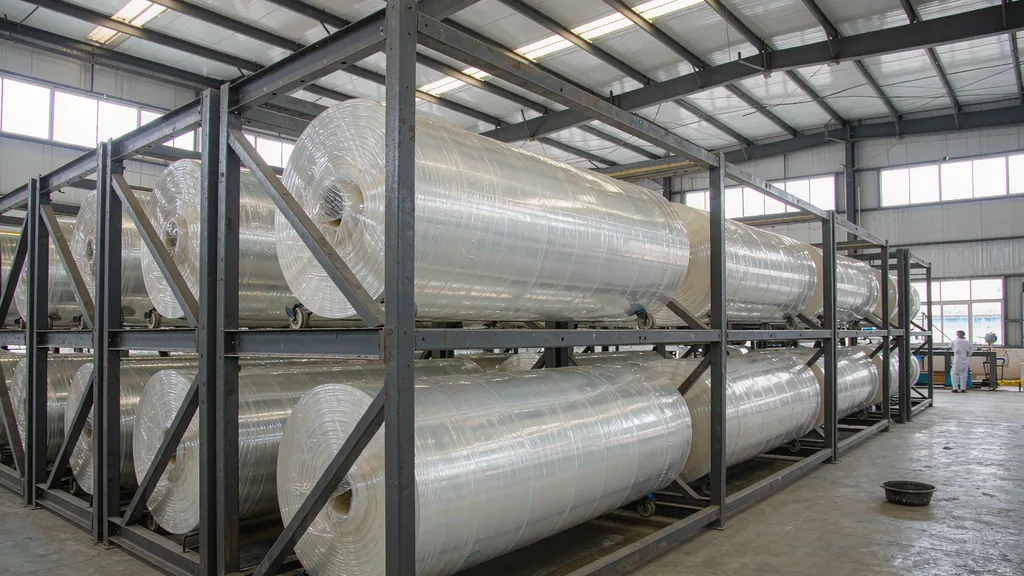
Most film that fails on a packing line was not made badly — it was stored badly. Packaging film storage problems show up weeks later as blocked layers, weak seals, corona decay and print defects, and by then nobody connects the defect to the warehouse. Set your storage rules around temperature, humidity, orientation, stacking and age, and most of these failures disappear. Here is what actually happens to film in storage and what a food factory should require.
Why Does Stored Film Go Bad Before It Is Even Used?
Laminated flexible packaging film is a layered system held together by adhesives, and every layer responds to its environment:
- Moisture absorption. PA (nylon) and EVOH layers absorb ambient moisture in high humidity, which raises OTR and WVTR and can cause curl.
- Corona treatment decay. The surface energy created by corona treatment drops measurably over months of storage, especially in warm, humid rooms — wetting tension can fall from 38 dyn/cm toward 34 or lower.
- Blocking. Under heat and pressure, adjacent film layers fuse lightly and refuse to unwind cleanly.
- Adhesive and print changes. Residual solvents, ink systems and lamination adhesives continue to react after production.
A wetting-tension test with corona pens (ASTM D2578) on film that has been in the warehouse for six months tells you immediately whether the decay has crossed your printing or sealing threshold.
What Temperature and Humidity Should Film Be Stored At?
The commonly accepted band for laminated packaging film is 15–25°C at a relative humidity below 65%, away from direct sunlight and away from heat sources. Two failure modes sit just outside that band:
- Above 30°C, PE-based sealant layers soften, blocking risk rises sharply, and residual solvent release increases odor complaints in food products.
- Below 5°C, condensation forms when rolls move into a warm packing hall; moisture on the film surface ruins both heat sealing and printing.
Cold-season acclimation matters as much as storage temperature. A roll moved from a 5°C warehouse into a 25°C hall should rest sealed in its wrap for roughly 12–24 hours before unwrapping, or condensation will form on the film itself rather than on the wrap.
How Long Can Laminated Film Sit Before Performance Drops?
Industry practice treats most laminated structures as having a 6–12 month shelf life from delivery, with differences by structure:
| Film type | Practical storage limit | Notes |
|---|---|---|
| PE / CPP sealant films | 9–12 months | Blocking and slip migration are the limits |
| PA- or EVOH-based laminates | 6 months | Humidity absorption changes barrier values |
| Metallized PET laminates | 6–9 months | Delamination risk rises with age |
| Paper-based laminates | 4–6 months | Moisture uptake dominates |
Two aging mechanisms deserve attention beyond the calendar. First, corona decay: if printed rolls are stored for months, verify wetting tension before the print run — re-treating or re-ordering is cheaper than a full print lot of rejects. Second, seal-lane aging: PE sealant surfaces oxidize slowly, and heat-seal windows narrow; film that seals at 130°C fresh may need 145°C after a year of storage, which changes machine settings and can push a marginal seal into failures.
What Warehouse Mistakes Damage Film Rolls Most?
The recurring offenders, in order of how often they appear in root-cause reviews:
- Floor storage. Concrete draws moisture and cools rolls unevenly; rolls should sit on pallets or racking, never directly on the floor.
- Stacking too high. Weight on lower rolls causes blocking and core deformation; more than 3–4 layers of palletized rolls is already risky.
- Horizontal rolls stored on edge. Rolls should lie in their wound orientation; resting a roll on its core ends flattens the wind and causes tension faults at unwinding.
- Sunlight through warehouse windows. UV embrittles PE and fades inks even before printing is done.
- Forklift contact. Nicks in the roll edge become web breaks at speed; a damaged edge should be trimmed before the roll reaches the machine.
How Should Film Be Prepared Before It Reaches the Packing Line?
A short preparation routine keeps storage damage from reaching the machine:
- FIFO by batch, not by order. Rotate rolls by production date, and mark each pallet with the date it was received.
- Check the edge and core before loading. Cracked cores and dented edges predict web breaks.
- Acclimate sealed rolls 12–24 hours whenever storage and hall temperatures differ by more than 10°C.
- Run a first-article seal check on every new batch — a 30-second heat-seal test with a hand sealer costs nothing compared with a shift of faulty bags.
What Should a Factory Put in Its Film Storage Standard?
One page is enough, provided it sets the numbers:
- Storage temperature range (15–25°C) and RH ceiling (65%)
- Maximum storage height and mandatory pallet/racking use
- FIFO rule with batch and receipt-date labeling
- Acclimation time before unwrapping after cold transport
- Storage shelf life per structure, with a re-verification step (wetting tension plus seal test) for film older than six months
- Quarantine rule for rolls with damaged edges or cores
Receiving inspection should not stop at appearance. A quick wetting-tension check and a hand-seal test on arrival catches storage damage from the supplier’s side of the journey, not just yours. Film that passes can move straight into the new packaging film qualification protocol, where seal windows are verified on the real packing line; the same heat seal parameters apply when aged film needs a higher sealing temperature. For downstream format decisions, see how pouch dimensions are derived in the stand-up pouch sizing guide on OMOPACK, and how export compliance affects roll orders in the EU EPR packaging rules.
FAQ: Packaging Film Storage Questions
What is the correct storage temperature for laminated packaging film?
Store laminated film at 15–25°C with relative humidity below 65%, away from sunlight and heat sources. Outside that band, blocking, condensation and barrier degradation become measurable within weeks.
How long can packaging film be stored before it degrades?
Most laminated structures hold full performance for 6–12 months. PA and EVOH laminates are the most humidity-sensitive and should be used within about six months, and film older than six months should be re-tested for wetting tension and sealability.
Why does corona treatment decay during storage?
Corona treatment raises surface energy temporarily, and that energy relaxes over time, faster in warm humid rooms. ASTM D2578 wetting-tension testing with corona pens shows whether treated film still meets printing or sealing requirements.
Can film rolls be stored on the floor?
No. Concrete floors are cooler, damper and dirtier than the film tolerates, and floor contact causes moisture uptake and edge damage. Rolls should always be kept on pallets or racking.
Do film rolls need acclimation after cold transport?
Yes. When rolls move from cold storage or winter transport into a warm hall, leave them sealed in their wrap for 12–24 hours so condensation forms on the wrap instead of the film.
What is film blocking and how do I prevent it?
Blocking is the light fusion of adjacent film layers under heat and pressure, which makes rolls hard to unwind. It is prevented by keeping storage cool, limiting stack height, and using rolls within their shelf life.
