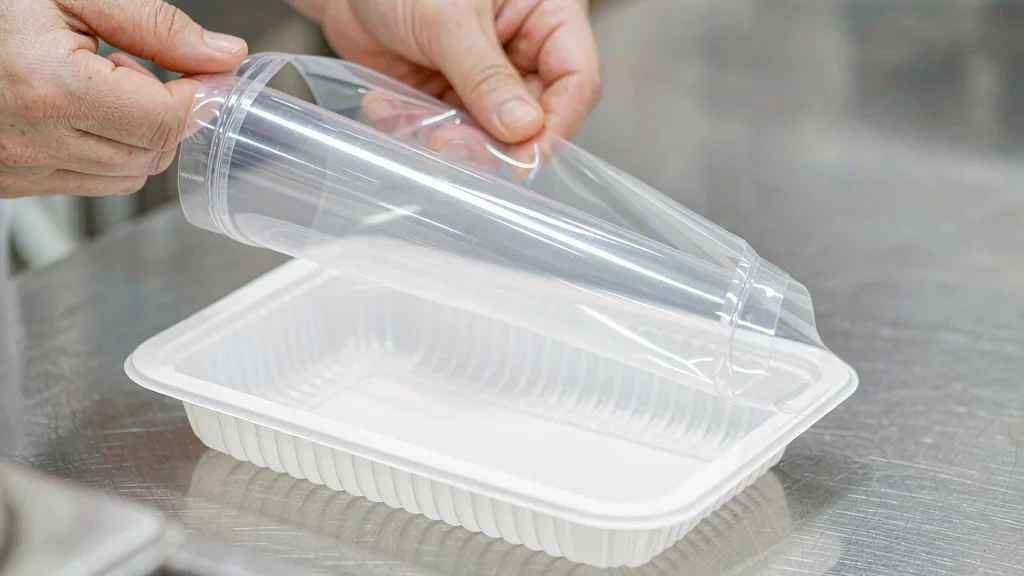
A peelable seal is specified as a peel force window in N/15 mm, measured with a tensile tester, not as a description like “easy to open”. Define the lower bound as the force that keeps the pack leak-free through distribution, and the upper bound as the force a consumer can open. Everything else follows from those two numbers.
What Is a Peelable Seal?
A peelable seal is a heat seal engineered to fail at the interface between two film layers rather than through the film itself. The seal is strong enough to survive filling, transport and storage, but separates cleanly when the consumer pulls.
There are two failure modes, and you need to name the one you want:
- Adhesive peel. The seal opens at the bond interface. Both film surfaces stay intact, there is no fibre tear and no residue. This is the standard easy-peel requirement.
- Cohesive peel. The seal opens *inside* a sealant layer, leaving a stringy or hazy residue on both sides. It is acceptable on some trays, and unacceptable where the customer expects a clean visual.
A locked seal, by contrast, is specified to fail in the film body, not at the seal. That is what you want for retort, for heavy loads and for anything that must not open in a parcel.
What Peel Force Should You Specify?
Peel strength is measured by ASTM F88/F88M, using a 15 mm or 25.4 mm strip pulled at a controlled rate — commonly 250 to 300 mm/min. Results are reported as force per width, so always quote the width. A target of “8 N” is meaningless; “8 N/15 mm” is a specification.
| Application | Typical peel force | Failure mode wanted | Note |
|---|---|---|---|
| Easy-peel lidding on trays | 3–8 N/15 mm | Adhesive, clean | Openability is the selling point |
| Semi-peel / reclosable interface | 8–15 N/15 mm | Adhesive | Still hand-openable, survives distribution |
| Locked seal, dry product | Above 25 N/15 mm | Film tear | Leak risk matters more than openability |
| Retort and hot-fill | Above 25 N/15 mm before sterilisation | Film tear | Peel force rises with the thermal cycle |
Numbers vary with structure and jaw conditions, so treat these as starting windows and confirm them on your own line. The important part is the window, not one number: below it, you ship leakers; above it, customers complain they cannot open the pack.
Which Layer Controls Peelability?
The sealant layer does. The same substrate with a different sealant gives a completely different peel behaviour.
- PE-based peel systems. Blends of polyethylene with EVA, ionomer or polybutene. Wide sealing window, good seal-through-contamination behaviour, common on lidding for PP and PE trays.
- PP-based peel systems. Used where the tray and lid are both PP, or where the pack sees heat. Narrower window, more sensitive to jaw temperature.
- Coextruded peel sealants. A peel layer buried inside the sealant film. Consistent, but the peel force is fixed at film-making time — you cannot tune it much at the sealing jaw.
- Ionomer sealants. Strong, tolerant of contamination, but their peel force tends to climb during storage. Always test at end of shelf life, not only at day one.
If you are comparing structures, ask for the peel force curve — peel strength plotted against sealing temperature. A flat plateau means a forgiving process; a steep curve means your line will drift out of specification the moment the jaws warm up. The parameters behind that curve are set out in the heat seal parameter guide.
Why Does Peel Force Change After Sterilisation?
Because heat, pressure and time all push the seal further. This is the single most common cause of “the sample opened fine, the production batch does not”.
- Retort at 121 °C increases interdiffusion across the seal interface. A peelable seal can shift upward and become hard to open, or in a badly matched structure, drop and start leaking.
- Storage at ambient continues the same process more slowly. Ionomer and EVA systems are known for this; specify a day-7 test *and* an end-of-shelf-life test.
- Product contact matters. Fatty or acidic products plasticise the sealant and can lower peel force. Test with the real product in the pack, never with empty pouches.
A practical rule: qualify the seal at three points — immediately after sealing, after the thermal process, and at the end of the intended shelf life. If any point falls outside the window, change the sealant, not the operator.
How Do You Test and Sign Off a Peelable Seal?
Keep the method boring and repeatable.
- Condition the samples. ASTM D618 practice: 23 ± 2 °C and 50 ± 5% RH for at least 40 hours before testing. Testing warm film straight off the line gives numbers you cannot reproduce.
- Cut consistent strips. 15 mm wide, taken from the same location on the pack. Edge and corner seals read differently from straight runs.
- Test at a fixed rate. 250 to 300 mm/min, and record the *average* force over the peel travel, not the peak. Peak force is what your tester displays first and it is not what the standard asks for.
- Record the failure mode. Photograph the opened surfaces. A clean adhesive peel and a stringy cohesive peel can both hit 6 N/15 mm, but only one is acceptable to the customer.
- Pair it with an integrity test. Peel strength tells you how the pack opens, not whether it leaks. Use the seal integrity testing comparison alongside it, because the two answer different questions.
For products where the pack is opened and reclosed, the closure choice interacts with the seal — a peelable membrane under a rigid lid behaves differently from a pouch that relies on a zipper, easy-tear or spout. Where the fill is a liquid or a sticky sauce, the contamination risk described in the sauce pouch guide applies to peelable seals even more strongly, since a contaminated seal opens unevenly.
What to Send Your Film Supplier
To get a peelable structure quoted correctly the first time, send this:
- Tray or pouch material and its sealant (PP, PE, PET, PS, aluminium)
- Target peel force window in N/15 mm, and the acceptable failure mode
- Thermal process: pasteurisation, hot fill, retort temperature and F0, or none
- Product type: dry, fatty, acidic, aqueous
- Shelf life and storage temperature
- Whether the pack must be leak-tight under vacuum or modified atmosphere
- Packing line type and maximum jaw temperature
That is the same information a factory needs for any specification, and it is the difference between one trial roll and three.
FAQ
Is a stronger seal always better?
No. A seal stronger than the film will tear the film instead of opening, which customers read as a defective pack. The goal is a window: strong enough not to leak, weak enough to open.
What is the difference between peel strength and seal strength?
Peel strength is the force to separate a sealed joint (ASTM F88). Seal strength is sometimes used loosely for the same thing, but in practice the useful distinction is whether you measure the opening force (peelable) or the burst resistance (locked).
Why does my sample open cleanly but production packs do not?
Usually because the production packs went through a thermal process or a storage period the sample did not. Peel force drifts upward after retort and during ambient storage. Qualify at day one, after processing, and at end of shelf life.
Can I make a peelable seal from the film I already use?
Rarely. Peelability comes from the sealant layer, and a standard sealant is designed to weld, not to release. Changing the sealant grade or adding a peel-layer coextrusion is the usual route.
What is cohesive failure and is it a defect?
Cohesive failure means the seal split inside a layer, leaving residue on both faces. It is not automatically a defect — some lidding applications accept it — but if you specified a clean adhesive peel, it is a reject.
How many samples should I test per lot?
Enough to see the spread. A practical minimum is ten strips per seal condition, taken from start, middle and end of the run, so that jaw temperature drift during the run shows up in the data.
Does a peelable seal work under modified atmosphere?
Yes, but the window narrows. The seal must hold internal pressure through distribution, so the lower bound rises and the sealant has to tolerate contamination from the product at the same time.
PURESTPACK supplies peelable and locked seal structures for food factories running trays, lidding and pouches, and will quote a peel force window rather than a product name.