

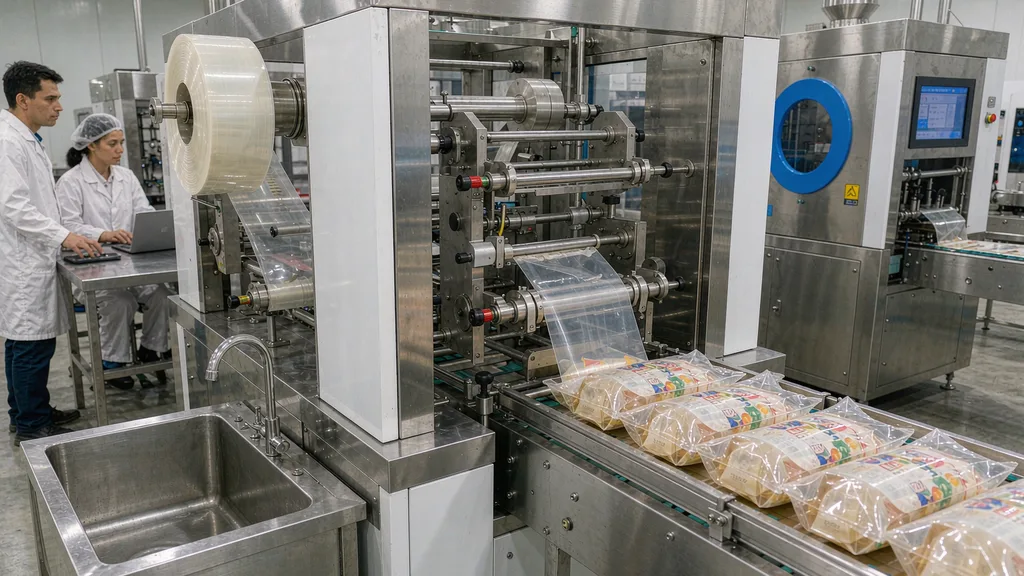
MAP packaging film is the flexible material that holds a deliberately chosen gas mixture — usually oxygen, carbon dioxide and nitrogen — around a fresh food product. Specify it by three numbers: the target gas mix, the oxygen transmission rate (OTR) that mix demands, and the seal integrity your line can actually hold. Film choice follows from those, not the other way round.
What Is MAP Packaging Film?
Modified atmosphere packaging replaces the air inside a pack with a controlled gas blend. In flexible packaging, the film must do four jobs at once: hold the gas mix for the target shelf life, resist the machine’s sealing cycle, tolerate the cold chain without cracking, and stay within food-contact law. Film that fails on any one of these makes the other three worthless — a high-barrier laminate with a leaking seal gives worse shelf life than a plain film with a perfect seal.
MAP is not vacuum packaging. Vacuum removes most headspace gas and relies on the absence of oxygen. MAP keeps a gas volume and uses gas composition to control microbiology, colour and texture. For products that would be crushed under vacuum — salads, soft bakery, meat cuts — MAP is generally the only workable route. The barrier logic behind both is covered in this overview of high-barrier packaging materials, and the supplement route in this guide to active packaging with oxygen scavengers.
Gas Mix by Product Category
The gas blend is decided by the food technologist, not the converter — but the film must be specified to protect it. Typical published ranges:
| Product | O2 | CO2 | N2 | Purpose of the mix |
|---|---|---|---|---|
| Red meat (retail cuts) | 70–80% | 20–30% | — | Keeps myoglobin red |
| Poultry | — | 30% | 70% | Controls spoilage bacteria |
| Fresh pasta | — | 20–30% | balance | Mould suppression |
| Hard cheese | — | 100% or 30% | balance | Mould and rind control |
| Soft bakery | — | 0–20% | balance | Mould control |
| Prepared salads | 2–5% | 5–10% | balance | Respiration and browning control |
| Dried snacks | 0–2% | 0–10% | balance | Rancidity and oxidation control |
Two consequences follow. High-O2 mixes for red meat need a film that resists oxygen rather than blocks it, so a plain PA/PE structure is normal. Low-O2 or O2-free mixes need real barrier. And CO2 dissolves into moist products, reducing headspace volume, which can make a pack look collapsed.
Barrier Requirements: OTR and WVTR Targets
The film must hold the gas mix for the expected shelf life, so the requirement is a maximum gas loss, not a film brand.
| Shelf-life target | Typical OTR requirement | Typical WVTR requirement | Usual structure |
|---|---|---|---|
| 5–10 days, chilled | 30–100 cm³/(m²·24h·atm) | 5–15 g/(m²·24h) | PA/PE, PET/PE |
| 10–21 days, chilled | 5–30 | 3–8 | PET/EVOH/PE |
| 21–45 days, chilled | under 5 | under 5 | PA/EVOH/PE, PET/AL/PE |
| Ambient, 6–12 months | under 1 | under 2 | PET/AL/PE, PET/AL/PA/PE |
Never accept a number without its test condition. OTR is measured by coulometric methods under ASTM F1927 or by pressure-difference methods; WVTR by infrared or cup methods under ISO 15106. A WVTR measured at 23°C / 50% RH is not comparable with one at 38°C / 90% RH, and the gap can exceed a factor of three.
Film Structures That Actually Deliver MAP
- PA/PE. The workhorse for high-O2 meat and poultry. Nylon gives puncture resistance and thermoformability; PE gives the seal. Limited oxygen barrier, which is exactly what high-O2 mixes want.
- PET/EVOH/PE. The standard low-O2 chilled structure. EVOH delivers oxygen barrier at low thickness. Weakness: EVOH loses barrier in high humidity, so the PE layer must keep moisture away from it.
- PET/AL/PE and PET/AL/PA/PE. Ambient and long-life structures. Aluminium foil gives effectively total light and gas barrier, but it is not microwaveable and cannot be counted as recyclable in flexible streams.
- Mono-material PE and PP grades. Increasingly specified where recycled content or design-for-recycling obligations apply. Barrier comes from the seal layer and coatings, and it will not match EVOH for long ambient shelf life.
- Antifog grades. Chilled MAP needs an antifog additive in the seal layer, otherwise condensation hides the product on shelf. Antifog and slip additives compete, so specify both together.
Food-contact compliance is a separate gate: the finished laminate must satisfy the migration limits of EU Regulation 10/2011 for EU-bound product, or FDA 21 CFR for the US. What a film supplier should be asked to provide is set out in this guide to food contact migration testing.
Seal, Antifog and Machine Performance
On a form-fill-seal line, the film must seal through whatever the filling station leaves behind. This is where MAP projects fail.
- Seal strength. A common acceptance band is 20–40 N per 15 mm under ASTM F88. Too weak and the pack opens in the case; too strong and it tears beyond the easy-open line.
- Hot tack. The seal must hold before it cools, especially on fast cycles. Ask for hot tack data, not just final seal strength.
- Seal-through-contamination. Oil, powder and brine reduce seal strength dramatically. Measure seal strength on deliberately contaminated samples.
- Coefficient of friction. Too much slip and the reel telescopes; too little and the film drags and misaligns. Any surface change needs a machine trial.
- Low-temperature toughness. Chilled MAP film sits at 0–4°C, so nylon or a metallocene PE seal layer prevents cracking on impact in distribution.
Why MAP Packs Leak: The Three Failure Points
Gas analysis on a leaking pack tells you nothing, so leakers are the measurement that matters. Failures cluster in three places:
- The seal area. Contamination, insufficient dwell, worn seal jaws, or a film thickness change without a parameter change.
- Corners and gussets. Stress concentrates at pouch corners and gusset folds, especially with sharp products. Corner radius and film thickness matter.
- Puncture and abrasion. Bone shards, shells and dried pasta edges abrade the film in transit. Extra thickness is not always the answer — a nylon layer often performs better per gram.
Non-destructive leak testing after filling is the most reliable control. Vacuum-decay methods such as ASTM F2338, or in-line pressure and gas sensors, catch defects visual inspection misses.
Cost, Downgauging and Realistic Shelf Life
Two levers are worth checking before accepting a quote:
- Right-size the barrier. Moving to a thinner EVOH layer at the same OTR is a genuine saving, and the same logic applies to the outer layer. See how it works in packaging downgauging.
- Question ambient shelf-life claims. If the product carries a use-by date under 21 days in chilled distribution, an ambient-grade foil laminate is paying for performance nobody uses.
Shelf life must be confirmed by trial, not arithmetic. Barrier data predicts gas loss; it does not predict colour, texture or microbial growth. The standard route is a challenge test with real product on the real line. Where a vacuum-pack structure is already validated, the comparison is set out in this guide to vacuum pouches.
FAQ
What is MAP packaging film?
MAP packaging film is flexible packaging material designed to hold a controlled gas mixture — typically oxygen, carbon dioxide and nitrogen — around a food product. It must hold the gas mix, seal reliably on the filling line, tolerate the cold chain, and comply with food-contact law.
How is MAP different from vacuum packaging?
Vacuum packaging removes most headspace gas, while MAP keeps a deliberate gas volume with a chosen composition. MAP is used where the product would be crushed under vacuum, such as salads, soft bakery and retail meat cuts, or where gas composition controls colour and microbiology.
What OTR does MAP film need?
It depends on the gas mix and shelf-life target. Chilled products with 5–10 days of shelf life commonly specify 30–100 cm³/(m²·24h·atm); 21–45 day chilled products typically require under 5; ambient products needing 6–12 months usually need under 1 and normally use aluminium foil.
Why do MAP packs collapse?
Carbon dioxide dissolves into moist food, reducing headspace gas volume and pulling the film inward. Adjusting the gas ratio, pack volume or film stiffness usually resolves it.
Can mono-material film be used for MAP?
Yes, for shorter chilled shelf life and where the barrier target is modest. Mono-material PE or PP structures support design-for-recycling obligations, but they will not match an EVOH or aluminium foil laminate for long ambient shelf life, and performance must be validated on a real filling line.
Which standards cover MAP film testing?
OTR is commonly measured under ASTM F1927 or by pressure-difference methods, WVTR under ISO 15106, seal strength under ASTM F88, and non-destructive leak detection under ASTM F2338. Food-contact compliance follows EU Regulation 10/2011 or FDA 21 CFR, depending on destination.
