

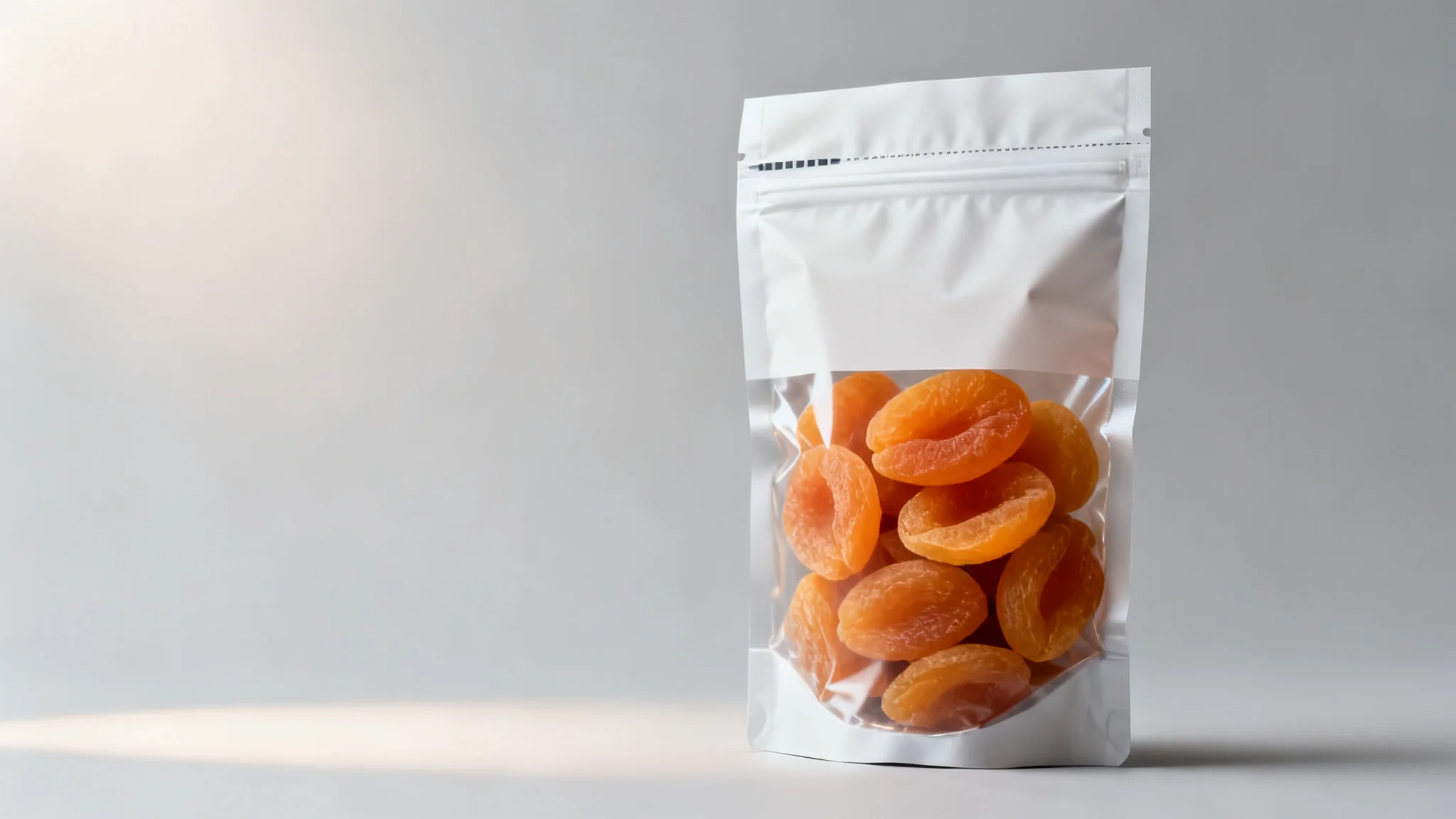
Stickiness in a dried fruit pouch is a surface and seal-area problem before it is a barrier problem, and that changes what you specify. Fruit that releases sugar onto the film will bond to the food-contact layer, bridge the seal area and stiffen the block of product, so a pouch with an impressive water vapour transmission rate can still fail in the consumer’s hand. The fix usually sits in the food-contact layer, the seal geometry and the opening feature rather than in an extra barrier ply.
Key Takeaways
- Stickiness is governed by the food-contact layer and by pressure on the fruit, not by the barrier ply.
- A resealable closure only works if the fill system keeps the track free of fruit and sugar.
- Seal strength and seal integrity are separate properties, and a specification needs both, with their test conditions.
This article is written for packaging engineers and quality teams drafting a specification, so it stays close to structure, seal behaviour and test methods. It deliberately treats candidate materials as options to be trialled, not as settled answers. The scope is flexible pouches filled on vertical form-fill-seal and premade lines, in markets where storage humidity varies.
Where does stickiness in a dried fruit pouch actually come from?
Tackiness in a dried fruit pouch has three sources that are frequently mixed up. The first is the fruit’s own surface: sugar and syrup migrate outward as moisture redistributes, and the surface becomes sticky well before the piece changes shape. The second is pressure and temperature during stacking and transit, which let pieces flow into one another and into the film. The third is the inner surface of the pouch itself, since a very smooth, low-surface-energy layer releases syrup more readily than a layer the syrup can wet.
Because the three interact, a change of pack format changes the problem. A three-side seal pouch compresses the product into a thin layer and raises the contact area per piece. A stand-up pouch with generous headspace reduces that contact but forms a block at the base as the fruit settles. Knowing which source dominates your complaint decides whether you change the fruit, the structure or the format.
Which film structures change stickiness, and which do not?
Adding a barrier ply changes how much moisture enters the pack; it does not change how tacky the fruit is when it touches the film. That distinction matters, because a team with a stickiness complaint sometimes responds by upgrading to a metallised structure and finds the complaint unchanged. What does change the behaviour is the innermost sealing layer and the surface it presents to the product, together with seal width and the amount of air left in the pack.
| Change | Effect on stickiness | Effect on reseal | To confirm |
|---|---|---|---|
| Different food-contact sealing layer | Changes how readily syrup wets and bonds to the film | Can improve or reduce cleanliness of the seal strip | Peel behaviour at the actual sugar load |
| Added barrier ply | Little direct effect | Narrows the seal window and needs more heat | Whether the seal window still fits the line |
| Wider seal area | Reduces bridging risk from stray fruit | Gives the zipper a cleaner strip | Fill volume lost to the wider seal |
| More headspace | Reduces direct contact pressure | Slight; the zipper position moves | Appearance on shelf and transit abuse |
How does the opening and reseal feature interact with sticky fruit?
A resealable feature on a sticky product has two duties that pull in opposite directions: it has to open without tearing the film, and it has to close on a strip that fruit and sugar will try to contaminate. Tear behaviour is governed by the notch, the film’s tear propagation and the direction of the seal pattern. Reseal performance depends on keeping the interlocking area clear, which in practice means controlling how much product lands above the fill line.
Consumer experience with dried fruit tends to show that the second and third openings matter more than the first, because by then the closure has seen product contact. If the track is contaminated during filling, no amount of structure selection recovers it. Choosing a closure for seal performance is a topic in its own right and is worth reviewing before the pouch drawing is fixed; the zipper and closure options for pouch seals set out the trade-offs between press-to-close, slider and hook-and-loop formats.
Specification points that decide stickiness and reseal
A dried fruit pouch specification should identify the food-contact layer by function and by the seal conditions the converter validated, not by a trade name alone. Alongside it, record seal width and position, notch type, the fill line relative to the seal, the headspace target, the pack format, and the storage conditions used during validation. Where the fruit is sugar-coated, add the surface condition of the product at packing, since fruit that leaves the dryer warm behaves differently from fruit that has cooled and stabilised.
It is equally useful to record what the specification does not cover. A structure chosen for sticky apricots will not necessarily suit a crisp apple chip in the same brand family, and one film used across both formats usually compromises the one it was not designed for. An explicit statement of intended product and format stops a later SKU inheriting an unsuitable film.
How should a sticky-fruit pouch be tested before scale-up?
Test in the order the failure appears, not in the order the laboratory finds convenient. Start with a handling trial on the real product to see whether the fruit releases from the film and whether sugar transfers to the seal area. Then evaluate seal strength and peel behaviour with a recognised method; seal strength under ASTM F88/F88M is measured under defined conditions, so ask for those conditions with the result rather than accepting a single pass figure. After mechanical testing, run a storage trial at the temperatures the pack will meet, and open and reseal pouches at each interval to record how the feature degrades.
Transport simulation comes last, because it reveals the interaction between stacking pressure, stickiness and seal integrity. Pouches that pass everything else can still show a bridged seal after a container has been through high temperatures.
Common specification errors to avoid
The most frequent error is answering a stickiness complaint with more barrier. The second is specifying a resealable feature without fixing the fill line, which leaves the track exposed to product. The third is validating a structure with a cooled, well-behaved sample from a pilot run while production packs fruit straight from the dryer. Each of these turns a material decision into a process problem that reappears after the artwork is locked.
Conclusion
For sticky dried fruit, treat the food-contact layer, the seal geometry and the opening feature as the primary specification, and keep barrier as a separate, product-driven decision. Trial candidates against real fruit at production temperature, test peeling and resealing at each storage interval, and record test conditions next to the results. A dried fruit packaging structure built around moisture and reseal plus a matching stand-up pouch for nuts and dried fruit is a sensible starting point for a trial programme, provided fruit, format and storage conditions go into the brief together.
Frequently Asked Questions
Is a metallised film the answer to dried fruit sticking to the pouch?
Usually not on its own. Stickiness is governed by the food-contact layer and by how much pressure the fruit sees, while metallising mainly changes moisture and light transmission. Upgrading the barrier can still be worthwhile when the fruit is also gaining or losing moisture across the shelf life, but the tackiness complaint normally needs a change in the innermost layer, the seal width or the fill level. Run the handling trial first so you know which of the three sources you are addressing.
Should a sticky dried fruit pouch have a zipper at all?
It can, but only if the fill system can keep the closure strip clean. A zipper adds value when consumers return to the pack several times, which is common for larger formats and for fruit eaten over several days. If sugar and fruit fragments regularly reach the track during filling, a press-to-close zipper will clog and the feature will disappoint. Where dust control cannot be improved, a simpler opening with a well-placed notch and a wide seal is often the more reliable specification.
How do I compare two supplier films for a sticky product?
Compare them on the same fruit, the same fill level and the same storage conditions, and record those conditions with the result. Ask for the food-contact layer identified by function, the validated seal window, and seal strength measured by a recognised method with its test parameters. A film that reports a better barrier figure but needs a wider seal window may not suit your line, so include a line trial in the comparison rather than deciding from data sheets.
What causes a dried fruit pouch to open along the seal after transport?
Bridging is the usual cause. Sugar, fine fruit particles or syrup in the seal area prevent the two sealing layers from bonding across their full width, so the seal survives handling but peels when the pack is compressed in a carton. The first check is the seal itself, opened and inspected, not the film certificate. After that, look at fill accuracy relative to the seal line, jaw cleanliness across the run, and whether stacking pressure in the outer carton is higher than the trial used.
