

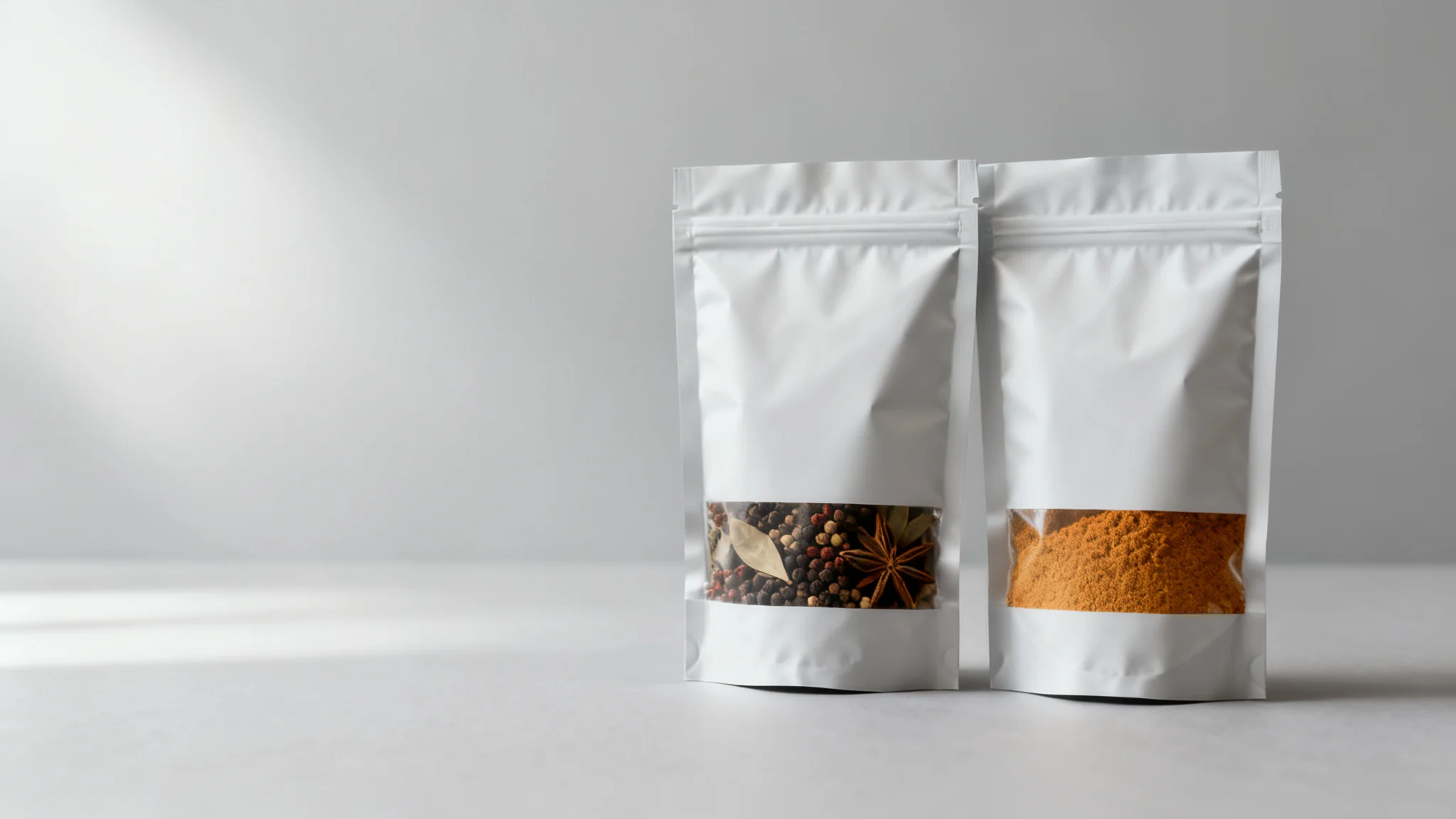
Spice pouch packaging specifications change with particle size on four axes at once: how the product flows and settles, how tightly fill weight can be held, how much dust reaches the seal, and how quickly aroma leaves the pouch. Whole spice and a fine grind can carry the same product label and still need different film, different fill settings and different sealing conditions. This article works through the translation from a particle size distribution and a bulk density figure to the pouch specification, and it concentrates on the decisions an engineering and quality team has to sign off before a trial run.
Key Takeaways
- Particle size distribution and bulk density, not the product name, decide how a spice fills, settles and seals.
- Fill weight control is a powder-flow problem first and a film problem second; the finer the grind, the wider the natural scatter.
- Dust reaching the seal is the most common cause of an aroma leak that a barrier upgrade cannot fix.
- Barrier data becomes comparable only when the test method, conditions and sample preparation travel with the figure.
Why does particle size change the pouch specification?
A spice pouch is asked to do four jobs at once: hold a fill weight, survive handling, keep volatiles inside, and present the product. Particle size distribution touches all four. A coarse grind has a low exposed surface per gram and flows as a granular solid; a fine grind behaves more like a cohesive powder, bridges in feeders and holds air. The same pouch design run on both formats will show different fill scatter, different settling inside the sealed pouch, and different amounts of product sitting in the sealing area.
Two measurements carry most of the translation. Particle size distribution describes the spread of particle sizes, including the fines fraction that dominates dust behaviour. Bulk density describes how much mass occupies a given volume, and it changes with both grind and settling. Both can be measured on the product as delivered, and both belong in the pouch specification rather than in a supplier’s assumptions.
How does bulk density affect fill weight on a pouch line?
Bulk density sets how a volumetric filler converts an auger or cup setting into grams. If bulk density drifts between deliveries, or changes when the grinder is reset, a line that filled correctly last month will move out of tolerance without any change to the machine. Fine grinds usually show a wider bulk density range, because aeration and settling change the value depending on how the powder has been handled.
The practical response is to control the variable rather than the symptom. Ask for the bulk density range of the delivered product, verify it on incoming material, and establish whether the filler is volumetric, gravimetric or a hybrid. A gravimetric filler removes most of the drift but not the seal contamination problem, and it does not remove the need to define an acceptable fill tolerance against the product’s own variation. Format matters here too: premade three-side seal seasoning pouches present a fixed fill opening, while rollstock gives the machine more control over film tension while the powder settles.
What changes at the seal when the grind gets fine?
Fine particles are small enough to sit inside the seal area and to stay there under vibration. A particle trapped in the seal creates a channel. The seal appears closed and passes a visual check, but it leaks slowly, and volatiles leave through that channel at a higher rate than through the film. The result looks like a barrier failure and is not one.
Three engineering responses are common. Reduce how much product reaches the seal area by adjusting the fill drop, adding a settling step, or using a jaw profile suited to the product. Increase the seal’s tolerance to contamination by choosing a sealant with a wider sealing window and holding jaw pressure and dwell inside a verified range. Verify on pouches filled with the real product, because a seal strength figure measured on clean film says little about a dusty seal.
Does ground spice need a higher barrier than whole spice?
Usually yes, and the reason is aroma rather than moisture alone. Grinding ruptures cell structures and releases volatile oils to the particle surface, so the same pouch loses aroma faster with ground product. Moisture protection still matters where the spice will sit in humid ambient conditions, and light exposure matters wherever the pouch is displayed in a bright position.
A barrier decision is therefore a set of three targets. Water vapour transmission, oxygen transmission and aroma retention are separate properties, and a structure that meets one may not meet another. Light blocking adds a fourth requirement and tends to push the design toward metallized or foil-containing structures. None of these can be settled from a family name alone, because the sealant layer, the adhesive system and the film thickness all contribute.
Comparing barrier data from two suppliers
Barrier figures are comparable only when the test conditions travel with them. Water vapour transmission rate is commonly measured with ASTM F1249 using a modulated infrared sensor, and oxygen transmission rate with ASTM D3985 using a coulometric sensor. Temperature, relative humidity, sample orientation and the number of layers tested all change the result, so a figure quoted without conditions cannot be ranked against another.
A comparison that holds up states the same test method, the same conditions, the same sample preparation and the same units, and describes the full structure with layer order. Where a supplier offers only a barrier adjective, treat the offer as unverified and ask for method and conditions. For a wider discussion of how structures differ, see high-barrier packaging materials explained.
Common misinterpretations when specifying spice pouches
- Treating aroma retention as a film property alone, when the seal and the headspace matter as much.
- Assuming a heavier total structure always performs better; crease cracking and seal contamination can reverse the ranking on a real line.
- Setting fill tolerance from machine capability without accounting for bulk density variation in the delivered powder.
- Comparing barrier values where one supplier quotes a single layer and another quotes a finished laminate.
When the product is a seasoning blend rather than a single ground spice, the same logic applies to custom seasoning pouches, where salt, acid and oil content join particle size as specification drivers.
Conclusion
Particle size and bulk density belong in the pouch specification, not in the background. Once they are stated, fill tolerance, sealing conditions and barrier targets can each be set against something measurable. For a single ground spice packed in fast turnover, a metallized structure with a verified seal window and an incoming bulk density check is often enough. For a fine blend with a long ambient shelf life, a foil laminate and a tighter sealing specification are justified. In both cases the decision should be confirmed on pouches filled with the real product, and the results recorded against the same test method so the next product in the range starts from data rather than from a repetition of the same trial.
Frequently Asked Questions
How should bulk density be measured for a pouch specification?
Measure it the way the filler will see it, on material as delivered and after the handling it will receive. A tapped bulk density value and an aerated value can differ substantially for a fine grind, and a filler is fed with something between the two. Agree with the supplier which condition is quoted, record the method used, and verify the figure on incoming material rather than accepting a single value on a certificate. The aim is a range that the line can tolerate, not a precise number that holds only in a laboratory.
Is a wider fill tolerance acceptable for a fine grind?
It often has to be, but the width should be a decision rather than a concession. Fine powders flow less predictably, so a volumetric filler will scatter more, and the first question is whether the declared fill weight can still be met on the worst case. Where it cannot, the options are a different filler principle, a settling step, or a change in the particle size distribution agreed with the product team. Widening the tolerance without checking label compliance is the option that creates a regulatory problem later.
Does a larger headspace help or hurt a ground spice?
It usually hurts, for two reasons. A larger headspace holds more air for volatiles to move into, which increases the driving force for aroma to leave the product, and it gives the powder more room to settle and shift during transport, which increases the chance of product reaching the seal. The exception is a pouch that needs headspace for a specific filling method or for reclose geometry. Size the headspace around fill tolerance and stack behaviour, then confirm that the aroma target still holds on retained samples.
What has to be stated with a barrier figure to make it comparable?
At minimum, the test method, temperature, relative humidity, sample orientation, the units, and the exact structure tested with layer order and thickness. Without those, two figures cannot be ranked, and a lower number is not automatically the better structure. Water vapour and oxygen transmission are different measurements and are not interchangeable. Where spice pouch packaging is being specified, ask the converter for the conditions behind every number before the data is used to choose between offers.
