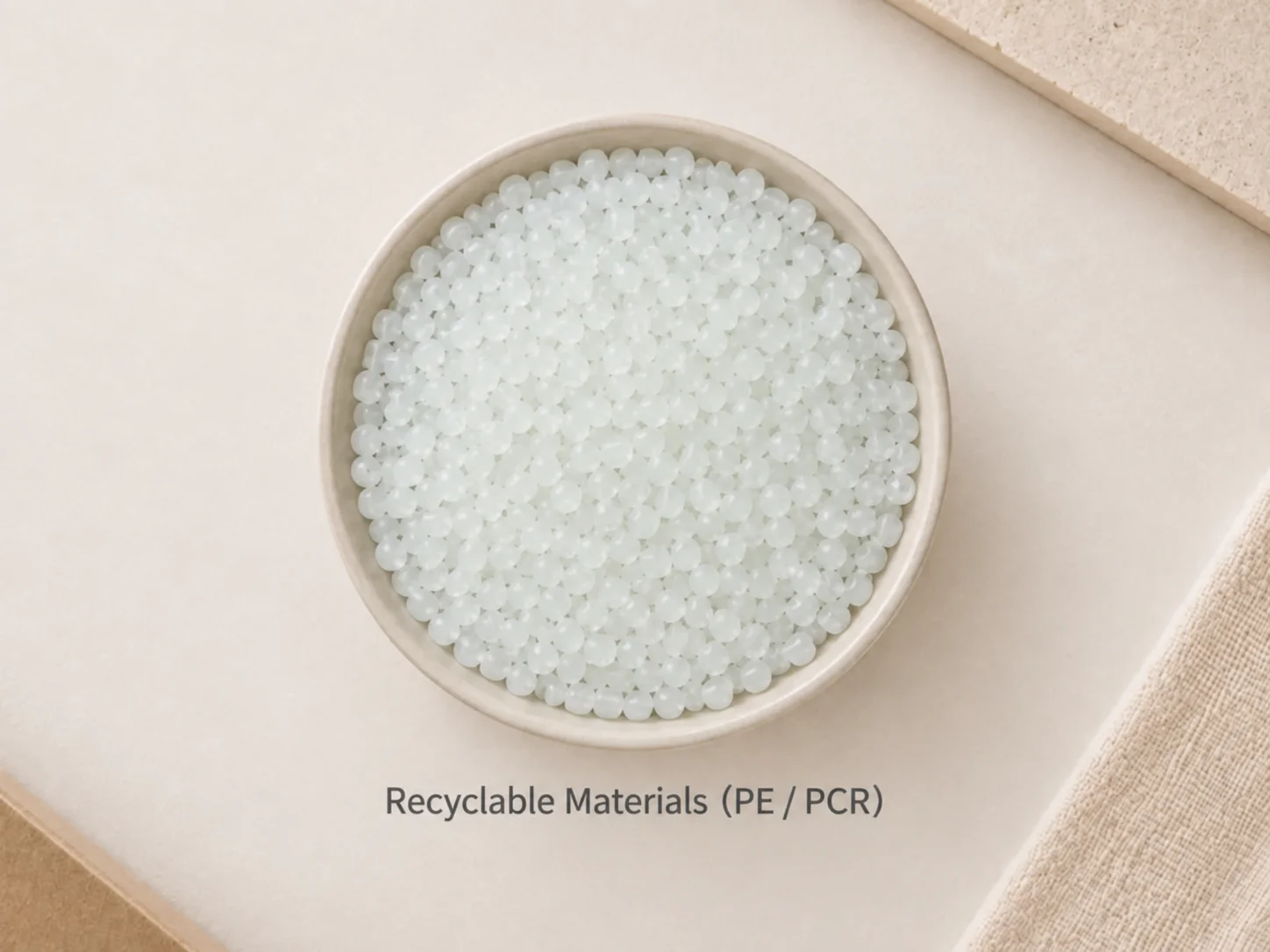
Every sustainability report promises more recyclable packaging, yet the numbers barely move. The reason is rarely the film itself. Flexible packaging recycling underperforms because the failure happens between the kitchen bin and the reprocessor: collection schemes are not built for light, dirty, multi-layer film, and sorting facilities cannot make money from it. Understanding where the chain breaks is the first step to designing around it.
Pouches are the most efficient packaging format ever put on a shelf: they use less material per gram of product protected than bottles, cans or cartons, and their carbon footprint in transport is hard to beat. That efficiency is also exactly what makes them hard to recover. The material is thin, low in mass, and often contaminated with food residue, so its value per tonne to a sorting plant is low.
Collection is designed for containers, not film
Most municipal recycling systems were built around rigid containers. Curbside programmes accept bottles, jars and tubs because those items have established end markets and can be sorted mechanically at speed. Film is a different shape and a different problem. It wraps around equipment, blows off conveyor belts and jams screens, so many facilities treat it as contamination and route it to energy recovery or landfill even when a household has put it in the right bin.
Where film collection does exist, it usually runs through store drop-off networks rather than kerbside collection. That shifts the burden onto the consumer, and participation falls sharply as soon as the drop-off point is not on the normal shopping route.
Sorting economics: why thin film loses
A materials recovery facility sorts by value, weight and behaviour on the line. Flexible film arrives flattened, lightweight and often coated with product residue. Bales of mixed film are worth little, because a reprocessor receiving them has to separate PE from PP from PET from metallized layers before anything can be extruded into a clean pellet.
Multi-layer laminates make this worse. A pouch built from PET, foil, adhesive and PE cannot be separated by any commercially available mechanical process. The layers are bonded, and the value is locked inside a structure that no one can economically pull apart. This is the single biggest reason flexible packaging recycling rates lag behind rigid packaging.
What actually moves the needle: mono-material design
The most reliable lever a brand controls is structure. Moving from a multi-layer laminate to a mono-material construction — typically all-PE or all-PP — means the whole pouch can be processed as one resin stream. There is no delamination step, no need to identify and separate a barrier layer, and the resulting pellet has a known composition. Our overview of design for recyclability principles walks through the changes this requires.
Three design rules follow from that:
- Keep one dominant resin. Barrier layers, sealants, closures and labels should all be compatible with the main polymer.
- Reduce coverage and complexity. Heavy full-panel ink, metallic pigments and large glue areas all reduce the value and processability of the recovered material.
- Keep the format easy to empty. Film that still holds product will be rejected or downgraded at the sorting stage.
Labels and closures matter more than most teams expect. A PE pouch sealed with a PP zipper or a PET label becomes a mixed stream again, and the recycler sees the same separation problem in miniature. Confirm compatibility of every component, not just the film. The same logic applies to structural choices such as the pouch format itself; a four-side seal pouch guide shows how much of the final recyclability is already fixed at the structure stage.
Performance is the limit that gets negotiated
Recyclable structures rarely match a foil laminate on absolute barrier. All-PE and all-PP pouches give up some oxygen and moisture protection, and the gap has to be recovered somewhere else: a thicker barrier layer, better filling controls, nitrogen flushing, or a shorter declared shelf life. Brands that treat recyclability as a materials swap alone usually fail validation testing and revert to the old structure.
The projects that succeed start from the product requirement, not the material label. If the required shelf life is 18 months in a humid climate, that constraint is fixed, and the structure is engineered backwards from it. If the constraint is soft, the brand gains room to choose a genuinely recyclable format.
What brands and converters should do now
Waiting for collection infrastructure to mature is not a plan. Three practical actions are available today. First, audit every SKU and rank them by how easily the structure could become mono-material; quick wins usually exist in dry goods. Second, confirm what the target market actually collects and how it labels recyclable film, so the on-pack claim survives scrutiny. Third, get supplier commitments in writing: resin composition, adhesion systems, and whether the finished pouch has been evaluated against a recognised recyclability guideline.
Suppliers should be able to state the dominant resin, the compatibility of every component, and the barrier they can realistically deliver in a mono-material format. If a converter cannot answer those three questions, the project is not ready to move to tooling.
The honest summary
Flexible packaging will not be recycled at the rate of rigid containers in the near term, because the economics of collecting and sorting light film remain difficult. What brands can control is whether their pouch is designed for the streams that do exist. Mono-material structures, restrained print coverage and component compatibility will not fix collection on their own, but they remove the most common reason a technically recyclable pouch still ends up in landfill.
For design thresholds, the CEFLEX guidelines are the European reference, and in North America the Association of Plastic Recyclers maintains its own design guidance for recyclable plastic packaging.
If you are planning a recyclable flexible format and want a structure assessment before tooling,
If you are planning a recyclable flexible format and want a structure assessment before tooling, send us your product and shelf-life requirements. Contact PurestPack for a mono-material feasibility review, and see more projects at purestpack.com.