

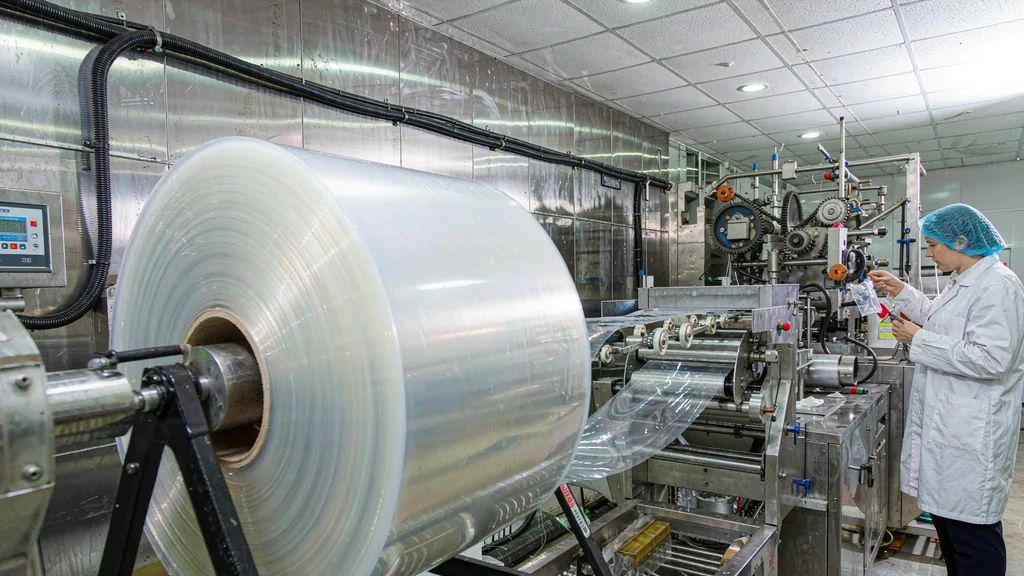
Packaging film qualification is the controlled process of proving a new film runs on your machine, seals within your validated window and protects the product for its full shelf life — before you commit a production order to it. Done in five steps, it typically takes two to four weeks and costs one trial roll; skipping it costs a stopped line.
What Qualification Actually Decides
A film change is not a purchase decision, it is a process change. The film is one of the three elements of every seal — film, temperature and dwell — and changing it silently invalidates the settings your operators trust. Qualification answers four questions in order:
- Does the film meet the written specification on the reel (dimensions, structure, print)?
- Does the material pass the lab tests that predict seal and barrier performance?
- Does it run at line speed without jamming, drifting or slipping?
- Does the finished pack survive distribution and hold shelf life?
Each step has a go/no-go gate. If step two fails, step three never happens — that discipline is what keeps a trial from turning into an unplanned maintenance day.
Step 1: Lock the Specification Before the Trial
Start with a one-page film specification both sides sign. As a minimum it should state:
| Item | What to fix |
|---|---|
| Structure | Layers, e.g. PET/AL/PE or PET/PE, and total gauge with tolerance |
| Reel dimensions | Web width, core ID, max outer diameter, unwind direction |
| Sealing layer | Sealing polymer and expected seal initiation temperature |
| Friction | Inner and outer COF range (typical VFFS films sit near 0.1–0.25 outer) |
| Barrier | OTR and WVTR targets matched to shelf life |
| Food contact | Compliance documents for the destination market |
The unwind direction and core size sound trivial, and they are the two most common reasons a “perfect” film physically cannot be loaded onto the machine. Fix them on paper first. The compliance documents matter as much as the physics — the food contact migration testing expectations for food contact films are separate from performance tests and should be collected before any trial material enters the plant. If the film is part of a larger supplier change, the checklist in the flexible packaging RFQ guide helps make sure nothing is missing from the brief.
Step 2: Lab Verification Before the Line Sees the Film
Three or four lab tests eliminate most candidates cheaply:
- Seal curve per ASTM F2029. The film is heat-sealed across a temperature ladder and the seals are measured for strength. The goal is a wide, flat plateau — a film whose seal strength collapses if the jaw runs 10°C hot is a film your operators will fight all season.
- Seal strength per ASTM F88/F88M. Quantifies the plateau value. Most converters want to see seal strengths comfortably above the minimum demanded by the pack weight — sized properly with a tool like the stand-up pouch sizing guide — commonly validated in the 1.5–3.0 N/15 mm range for snack structures and higher for heavier fills. The upper limit is set by openability: the same score line has to tear cleanly, as explained in this easy-tear pouch design guide.
- Coefficient of friction per ASTM D1894. On vertical form fill seal machines the film is dragged over formers and drawn by belts; a COF outside the agreed range shows up as wandering web edges and registration drift.
- Gross leak per ASTM F2096. A pressurized pouch under water finds pinholes and weak lanes that individual measurements miss.
Order roughly 500 to 1,000 metres of film for this stage. That is enough for full testing plus a manual sealing check, and small enough that a specification mistake costs a roll, not a reel.
Step 3: The Machine Trial — Watch These Five Things
Run the trial film on the production machine, not on a lab sealer. A lab heat sealer has perfect flat jaws and no web tension; the line is where reality lives. During the run, log:
- Seal window. Map quality across a temperature and dwell matrix around your current settings. A good film gives an acceptable seal at least 10°C on either side of nominal.
- Web tracking and tension. Watch for edge wander, stretching and print drift between registration marks.
- Jam and misfeed count per 30 minutes. Compare against the incumbent film’s documented baseline, not against memory.
- Filling interference. Dust, product pinch in the seal area and static cling on powder products.
- First-output seal integrity. Pull a 30-pack sample from the first stable production window and run leak checks before anyone leaves the machine.
A well-run trial needs about half a shift. Anything longer usually means the specification in step 1 was incomplete — stop and fix the paper, not the machine.
Step 4: Distribution and Shelf-Life Confirmation
A film that seals beautifully can still fail on a pallet. Subject trial packs to a standard distribution cycle — the drop, vibration, compression and climate sequences described in ASTM D4169 or the ISTA series — and then hold the remaining packs through at least one accelerated shelf-life interval before the full rollout order. For ambient products, accelerated storage at elevated temperature is standard practice; for chilled and frozen, run real-time holds, because accelerated models are unreliable across phase changes.
If the new film changes barrier properties in either direction, shelf life must be re-confirmed, not assumed. A higher-barrier film rarely causes trouble; a downgauged or mono-material film often does.
Sign-Off Criteria and When to Requalify
Close the qualification with a signed summary that records: specification acceptance, lab results, trial run statistics (jam rate, seal window width), distribution result and shelf-life plan. This document becomes the reference when the same film returns in a different gauge or print.
Requalification is triggered by real changes, not by the calendar alone: a new film supplier or lamination site, a structural change, a new seal system, or a packing machine overhaul. Print-only changes generally do not require a new qualification — but a change in ink system that affects the sealing layer’s surface does.
FAQ
How much film does a qualification trial need?
For most vertical and horizontal fill seal applications, 500 to 1,000 metres covers lab testing, a half-shift machine trial and retained samples. Ordering less usually forces a second batch, which adds lead time without saving money.
How long does a film qualification take?
Two to four weeks in practice: days for lab tests, one scheduled half-shift for the machine trial, then distribution testing and the first shelf-life checkpoint. Products with long ambient shelf life can start production before the full real-time study completes, using accelerated storage as an interim gate.
Can we qualify a new film without stopping the production line?
Yes — schedule the trial at a shift change or alongside a planned changeover, and treat the first 30 minutes as supervised sampling rather than full production. The trial should end with a documented go/no-go decision, never with the film left running unattended.
What is the single most common cause of a failed film trial?
An incomplete specification, most often friction and unwind direction. The film’s barrier and seals are fine, but it will not track or load correctly on the machine. Both parameters cost nothing to fix on paper before the trial.
Do we need to requalify after a print change only?
Usually no. A print-only change does not alter seal or barrier performance. Requalification is required when the ink system or varnish changes the surface of the sealing layer, or when the print supplier changes the lamination process.
Which tests should every food factory run in-house?
Seal strength on a simple tensile tester and a bubble-emission leak check cover the two failure modes that appear most often on the line. COF and seal-curve work is usually outsourced to the film converter’s lab, with results attached to the specification.
Who signs off the qualification?
The packing line owner, the QA lead and the procurement owner should all sign, because the decision binds production capacity, product safety and cost at the same time. A single-department sign-off is how films that “run but leak” reach the market.
