

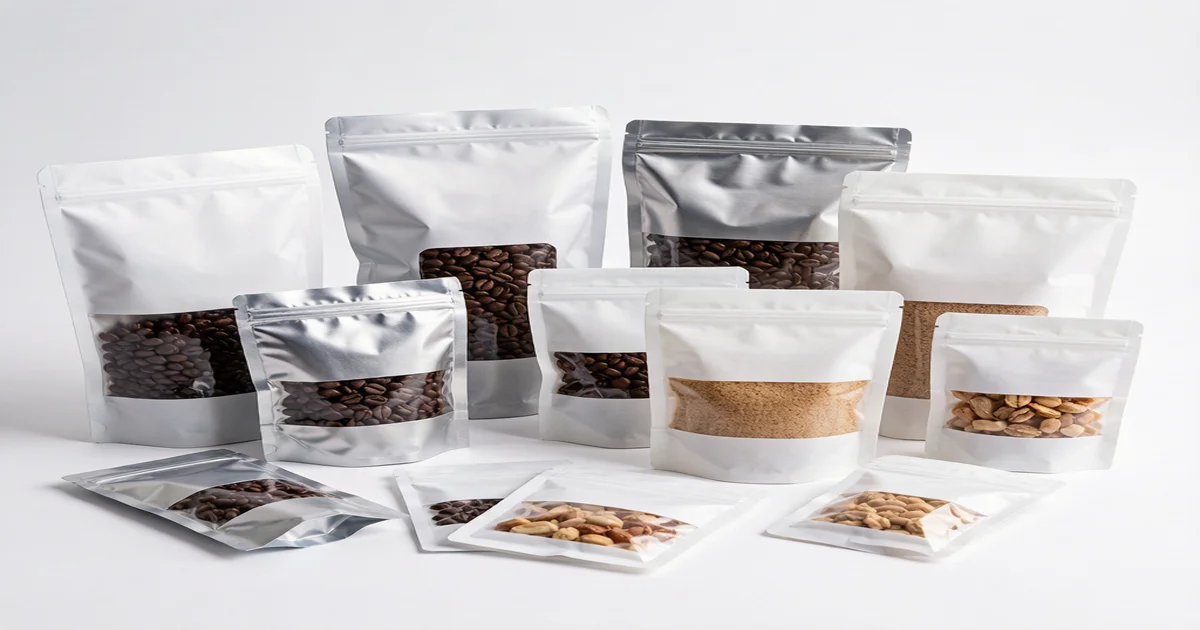
Custom food flexible packaging pouchesrepresent an essential step for every food brand entering the market, but according to the China Packaging Federation, improper packaging selection caused return losses of up to CNY 1.2 billion in 2024. As practitioners with years of experience in flexible packaging, we have seen too many brands stumble into pitfalls on their first custom pouch order — wrong materials, mismatched pouch types, ignoring MOQ limits, uncontrolled print color deviation. These mistakes either delay market launch or, in the worst case, scrap entire batches of packaging.
This article sorts throughCustom food flexible packaging pouchesthe 5 most common mistakes in the process and provides practical solutions to help you avoid the traps that make peers spend 3x their budget.
5 Common Misconceptions in Custom Food Pouch Manufacturing
Misconception 1: “A transparent bag is PET, so it must be the right choice” — the first pitfall in food flexible packaging material selection
This is the mistake beginners make most often. PET (polyester film) is indeed highly transparent and stiff, but it is not suitable for all food types.
Real case: a nut brand chose a clear all-PET/PE structure for its first custom pouch. Within a month of launch, widespread oil seepage and bag failures appeared, and consumer complaints surged. The reason: sharp nut edges punctured the PET layer, while oils accelerated separation of the laminate.
Correct approach: oily foods (nuts, fried snacks, jerky, etc.) should useBOPA (biaxially oriented nylon) or KPET structures. BOPA’s puncture resistance is more than 3x that of PET, effectively withstanding physical damage from sharp contents. The specific matching options are as follows:
| Food type | Recommended material structure | Core reason |
|———-|————-|———-|
| Nuts/fried snacks | BOPA/PE or KPET/CPP | Puncture resistance, aroma preservation |
| Coffee beans/ground coffee | PET/AL/PE | Oxygen barrier, light blocking, aroma preservation |
| Freeze-dried fruit | PET/VMPET/PE | Medium barrier, good display |
| Meat products/seafood | PA/PE (co-extruded) | Low-temperature resistance, puncture resistance |
| Baked goods (bread) | Single-layer BOPP or PET/PE | Short shelf life, cost priority |
> Rule of thumb: oily products use nylon, oxygen-sensitive products use foil, frozen products need co-extrusion, short-shelf-life products can use fewer layers.
Misconception 2: “Just pick a good-looking pouch type” — the fit logic of food flexible packaging pouch types
Custom food flexible packaging pouches, pouch type selection directly relates to filling efficiency, shelf display effect and user experience. The pouch type is not “just about looks”, but needs to match the product form, filling equipment and sales channels.
Matching pouch types to food categories
We have summarized the matching relationships between common pouch types and food categories:
– three-side seal pouch: suitable for powders and granules (coffee powder, seasoning powder), high filling efficiency, lowest cost
– stand-up pouch: suitable for liquids and semi-fluids (juice, jelly, sauce), good shelf display
– quad seal pouch: suitable for products needing high barrier (tea, health products), large sealing area
– shaped pouch: suitable for brand differentiation needs (jelly, candy), higher mold fees
– vacuum pouches: suitable for fresh meat and rice, requires a vacuum packaging machine
Key tips: if you already have a filling line, confirm pouch type compatibility with your filling machine before ordering. We once had a customer order 10,000 stand-up pouches, only to find their filling line only supported three-side seal pouches — the entire batch had to be scrapped.
Misconception 3: “Start with 5000 pieces to try, add more if needed” — the minimum order trap in flexible packaging customization
This may be the most costly mistake. Many beginners thinkCustom food flexible packaging pouchesthe lower the MOQ the better, but the cost structure of the flexible packaging industry meansthe smaller the MOQ, the higher the unit price。
The relationship between MOQ and cost in custom food pouches
Taking a common medium stand-up pouch (PET/AL/PE structure) as an example:
| Minimum order | Unit price (CNY/pc) | Total price | Unit price ratio |
|——–|————-|——|——–|
| 1,000 pcs | ¥3.20 | ¥3,200 | Baseline |
| 5,000 pcs | ¥1.80 | ¥9,000 | ↓44% |
| 10,000 pcs | ¥1.15 | ¥11,500 | ↓64% |
| 50,000 pcs | ¥0.68 | ¥34,000 | ↓79% |
the total price of 1,000 vs 10,000 pouches differs by only 2.6x, yet the quantity differs by 10x. If expected sales can absorb it, ordering above the break-even quantity dramatically reduces the per-unit cost.
In addition, some manufacturers (such as PurestPack) now support small-batch digital printing with MOQs as low as 100 pieces, ideal for new brands testing the market or limited-edition product trials.
Misconception 4: “The design file colors are the printed colors” — color management in food packaging printing
This is a pain point every custom packaging buyer knows well. Screens display in RGB color space while printing uses CMYK, and the two differ inherently.Custom food flexible packaging pouches, without color management, the printed pouch may look “completely different from the design”.
Common failure scenarios:
– Fluorescent/neon colors turn dull after printing (CMYK cannot reproduce RGB fluorescent colors)
– Dark blue turns purple -> imbalanced cyan and magenta ratio
– Coffee brown turns reddish -> spot color not confirmed with a proof sample
Color management workflow for food flexible packaging printing
1. Use CMYK mode in the design file (not RGB)
2. Ask the factory to providePantone color matching
3. Must confirm before mass productionphysical sampling, rather than only looking at the digital proof
4. Keep the first approved color sample as the reference for subsequent color matching
For more details on preparing design files, refer to our [Packaging Design and Prepress Guide](#).
Also, if you are interested in packaging solutions for a specific food product, check out our [Custom Food Pouch Solutions](#), which covers recommendations from material selection to printing processes.
Misconception 5: “Eco-friendliness doesn’t matter, cheap is fine” — the green compliance trend in food flexible packaging
This mindset is being eliminated by both the market and regulations. Since 2025, multiple provinces have implementedEPR (Extended Producer Responsibility) regulations, requiring packaging manufacturers to be responsible for the entire product life cycle. Meanwhile, consumer preference for eco-friendly packaging has shifted from “a bonus” to “a basic requirement” — Nielsen research shows 68% of Chinese consumers are willing to pay a premium for eco-friendly packaging.
InCustom food flexible packaging pouches selection, choosing eco-friendly options is not only a compliance requirement but also an opportunity for brand differentiation:
– Degradable options: PLA/PBAT composite materials, compost degradation rate ≥90% within 180 days, suitable for organic food brands
– Mono-material options: all-PE structure replacing PET/PE lamination, recycling rate up from below 10% to over 85%
– Thinner-gauge options: process optimization reduces gauge by 15%-20% while maintaining strength, saving material costs and carbon footprint
For more detailed eco-friendly packaging solutions, please see our biodegradable eco-friendly pouch product series.
If your products also need rigid packaging (such as blister trays, plastic boxes, etc.), you can also refer to our sister brand plastic packaging customization platform for one-stop solutions from flexible to rigid packaging.
Summary: three core principles of food flexible pouch customization
Reviewing the 5 common misconceptions above,Custom food flexible packaging pouchesthe success of food flexible pouch customization can
1. Material matches product— not the more expensive the better, but the more suitable the better. Oily foods choose nylon, oxidation-prone foods use aluminum foil, frozen foods use co-extrusion.
2. Calculate quantities before ordering— the unit price of 1,000 pcs and 10,000 pcs may differ by 3x; combine sales forecasts to find the optimal minimum order.
3. Sample confirmation before mass production— print colors, pouch structure and material feel; physical sampling is the last line of defense against batch failures.
> Packaging is the first business card a product hands to consumers. A goodCustom food flexible packaging pouchessolution not only protects the product, but also builds the brand.
Need professional packaging advice? Contact the PurestPack expert team for one-on-one custom solutions and free samples.
—
*References: China Packaging Federation “2024 Packaging Industry Quality Report”, GB/T 10004-2008 “Plastic Composite Films and Pouches for Packaging”*