

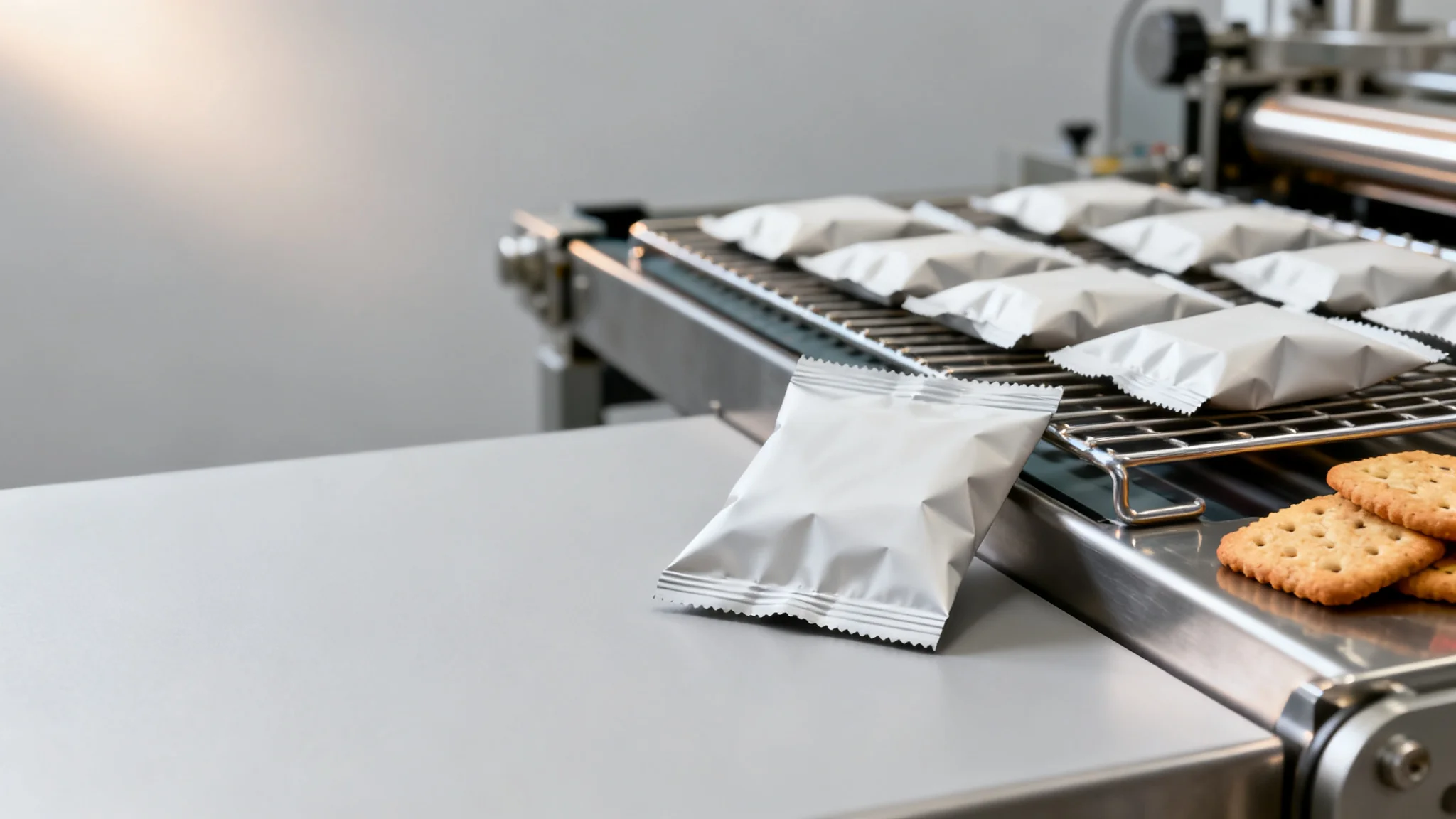
Bakery snack packaging loses crispness for reasons that are usually visible on the cooling line, not in the film datasheet. Cakes, cookies and baked crisps leave the oven with residual moisture and internal heat, and if they are packed before that heat has dispersed, the moisture redistributes inside the sealed pouch and the texture changes within days. The practical fix starts with exit temperature and hold time, then moves to structure and seal quality. Barrier alone rarely solves a cooling problem.
Why Crispness Is Lost After Cooling, Not During Baking
Baking drives moisture to the surface. Cooling moves it back inward and lets the product reach equilibrium. If a pouch is sealed while the centre is still warm, the water vapour pressure inside the pack stays above ambient, and that vapour condenses on the coolest surface available, which is the film. The result is a soft surface layer on the product and a film that looks fogged when the pack is opened.
This is a process problem with a packaging symptom. Adding a heavier barrier to a pack that is sealed too warm simply traps the same moisture more effectively.
Residual Moisture and Exit Temperature: The Two Numbers to Specify
Two figures belong on the specification sheet: the product temperature at the packing head and the holding time between the cooling tunnel and the bagger. Both are easy to log and both are frequently left to the operator.
A workable approach is to record temperatures at the tunnel exit and again at the infeed of the bagger, then correlate them with complaints. Where a factory has no historical data, a short trial with a probe and a stopwatch will usually show whether the gap between the two points is stable or swings with line speed. When speed rises, hold time falls, and that is when warm product reaches the seal.
Does Bakery Snack Packaging Need a High-Barrier Structure?
Not automatically. A short-shelf-life bake with a dry, low-fat recipe can run on a standard metallised structure, while a chocolate-coated or cream-filled product may need better moisture and oxygen control and often a light barrier to protect fats. The correct level depends on water activity, fat content, expected shelf life and how the pack is stored.
The scope of the decision narrows once the two functions are separated. Moisture control protects texture. Oxygen control protects fats and aromas. A structure that is strong on one is not necessarily strong on the other, and the pack has to satisfy whichever risk dominates. Bake-off products sold within days are a different specification problem from a snack bar shipped through a distribution chain.
Why Do Crumbs and Sugar Dust Break the Seal?
A seal only forms where the two inner surfaces meet cleanly. Crumbs, sugar dust and fat from the product sit between the layers and create channels that look sealed but leak. The failure is often intermittent, which is why it survives visual inspection and appears as scattered complaints rather than a line stoppage.
Three causes are common on bakery lines. The fill chute sits too close to the seal area, so product falls into the jaw zone. Air knives and brushes are set for the widest product rather than the dustiest. And the bagger runs at a speed where the film has no time to settle before sealing. Each is adjustable without changing the film.
Key Takeaways
- Sealing a warm bake traps moisture that later condenses on the film; structure changes cannot compensate for poor cooling.
- Logging product temperature at the packing head and the hold time before bagging turns a texture complaint into a measurable process variable.
- Barrier level should follow water activity, fat content, shelf life and storage conditions, not product category.
- Crumbs and sugar dust create intermittent channel leaks that pass visual inspection and are usually resolved by fill and cleaning settings.
- A specification sheet that omits fill temperature and seal window will produce rework, however good the film is.
Specification Sheet: The Fields That Prevent Rework
A bakery snack specification is more useful when it records process conditions alongside material data. The fields that prevent repeat problems are the product temperature range at sealing, the maximum gap between cooling and bagging, the seal width, the seal window in temperature and pressure, and the acceptable pack vacuum or headspace.
Seal strength belongs on the sheet as a test method rather than a single target value, because the result depends on how the sample is pulled. ASTM F88/F88M defines a peel test for flexible barrier materials and records the specimen width and test speed, without which readings from two labs cannot be compared. Moisture loss across the whole pack is measured separately, and ASTM F1249 covers the standard water vapour transmission method and its test conditions.
How to Validate a Bakery Snack Pack Before Full Production
Validation should reproduce the two things that cause the most trouble: warm product and contaminated seal areas.
- Run a batch at the highest realistic line speed, which produces the shortest cooling hold time.
- Introduce a controlled dust load at the seal area to test whether the pack still holds.
- Pull seal samples at the start, middle and end of the run and test them by the same method each time.
- Hold finished packs at the worst storage condition you expect, then evaluate texture rather than only seal integrity.
Material decisions are easier once those results exist. A film specification guide is useful for structuring the material fields, and the four-side seal pouch structure guide explains how panel layout and print influence the format. Where the range includes extruded or puffed snacks run on reel-fed equipment, custom snack roll film is the format that matches those lines.
Conclusion
Protect crispness on the cooling line first. Fix the exit temperature and the hold time before bagging, then write both into the specification with a seal window and a test method. Barrier choice comes after those numbers are stable, and it should answer a specific risk rather than follow the product category. Validate on a fast run with dusty seals, hold the samples under the worst storage condition you expect, and judge texture as well as seal integrity.
Frequently Asked Questions
How long should baked snacks cool before packaging?
The answer depends on the centre temperature you allow at the packing head, which varies with recipe, piece size and line speed. There is no universal hold time. The practical method is to log centre temperature at the cooling tunnel exit and again at the bagger infeed, then set the minimum hold time from the point where the two readings stop drifting. Re-check it whenever line speed changes.
Can a zipper or reseal closure make a bakery snack pack more moisture-proof?
Not by itself. A zipper helps after the pack is opened, but on a closed pack the barrier comes from the film and the seal, so a resealable format with a weak top seal will still lose crispness. Where a pack is opened repeatedly, a closure does reduce repeated exposure and is worth the cost. Decide on the closure from consumer use, and keep the moisture target on the structure and the seal.
What should be checked when a bakery snack pack looks sealed but the product still softens?
Start with the pack weight and the fill temperature, then look at the seal. A pack that softens rather than leaks is usually sealing warm product or losing moisture through a thin region of the seal. Weigh a sample against the target, open a pack immediately after sealing to check for vapour, and press-test the seal edges. If the weight is correct and the pack is warm, the fix is on the cooling line, not the film.
Do all bakery snacks need metallised or foil structures?
No. Metallised and foil layers provide light and oxygen protection that some products need and others do not. A dry cracker with a short life may run comfortably on a simpler structure, while a cocoa-coated product can benefit from light protection against fat bloom. The decision should follow the specific risk, moisture, oxygen or light, and be confirmed by holding samples under realistic storage conditions before the structure is fixed, because bakery snack packaging has to answer the dominant risk rather than cover all of them. Custom bread packaging shows how a short-life bakery format is specified in practice.
