

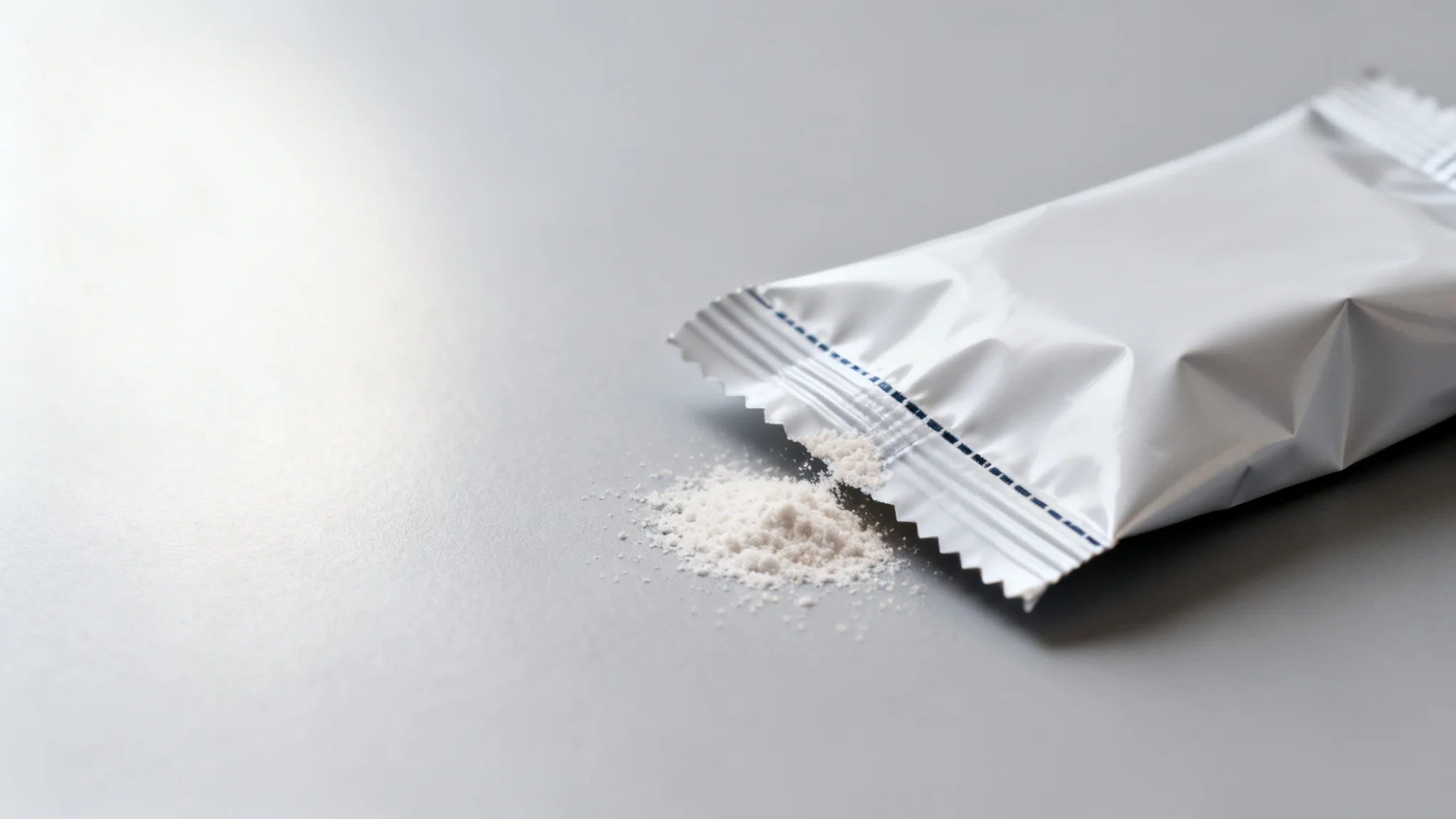
A candy packaging pouch for a sour product fails at the seal far more often than it fails in the film. Acid powders and fine sugar dust settle on the sealing surfaces during filling, and the seal then forms around the particles instead of through them, so the pouch looks closed and holds air until it is compressed in a carton. The engineering question is not which film is strongest but where the powder goes and how the seal is validated. This article covers the mechanism, the test methods that separate a seal defect from a film defect, and the acceptance criteria worth writing into a specification. The scope is flexible pouches filled on vertical form-fill-seal and premade lines for products carrying loose powder.
Why do sour candy powders end up in the seal area?
Three mechanisms put powder where it does not belong. The first is simple drop: coarse particles bounce off the product stream and land on the inside of the pouch wall above the fill line. The second is static, which matters more with fine acid blends because charged particles travel to the nearest surface, and the film web is a convenient one. The third is migration after filling, when vibration on the way to the sealing station redistributes dust upwards.
The proportion of each mechanism changes with the formulation. A coated particulate candy carries less loose dust than a product tumbled in an acid-sugar blend, so a line that seals cleanly on one SKU can fail on another without any change in machine settings.
What do acids and sugar dust actually do to a seal?
During heat sealing, two polymer surfaces must be in intimate contact at a temperature that lets them interdiffuse. A particle in the interface holds the surfaces apart by its own thickness, so the bond forms around the particle rather than across it. Sugar dust behaves this way as an inert spacer. Acid powders add a second effect, since hygroscopic particles absorb moisture from the surroundings, and that moisture sits between the layers while the seal forms.
The result is a seal that can pass a light pull test and still leak. The failure is a channel rather than a wide opening, which is why it often appears as a gradual loss of crispness or as leakage under compression rather than as an obvious split. Seal strength is not the same property as seal integrity, and a specification needs both.
How can you tell whether the seal or the film is at fault?
Opened and inspected seals settle this quickly. A bonded seal with a channel around a particle is a contamination defect. A seal that peels evenly with a dull surface and no particles suggests insufficient temperature, pressure or dwell for that film. A film that tears away from the seal, leaving fibres, points to a sealant layer that is too aggressive for the application.
Where visual inspection is inconclusive, use a method that finds channels rather than strength. Seal strength under ASTM F88/F88M quantifies the force needed to open a bonded seal under defined conditions, and integrity methods that reveal a leak path answer the different question of whether the pack is closed at all. Report both, and record the test conditions with the result instead of quoting a single figure.
What to change first: the powder, the line or the film?
Change the powder path first, because it is the cheapest and it addresses the cause. Options include reducing the drop height between the filler and the bag, adding or repositioning an ionising air rinse above the fill line, adjusting the seal line so it sits further from the product, and reviewing the dwell before the jaws close. Only when those have been exhausted does a film change become the sensible next step, and even then the change is usually to the sealant layer or seal geometry rather than to the barrier plies.
Film changes are worth considering when the seal window itself is narrow. A wider seal window tolerates more variation in jaw temperature across a run, which is useful on a dusty line where conditions drift.
Seal geometry and where contamination matters most
Not every millimetre of a seal is equally exposed. On a three-side seal pouch, the top seal is the most vulnerable because it is formed after filling and faces the product directly. On a four-side seal or a stand-up pouch, the seal that runs closest to the fill stream collects the most dust. Seal geometry decisions, including where the pattern sits relative to the fill line and how much flat film is left clean for the closure, are covered in the guide to four-side seal pouch structure and print, and they matter more on a dusty product than on a clean one.
Where the product is a sticky or coated confectionery rather than a dry sour candy, the same contamination logic applies with an added tackiness problem, which is discussed in the notes on gummy stickiness and reseal.
Specification points worth fixing in writing
- Seal window, with the method used to establish it.
- Minimum clearance between the fill line and the seal pattern.
- Air rinse arrangement and its position relative to the fill stream.
- Jaw inspection interval, and who records it.
Write the seal window rather than a single seal temperature, and state the test method used to establish it. Record the permitted distance between the fill line and the seal pattern, the air rinse arrangement, and the frequency of jaw inspection during a run. Where the product carries acid powder, add a cleanliness requirement for the seal strip that can be checked on a sample rather than inferred from the machine settings.
Also state the pack format the specification applies to. A window pouch for a freeze-dried confectionery such as a custom window candy pouch has a different seal pattern and a different exposure to dust than a flat three-side seal bag, and a single specification cannot cover both without losing precision.
Conclusion
For sour candy, treat seal integrity as a powder-control problem before treating it as a film problem. Verify seals by inspection and by a leak method as well as by strength, write the seal window and the fill-line clearance into the specification, and re-check the middle of a production run rather than only the start. A film change is the last lever, not the first.
Frequently Asked Questions
Does an acid powder damage the film, or only the seal?
In the short term it affects the seal far more than the film. Particles sitting in the interface prevent bonding and create channels, while the film itself is usually unaffected across a normal shelf life. Longer-term interactions between acidic residues and a sealant layer are possible, so where the product contact is heavy it is worth checking the food-contact layer with the supplier rather than assuming the film is inert.
Should sour candy run on a different machine from plain candy?
Not necessarily a different machine, but usually different settings. The dust load changes the optimum fill method, the seal-line position and the need for an air rinse, so a line shared between a dusty sour product and a clean one will need two documented setups. Treating them as separate specifications rather than one compromise setup is what keeps both products in tolerance.
How often should seals be checked on a sour candy line?
Check at the start, at the middle and at the end of every run as a minimum, and add a check after any stoppage longer than a few minutes. Dust build-up on the jaws is progressive rather than constant, which is why a clean start can be followed by a poor finish. Recording the results against time through the run shows whether the process is drifting and how often jaws need cleaning.
Why does a pouch that passes a squeeze test still leak in transit?
Because a squeeze test applies pressure in one direction and a carton applies it in several, repeatedly, over days. A seal with a narrow channel can resist a short manual squeeze and still open when the pack is compressed against a neighbour. Where transit is the concern, add a compression or vibration step to the trial, and evaluate packs from the bottom of a stacked pallet rather than from the top.
